Mars's Carbon Enigma & The Multi-Planetary Imperative: From Robotic Tactility to Starship's Roar
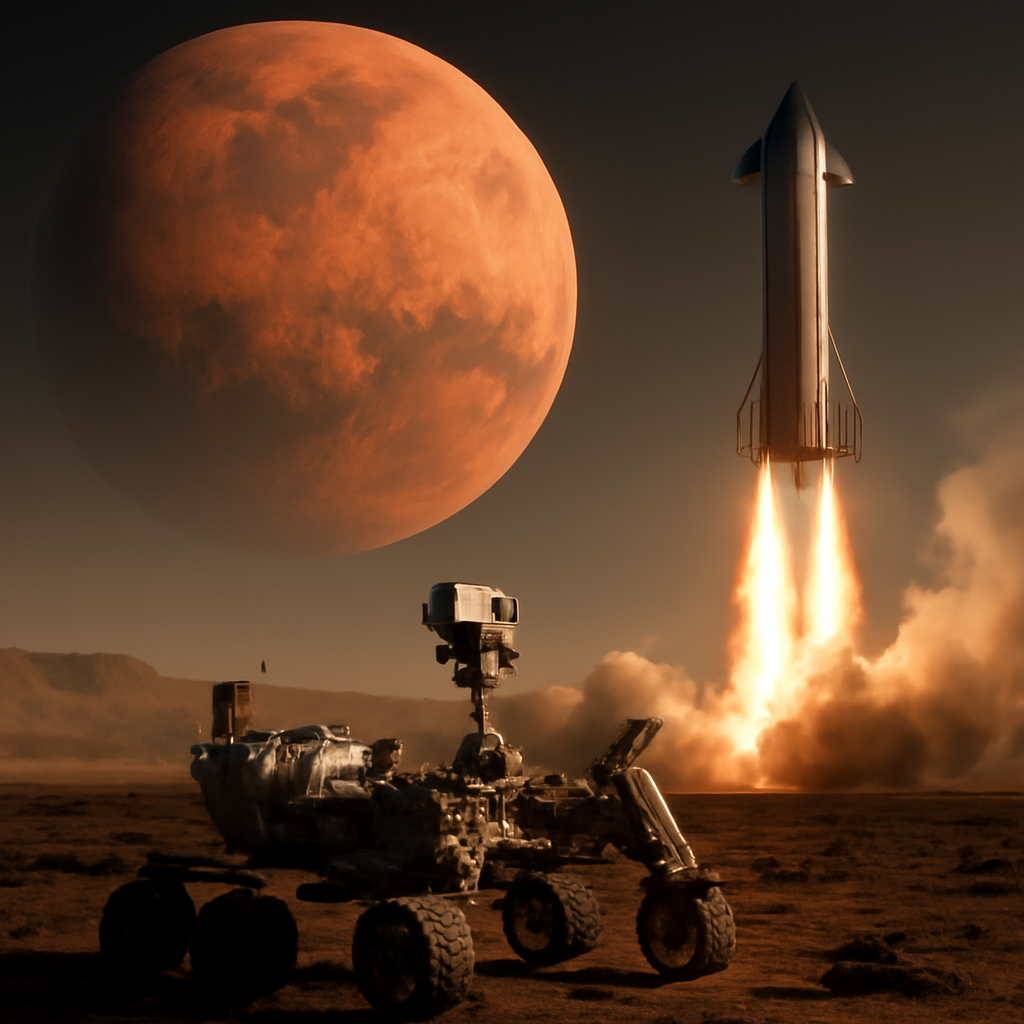
As Mars reveals complex carbon signatures, hinting at past life, the drive to expand humanity's presence beyond Earth accelerates. Today's developments showcase a surge in advanced manufacturing, robotics, and spaceflight capabilities, underscoring our species' vital transition to a multi-planetary future.
Martian Carbon: The Biological or Geological Riddle
The discovery of complex carbon molecules within Martian mudstone rocks has reignited the debate about the planet's potential for past or present life. These aren't simple carbon compounds like carbon dioxide, but intricate organic structures, the building blocks of life as we know it. Scientists are analyzing these molecules using advanced techniques, akin to the color-changing tactile sensors engineers are developing for robots to "feel" their environment. Just as these sensors translate pressure into visual cues, spectroscopic and mass spectrometry analyses are translating the chemical signatures of Martian rocks into detailed molecular maps. The key question is whether these molecules are purely geological in origin, formed through abiotic processes like serpentinization or Fischer-Tropsch synthesis, or if they are biosignatures, remnants of ancient microbial activity. Distinguishing between these possibilities is critical. Geological processes can create complex hydrocarbons, but the specific types and arrangements of carbon found in these mudstones are particularly intriguing. The current challenge mirrors the precision needed in advanced manufacturing, where even minute defects can alter performance. Here, understanding the exact molecular architecture is paramount to deciphering whether it points to a prebiotic chemistry or a biological past, a distinction that profoundly impacts our understanding of life's prevalence in the cosmos.
Robotic Tactility: Extending Our Senses to Alien Terrains
The ability of robotic explorers to interact with alien terrains is rapidly advancing beyond simple locomotion and sample collection. Recent breakthroughs in tactile sensing are equipping these machines with a far more nuanced understanding of their environment, akin to giving them a sense of "touch." One promising development involves novel color-changing tactile sensors. These innovative devices translate invisible forces – pressure, shear, and texture – into distinct, visible color patterns. This allows robots to "see" and interpret touch in real-time with remarkable resolution. Unlike previous generations of sensors that might provide binary contact or crude force feedback, this technology offers a rich, high-fidelity sensory input. For missions on Mars or the Moon, this means a robot could differentiate between loose regolith and solid rock, identify subtle cracks in a surface, or even gauge the grip strength required for manipulating delicate samples. Such enhanced tactility moves robots from being mere remote-controlled tools to more autonomous, perceptive agents, capable of adapting their actions based on detailed physical feedback, ultimately increasing the scientific return and operational efficiency of extraterrestrial exploration.
Advanced Manufacturing: The Foundation of Off-World Habitats and Infrastructure
The foundational element for establishing a sustainable off-world presence, from habitats to critical infrastructure, lies in mastering advanced manufacturing, particularly additive manufacturing. Companies like Velo3D are dramatically expanding their metal additive manufacturing capacity with new, large-scale production campuses, enabling the serial production of complex, mission-critical components. This is crucial for creating everything from rocket engine parts to structural elements for habitats, potentially utilizing materials that can be sourced or refined locally on Mars, reducing reliance on Earth-based resupply. Simultaneously, advancements in polymer additive manufacturing, as seen in the military drone sector where demand is driving significant market growth, offer lightweight, customizable solutions for habitats, tools, and even protective gear. Innovations in material science are also key; research into chemical-free metal recycling for 3D printing, for example, points towards a more circular economy on Mars, minimizing waste and resource expenditure. The development of novel materials, such as high-energy density zinc-ion batteries 3D printed by UCLA researchers, could power future Martian outposts, while companies like Roboze are partnering to bolster localized production capabilities in strategic sectors, a model directly applicable to extraterrestrial endeavors. This robust and adaptable manufacturing ecosystem is not just about building, but about building intelligently and sustainably for the long-term human presence beyond Earth.
Lunar-Forward Engineering: Repurposing Mars Tech for the Moon
NASA's ambitious lunar agenda is increasingly leveraging the hard-won lessons from its Mars exploration program. The agency is actively assessing the feasibility of repurposing a nuclear-powered rover, originally designed for the rigors of the Martian environment, for missions on the Moon. This potential cross-pollination of interplanetary engineering highlights a strategic approach to accelerating lunar capabilities. The challenges of operating in the harsh, low-radiation, and dust-laden Martian surface necessitate robust power systems and durable mechanical components, attributes that are directly transferable to the lunar landscape. Specifically, the rover's nuclear power source, likely a radioisotope thermoelectric generator (RTG), offers consistent energy generation independent of solar illumination, a significant advantage for extended lunar surface operations, especially in polar regions with long periods of darkness. Furthermore, the advanced locomotion systems and environmental sensors honed for Mars are being evaluated for their suitability in navigating lunar regolith and characterizing its unique geology. This pragmatic "lunar-forward" engineering philosophy aims to de-risk new lunar missions by building upon proven technologies, optimizing resource allocation, and expediting the development timeline for crucial lunar surface assets.
Starship's Ascent: Fueling the Martian Frontier
SpaceX's recent successful 60-second static fire test of its Starship vehicle's Raptor engines represents a critical milestone in the development of a reusable super heavy-lift launch system. This extended burn duration, verified at their Starbase facility, demonstrates the robust thermal management and sustained combustion necessary for orbital-class missions. Coupled with the ongoing expansion of their Texas infrastructure, exemplified by the naming of the 'Starpipe' facility, these advancements are foundational for establishing the interplanetary transport capability required for sustained human presence on Mars. The ability to repeatedly and reliably launch massive payloads, including habitats, life support systems, and eventual crewed vehicles, hinges on such rigorous testing and scalable manufacturing. This focus on rapid iteration and infrastructure build-out, a hallmark of SpaceX's approach, directly addresses the immense logistical challenges of sending significant resources and personnel to Mars, moving beyond theoretical concepts towards tangible operational capacity.
3D Printing for Life Support and Habitation
The prospect of sustaining human life on Mars hinges on our ability to manufacture critical components on-site, a capability that additive manufacturing, or 3D printing, is rapidly advancing. Drawing parallels from terrestrial applications, such as IU Health's FDA-cleared surgical modeling studio for patient-specific anatomical replicas, future Martian habitats could utilize similar technology for medical training and even producing custom prosthetics or implants. Furthermore, the development of robots with enhanced tactile sensing, capable of translating forces into visual cues, suggests a future where robotic construction crews on Mars could assemble complex structures with a fidelity previously only achievable through human oversight. This mirrors DEEP's successful installation of a subsea habitat built using Wire Arc Additive Manufacturing (WAAM), demonstrating the potential for large-scale, robust structures to be fabricated in challenging environments. As companies like Velo3D expand their domestic metal additive manufacturing capacity, the groundwork is being laid for producing mission-critical parts for interplanetary missions, from heat exchangers for advanced propulsion systems, as seen in the race car sector, to the very building blocks of off-world shelters, potentially even utilizing Martian regolith as feedstock. The ability to print everything from spare parts and tools to complex life support systems, all while minimizing reliance on Earth-based resupply, is paramount for any long-term human presence.
The Next Generation of Spacecraft and Launch Systems
The burgeoning landscape of space exploration, particularly Mars missions, is increasingly reliant on advancements in aerospace manufacturing and launch systems. Rocket Lab's pending acquisition of Iridium Communications for $8 billion signifies a strategic pivot towards vertical integration. This move aims to consolidate launch capabilities with satellite manufacturing, spectrum rights, and orbital communications infrastructure, creating a more streamlined and robust ecosystem for deploying and operating complex constellations, which could be crucial for future Martian communication networks. Concurrently, the military's growing demand for affordable, rapidly deployable drones, fueling a projected $900 million 3D printing market expansion, highlights the accelerating pace of additive manufacturing adoption. Companies like Velo3D are scaling up metal additive manufacturing with large production campuses, while others are exploring innovative applications, such as polymer cold spray for composite repair or Wire Arc Additive Manufacturing for subsea habitats. The integration of advanced manufacturing, including drone autonomy powered by additive manufacturing as seen in the Quantum Aero and Konyang University collaboration, is not merely about cost reduction; it's about enabling the creation of highly customized, mission-critical components with unprecedented design freedom, essential for pushing the boundaries of interplanetary travel.
Simulating Mars: Preparing Humanity for Long-Term Extraterrestrial Stays
The immense challenge of establishing a sustained human presence on Mars necessitates rigorous preparation, with simulation missions serving as crucial proving grounds. NASA's call for volunteers for a year-long Martian habitat simulation underscores this imperative. These missions meticulously replicate the environmental stressors, isolation, and operational demands of extraterrestrial living, moving beyond theoretical models to empirical data collection. Participants will undergo psychological assessments, test closed-loop life support systems, and refine emergency protocols under carefully controlled conditions. This isn't merely about surviving for 365 days; it's about understanding the long-term psychological and physiological impacts of reduced gravity, confined spaces, and extreme isolation on crew dynamics and performance. Furthermore, these simulations are vital for testing the integration of advanced technologies, such as the color-changing tactile sensors now enabling robots to "feel" with greater precision, or the potential for 3D printing to produce critical spare parts on-demand, mirroring advancements seen in terrestrial applications from surgical models to tank components. The data gleaned from these terrestrial Mars analogues will directly inform the design of future habitats, operational procedures, and the selection of astronauts, ensuring humanity is as prepared as possible for the multi-planetary future.
The persistent whispers of potential past life on Mars, now amplified by the discovery of complex carbon molecules, serve as a potent reminder of our cosmic isolation and the imperative to become multi-planetary. This isn't merely exploration; it's existential insurance and the next logical evolutionary step. Today's news, a tapestry of advanced manufacturing breakthroughs, robotic sensory enhancements, and robust space launch systems, paints a picture of a species rapidly acquiring the tools to seed new worlds. From sophisticated 3D printing enabling everything from lunar rovers to life-support habitats, to the sheer power of Starship, we are building the infrastructure and the very 'touch' necessary to thrive beyond Earth. This convergence of technological leaps is not accidental; it is the accelerating pulse of our species' destiny.
This content was produced by the news editor with AI.