Mars Unleashed: SpaceX's Starbase to Olympus Mons and Beyond
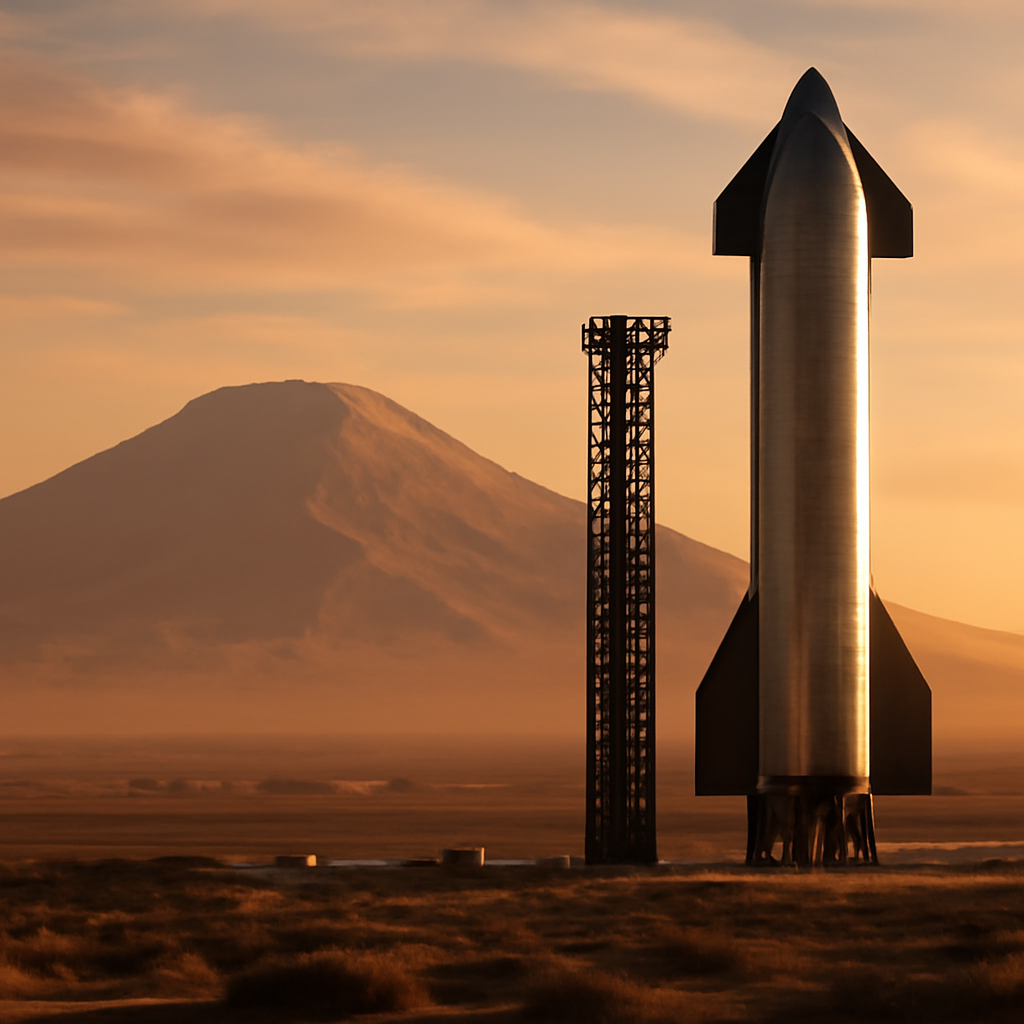
Exploring the latest developments in Mars exploration, from SpaceX's endeavors at Starbase to the mysteries of Olympus Mons and the future of private spaceflight.
SpaceX vs. Texas Environmentalists
SpaceX's legal battle with Texas environmentalists over the closure of a public beach near its Starbase facility in Boca Chica showcases the intricate interplay between space exploration ambitions and environmental concerns. The denial of the environmental groups' bid to prevent SpaceX from closing the beach highlights the complexities of balancing private space industry developments with public access to natural resources.
The beach closure, essential for SpaceX's rocket launch operations, underscores the critical role of site selection in ensuring the safety and success of space missions. Boca Chica's proximity to the Gulf of Mexico offers valuable advantages for launching rockets over water, minimizing risks to populated areas in case of mishaps during liftoff. Additionally, the closure of the beach serves to establish a clear safety perimeter around the launch site, crucial for safeguarding both personnel and equipment during rocket launches.
SpaceX's ability to secure the legal right to close the beach demonstrates the company's commitment to advancing its space exploration goals, including upcoming missions to Mars and beyond. As SpaceX prepares for critical test flights of its Starship system and envisions deep-space exploration, the legal victory in Texas underscores the importance of regulatory clarity and support for private space ventures. Balancing environmental considerations with the need for secure launch facilities is key to fostering innovation in the space industry and propelling humanity's reach into the cosmos.
Starship Test Flight
SpaceX's Starship system is undergoing a critical test flight to showcase its readiness for deep-space missions. This pivotal demonstration aims to validate the vehicle's ability to transport humans and cargo to destinations like Mars. The Starship's innovative design features a fully reusable rocket and spacecraft combination, intended to revolutionize space travel by significantly reducing costs and increasing launch frequency.
The test flight will assess various aspects of the Starship system, including its launch, ascent, in-orbit maneuvering, re-entry, and controlled landing. These tests are crucial for evaluating the vehicle's performance under simulated mission conditions and ensuring its safety and reliability for future crewed missions to Mars and beyond.
One of the key technologies being tested is the Starship's advanced propulsive landing system, which enables precise vertical landings on planetary surfaces. This capability is essential for conducting safe and controlled landings on Mars, where the thin atmosphere and rugged terrain pose unique challenges for spacecraft.
The success of this test flight will be a significant milestone for SpaceX's ambitious Mars exploration goals and could pave the way for the first crewed mission to the Red Planet in the coming years. As SpaceX continues to push the boundaries of space exploration, the Starship system represents a groundbreaking advancement in space transportation technology, with the potential to revolutionize how we explore and colonize other planets in the solar system.
Olympus Mons: The Giant Among Giants
Olympus Mons stands as a testament to the geological wonders of Mars, captivating scientists and space enthusiasts alike. This colossal shield volcano is the tallest in the solar system, dwarfing Earth's largest volcanoes. Its immense size and height, reaching approximately 13.6 miles (22 kilometers) above the Martian surface, are a result of Mars' lack of tectonic plate movement, allowing magma to continuously erupt in one location over millions of years.
The engineering feat of exploring Olympus Mons poses unique challenges due to its sheer scale and the harsh Martian environment. Robotic missions have provided valuable insights into the volcano's structure and composition, but the dream of sending humans to stand on its summit remains a distant aspiration. The thin atmosphere, extreme temperatures, and vast distances on Mars necessitate advanced spacecraft design and meticulous mission planning to ensure safe exploration of Olympus Mons.
As space agencies and private companies intensify their focus on Mars exploration, the allure of Olympus Mons as a potential destination for future missions grows stronger. Studying this geological giant offers a window into the planet's fiery past and helps unravel the mysteries of Mars' volcanic history. With the continued advancement of space technologies and the collective ambition to push the boundaries of human exploration, Olympus Mons stands as a beacon of scientific curiosity and engineering innovation in our quest to unravel the secrets of the Red Planet.
Phobos' Origins Revealed
Phobos, one of Mars' two moons, has long puzzled scientists with its enigmatic origins. Recent studies delving into Phobos' internal structure and formation are shedding light on this mysterious moon's history. By analyzing the moon's geophysical properties, researchers are gaining valuable insights that could unravel whether Phobos is a captured asteroid or a remnant from a catastrophic impact on Mars.
One key aspect of this study involves investigating the density distribution within Phobos. By examining variations in density throughout the moon, scientists can infer crucial details about its composition and formation processes. Additionally, researchers are analyzing seismic data to probe the moon's internal structure, potentially revealing clues about its past geological activity and evolution.
Moreover, understanding Phobos' origins has broader implications for our understanding of the Martian system as a whole. By deciphering the moon's history, scientists can glean insights into the dynamics that shaped the Martian moons and the Red Planet itself. This knowledge not only enhances our understanding of the solar system's evolution but also provides valuable context for future exploration missions to Mars and its moons.
As spacecraft and rovers continue to unravel the mysteries of the Martian system, each new discovery brings us closer to unlocking the secrets of our neighboring planet and the enigmatic moons that orbit it. The ongoing research into Phobos' internal structure exemplifies the intricate interplay between geophysics, planetary science, and space exploration, paving the way for deeper insights into the origins of celestial bodies in our cosmic neighborhood.
Starfall Demo: Orbital Manufacturing
SpaceX's Starfall Demo mission marks a significant milestone in testing the feasibility of orbital manufacturing for future Mars exploration. The mission features a unique disk-shaped capsule designed to showcase the capabilities of manufacturing components in space, a crucial step towards sustainable and efficient space travel.
Orbital manufacturing offers several advantages over traditional manufacturing on Earth, such as the potential to create larger structures that are difficult or impossible to launch from the surface of Earth due to size constraints. In the context of Mars exploration, orbital manufacturing could enable the production of spacecraft components in space, reducing the need for costly and complex launches from Earth.
The Starfall Demo mission aims to demonstrate the practicality and efficiency of manufacturing in the unique microgravity environment of space, paving the way for future missions to Mars and beyond. By testing the manufacturing processes in orbit, SpaceX is exploring innovative solutions to overcome the challenges of long-duration space travel and colonization efforts.
This mission comes at a time when space agencies and private companies are increasingly focused on advancing technologies for Mars exploration. With the growing interest in crewed missions to the Red Planet, the success of the Starfall Demo mission could have far-reaching implications for the future of space exploration and the eventual human presence on Mars.
Private Mars Orbiter Missions
NASA's recent decision to award a private company the contract to develop a Mars orbiter for the 2028 mission marks a significant shift towards commercial involvement in planetary exploration. This move reflects NASA's strategy to leverage the capabilities and innovations of the private sector to advance its ambitious goals for Mars exploration. By partnering with private companies, NASA can tap into their expertise in spacecraft design, engineering, and mission operations, allowing for more efficient and cost-effective missions to the Red Planet.
The involvement of private companies in Mars orbiter missions brings a fresh perspective and novel approaches to space exploration. These companies often employ cutting-edge technologies and agile development processes that can accelerate the pace of mission design and implementation. Additionally, the competition and collaboration among different commercial entities in the space industry can drive innovation and foster the development of new technologies that benefit not only Mars exploration but also broader space exploration endeavors.
With a private company at the helm of the 2028 Mars orbiter mission, NASA can also focus its resources and expertise on other aspects of its Mars exploration program, such as the development of advanced landers, rovers, and human exploration systems. This division of labor allows NASA to maximize its capabilities and ensure a comprehensive approach to exploring Mars, from orbital observations to surface exploration and potentially human missions in the future.
Mars Geological Discoveries
Recent research on Mars has uncovered fascinating insights into the planet's geological history, particularly regarding magmatic intrusions and mafic silicate compositions. Scientists have identified evidence of magmatic intrusions beneath floor-fractured craters in the Martian highlands. These intrusions likely resulted from magma moving into existing rock formations, creating new geological features and altering the surrounding terrain. By studying these magmatic intrusions, researchers can gain valuable information about Mars' volcanic activity and the processes that have shaped its surface over time.
In parallel, a new study focusing on visible to near-infrared reflectance spectra of Martian meteorites has provided significant data on the mafic silicate compositions present on the Red Planet. Mafic silicates are minerals rich in iron and magnesium that are commonly found in volcanic rocks. By analyzing the composition and abundance of mafic silicates in Martian meteorites, scientists can better understand the geological processes that have occurred on Mars and the types of rocks present on its surface.
These findings not only contribute to our knowledge of Mars' geology but also have broader implications for planetary science and our understanding of how rocky planets evolve. By studying magmatic intrusions and mafic silicate compositions on Mars, researchers can piece together a more comprehensive picture of the planet's geological past and the forces that have shaped its landscape.
The Future of Space Exploration
The quest for a manned mission to Mars presents a multitude of challenges that demand innovative solutions and technological advancements. Life support systems are crucial to sustaining astronauts during the long journey and on the Martian surface. Engineers are developing closed-loop systems that recycle air, water, and waste to minimize the need for resupply missions. Radiation protection is another critical concern, as astronauts will be exposed to higher levels of cosmic and solar radiation beyond Earth's protective magnetosphere. Shielding materials and spacecraft design must mitigate these risks to ensure the crew's safety.
Deep-space communication is essential for maintaining contact with astronauts during their journey to Mars, where communication delays can range from minutes to tens of minutes. Advanced communication systems, including laser communication technology, are being developed to enable real-time data transmission and teleoperation of equipment on Mars. Additionally, autonomous systems are being incorporated to handle routine tasks and emergency situations when direct communication is not feasible.
Furthermore, landing on Mars and returning to Earth require precision navigation and propulsion systems. Entry, descent, and landing technologies must enable safe touchdown on the Martian surface, accounting for the planet's thin atmosphere and varied terrain. Propulsion systems for the return journey need to be efficient and reliable to ensure a successful return to Earth.
In the face of these challenges, ongoing research, testing, and collaboration between space agencies and private companies are driving progress towards making a manned mission to Mars a reality. Each technological advancement brings us closer to unlocking the mysteries of the Red Planet and expanding humanity's presence beyond Earth.
In the quest to become a multi-planetary species, humanity is pushing the boundaries of space exploration with ambitious missions to Mars. From SpaceX's innovative technologies to NASA's collaborations with private companies, the race to unlock the secrets of the Red Planet is intensifying. As we venture deeper into the cosmos, new discoveries on Mars and advancements in space technology are paving the way for a future where humanity may one day call Mars home.
This content was produced by the news editor with AI.