Mars' Twin Moons: From Phobos' Secrets to Starship's Ascent
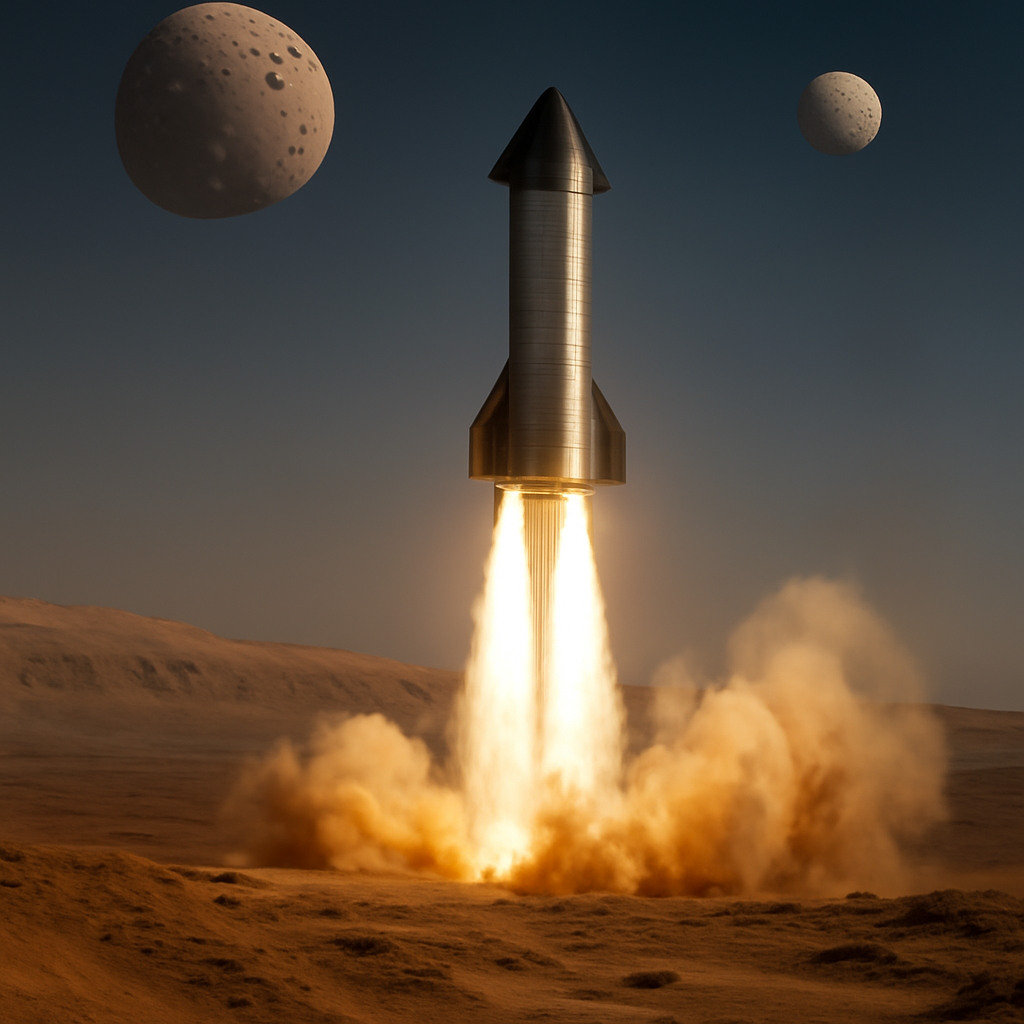
Recent breakthroughs in understanding Mars' moon Phobos, coupled with SpaceX's relentless Starship development and NASA's ambitious Mars exploration plans, paint a vivid picture of humanity's accelerating journey towards becoming a multi-planetary species.
Phobos' Deep Secrets: Unraveling Martian Moon's Genesis
Recent geophysical modeling of Phobos' Stickney Crater is providing compelling evidence to re-evaluate the moon's origin. Stickney, Phobos' most prominent impact feature, is disproportionately large relative to the moon's overall size, a characteristic that has long puzzled scientists. The prevailing hypotheses suggest Phobos is either a captured asteroid or a remnant from a colossal impact in Mars' early history. New simulations, integrating data on Phobos' mass distribution and gravitational anomalies, indicate a significant densified subsurface mass beneath Stickney. This localized increase in density is best explained not by simple impact excavation, but by the seismic reverberations of an ancient, colossal impact event that may have fractured Phobos' interior, followed by a subsequent re-accretion and densification of material within the crater's confines. This interpretation strongly favors the impact debris hypothesis, suggesting Phobos coalesced from material ejected during a cataclysmic collision involving proto-Mars, rather than being a rogue asteroid captured by Martian gravity. The precise modeling of these subsurface structures is crucial for understanding the dynamic processes that shaped Phobos and, by extension, the early Martian system.
Starship's Iterative Ascent: Engineering for the Red Planet
SpaceX's approach to developing its colossal Starship vehicle is a masterclass in iterative engineering, treating each launch as a crucial data-gathering mission rather than a final product demonstration. This methodology, mirroring agile software development cycles, allows for rapid learning and adaptation. Following the recent Integrated Flight Test 4, engineers meticulously analyze every sensor reading, structural response, and trajectory deviation. The acquisition of substantial AI computing power, as evidenced by the deal with Reflection, signals a commitment to processing this immense volume of telemetry data efficiently, enabling faster identification of performance bottlenecks and design refinements. Furthermore, the legal and regulatory landscape is actively shaping this progress. The Texas Supreme Court's recent denial of attempts to halt temporary beach closures for launches underscores the established infrastructure and the acceptance of such operational necessities. This de-risking of launch operations, combined with the sheer volume of flight data, accelerates the path toward Starship's ultimate goal: interplanetary transport and establishing a presence on Mars.
AI Fueling the Future: SpaceX's Computing Power Leap
SpaceX's recent multi-billion dollar agreement with AI startup Reflection signals a significant acceleration in their computational capabilities, a critical factor for the iterative and data-intensive development of complex systems like Starship. This substantial investment in computing power, potentially reaching $6.3 billion, suggests a strategic move to bolster their artificial intelligence and machine learning infrastructure. Such advanced computing resources are essential for processing the vast datasets generated by Starship's rapid prototyping and testing cycles, mirroring the software development approach of treating each launch as an opportunity for data-driven refinement. This includes sophisticated simulations for aerodynamic performance, structural integrity under extreme G-forces during ascent and reentry, and the optimization of engine performance. Furthermore, enhanced AI capabilities can expedite the design and analysis of novel components, potentially linked to the undisclosed payload on a recent Starship flight hinting at in-space manufacturing advances. This computational leap will be instrumental in achieving the ambitious timelines required for lunar missions, Mars colonization, and the overall scaling of SpaceX's ambitious interplanetary vision.
NASA's Mars Missions: Expanding Our Robotic Vanguard
NASA's commitment to robotic exploration of Mars continues to evolve, with recent developments signaling a broader approach to mission architecture and hardware advancement. In a significant move, the space agency has selected Relativity Space for a 2028 Mars atmospheric science mission. This partnership leverages Relativity's innovative approach to space launch, which utilizes 3D-printed rockets, aiming to reduce costs and increase payload capacity. The mission's objective is to conduct in-situ atmospheric studies, providing crucial data on Mars' climate and weather patterns. This deviates from traditional, bespoke mission spacecraft, instead integrating commercial launch capabilities into a NASA science objective. Concurrently, NASA is pushing the boundaries of rover mobility with the Ernest rover prototype. This next-generation rover is engineered for enhanced agility and speed, incorporating advanced autonomous navigation systems to traverse Mars' challenging and varied terrain more efficiently. The focus on increased maneuverability and faster transit times is critical for maximizing scientific return on future missions, allowing rovers to cover greater distances and access more scientifically promising locations within a given mission duration. These parallel advancements in launch capabilities and rover technology underscore a strategic expansion of NASA's robotic vanguard on the Red Planet.
In-Space Manufacturing: Starship's Unseen Payload Potential
The recent, undisclosed payload aboard Starship’s latest integrated flight test hints at a paradigm shift in off-world construction and resource utilization. While the exact nature of the cargo remains proprietary, the implications are profound. SpaceX’s iterative development of Starship, treating each launch as a data-gathering exercise akin to software updates, suggests a deliberate progression towards advanced capabilities. This isn't just about reaching Mars; it’s about *building* on Mars. The presence of advanced materials processing equipment, such as metal additive manufacturing systems like those developed by Phase3D or Continuous Composites, could enable on-demand fabrication of components directly from local Martian regolith. Imagine Starship delivering not just habitats, but the sophisticated 3D printers and robotic arms necessary to transform raw Martian soil into structural elements, tools, or even spare parts. This bypasses the immense logistical challenge of transporting every necessary item from Earth, drastically reducing mission costs and enabling more ambitious, self-sustaining outposts. The recent funding rounds for companies specializing in in-process inspection for metal AM underscore the growing industry focus on achieving high-reliability manufacturing in challenging environments, a capability that will be critical for any extraterrestrial industrial base.
Terraforming Mars: The Long Game of Habitability
The audacious vision of terraforming Mars, transforming it from a frozen desert into a world capable of supporting Earth life, remains largely in the realm of theoretical science, though research is actively exploring its feasibility. This endeavor hinges on fundamentally altering the planet's atmosphere and temperature. Scientists are investigating methods to thicken the Martian atmosphere, primarily by releasing trapped carbon dioxide from the polar ice caps and regolith. This could be achieved through large-scale orbital mirrors to reflect sunlight onto the ice, or by deploying heat-generating devices. A thicker atmosphere would not only raise the surface temperature through a greenhouse effect but also increase atmospheric pressure, potentially allowing liquid water to exist on the surface. However, current estimates suggest Mars lacks sufficient accessible CO2 to create a truly Earth-like atmosphere. Further research also probes the potential for introducing genetically engineered microbes or hardy plant life to gradually alter atmospheric composition and soil conditions, a process that would span centuries, if not millennia. The sheer scale of such an undertaking, coupled with the immense energy and resources required, means that while the scientific groundwork is being laid, a truly habitable Mars remains a distant, long-term aspiration.
Martian Survival: Understanding Microbial Threats
The prospect of human presence on Mars, whether for scientific exploration or eventual colonization, necessitates a rigorous assessment of potential biological hazards. Recent research simulating Martian and lunar environmental conditions has revealed a concerning resilience among certain terrestrial microbes. Specifically, studies indicate that common human pathogens can not only survive but also persist in these alien atmospheres and on simulated regolith. This survival capability is not merely passive; exposure to the fine Martian dust, or regolith simulant, has been shown to cause lung tissue damage in laboratory settings. This finding underscores a critical challenge for future missions: preventing the introduction of Earth-based microbes to Mars, which could contaminate potential native life and pose a direct health risk to astronauts. The research implies that stringent sterilization protocols for all equipment and personnel will be paramount, alongside developing countermeasures to protect crew health from the pervasive Martian dust.
Titan: A Potential Stepping Stone for Humanity?
While Mars presents a compelling target for colonization, the vast distances and harsh conditions necessitate exploring intermediate steps. Saturn's moon Titan, a world veiled in a thick, nitrogen-rich atmosphere, is emerging as a candidate for such a stepping stone. A recent NASA-backed study highlights Titan's significant resource potential, particularly its abundance of carbon, nitrogen, and oxygen. These elements are foundational for sustaining life and supporting self-sufficient human outposts. The carbon, readily available in the moon's abundant hydrocarbons like methane and ethane, could serve as a feedstock for producing plastics, fuels, and even building materials through advanced additive manufacturing processes, mirroring the iterative development seen in SpaceX's Starship program. Nitrogen, comprising over 95% of Titan's atmosphere, is crucial for breathable air mixtures and fertilizer production, vital for any enclosed agricultural systems. The presence of oxygen, though less abundant than on Earth, is still significant and could be extracted from water ice, which is believed to exist beneath Titan's surface. This prospect of in-situ resource utilization (ISRU) on Titan dramatically reduces the mass that would need to be transported from Earth, making a permanent presence more feasible and potentially paving the way for further exploration of the outer solar system.
Today's Mars headlines underscore humanity's exponential progress toward becoming a multi-planetary civilization. The deep dive into Phobos' origins, potentially linked to a massive impact, mirrors our own species' origin story and the need to understand our cosmic beginnings. SpaceX's rapid Starship iterations, fueled by massive AI computing deals and overcoming regulatory hurdles, embody the iterative engineering required for off-world expansion. NASA's selection of Relativity Space for a Mars atmospheric mission and the continued development of agile rovers like Ernest signal a maturing ecosystem of private and public entities dedicated to Martian settlement. Even the potential challenges, like ESG ratings or pathogen survival, are merely data points in the grand, accelerating trajectory of human expansion.
This content was produced by the news editor with AI.