Mars: The Organic Frontier and The Rocket Race
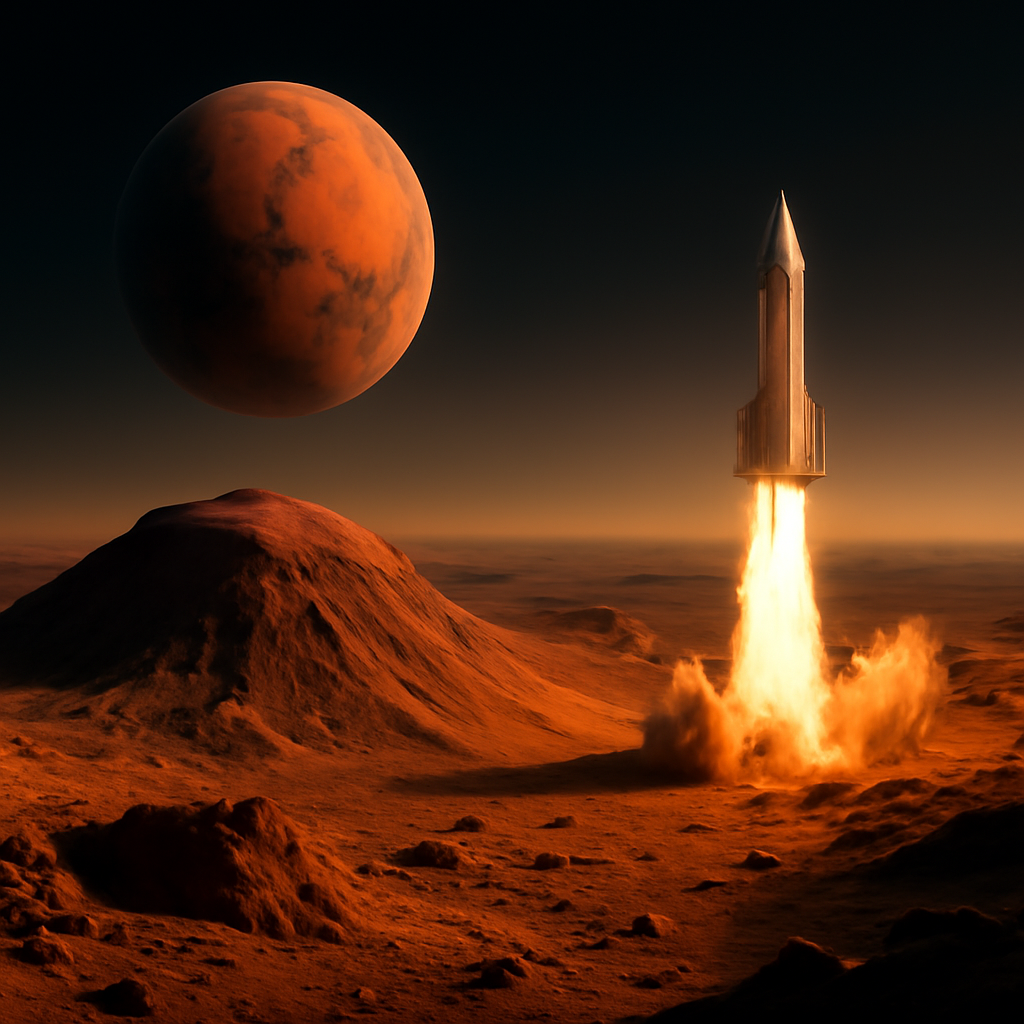
Recent Mars discoveries reveal complex organic molecules hinting at ancient habitability, while parallel advancements in rocket technology and additive manufacturing accelerate humanity's multi-planetary ambitions.
Organic Signatures: A Glimpse of Martian Life?
The Perseverance rover's recent detection of complex organic carbon in ancient Martian mudstones, particularly its association with specific minerals, represents a significant stride in the search for biosignatures. Organic molecules, carbon-based compounds fundamental to life as we know it, have been found before by both Perseverance and Curiosity, but this latest finding is particularly intriguing. The rover's instruments, like the SHERLOC (Scanning Habitable Environments with Raman & Luminescence for Organics & Chemicals) instrument, are designed to analyze the chemical composition and mineralogy of Martian rocks at a fine scale. When organic matter is found alongside minerals that are known to form under specific environmental conditions, such as those found in ancient lakebeds or hydrothermal systems on Earth, it strengthens the possibility that these organics were produced by biological processes. These mineral-organic associations act as potential "fingerprints" or biosignatures, indicating that past Martian environments may have harbored the conditions necessary for life to arise and persist. However, it's crucial to note that abiotic (non-biological) chemical reactions can also produce organic molecules and interact with minerals. Therefore, further analysis, including investigating the isotopic composition of the carbon and the precise structural arrangement of the organic molecules, is essential to differentiate between a biological origin and a geological one. The samples collected by Perseverance are slated for return to Earth by future missions, where more sophisticated laboratory analysis will be able to definitively probe these organic signatures.
Martian Geology: Unraveling the Red Planet's Interior
The seismic rumblings detected by NASA's InSight lander are painting a picture of a geologically far more dynamic Mars than previously imagined. Analysis of seismic wave propagation through the Martian interior reveals not a simple, inert core, but rather evidence of extensive, long-lived magma systems. These deep-seated heat sources would have been responsible for generating significant volcanic activity over geological timescales, shaping the planet's crust and potentially influencing its atmospheric evolution. The data suggests that magma chambers, the underground reservoirs where molten rock accumulates, were likely more widespread and persisted for longer periods than models based on Earth's plate tectonics would predict for a planet lacking such a mechanism. This implies that Mars possessed an internal heat engine capable of driving complex geological processes, including the formation of vast lava plains and the release of gases that could have contributed to or altered its atmosphere, even without the constant recycling of crustal plates seen on Earth. Understanding these deep internal processes is crucial for deciphering Mars's past habitability and the potential for preserving evidence of ancient life, such as the organic molecules being detected by rovers.
The Starship Imperative: Fueling the Future of Mars Access
SpaceX's ambitious plans for Starship hinge on a radical overhaul of its propellant logistics, moving beyond traditional road transport to a more direct and efficient system. The company is actively developing what it calls 'Starpipe,' a proprietary fueling mechanism designed to transfer propellants, primarily liquid methane and oxygen, directly from underground sources to the Starship vehicles. This initiative is complemented by proposals for substantial pipelines, including a significant 13-kilometer line, aimed at dramatically reducing the logistical burden and increasing the operational tempo of Starship launches. The construction of a dedicated pipeline is slated to begin next month, signifying a concrete step towards this goal. By circumventing the need for extensive road convoys of cryogenic fuels, SpaceX aims to minimize launch delays, mitigate safety concerns associated with road transport, and ultimately enable a much higher launch cadence for its fully reusable interplanetary spacecraft. This pipeline infrastructure is not just about getting fuel to the rocket; it's about creating a seamless, integrated system that underpins the entire Starship mission architecture, from production to launch and the eventual return of propellant from Mars.
Additive Manufacturing on Mars: Building the Future In-Situ
The burgeoning capability for additive manufacturing, or 3D printing, is poised to revolutionize off-world construction and repair, a critical factor for sustained human presence on Mars. While the recent detection of complex organic matter by Perseverance highlights the scientific imperative to explore Mars, the practicalities of establishing a foothold necessitate robust in-situ manufacturing. Technologies are rapidly advancing on Earth that directly address these needs. For structural elements, researchers are exploring biopolymer formulas, like sodium alginate, that enable the reliable 3D printing of earthen materials, potentially utilizing Martian regolith as a primary building component. On the metal fabrication front, companies like Phase3D are developing sophisticated in-situ inspection systems for metal additive manufacturing, ensuring the quality and integrity of printed parts layer-by-layer, a vital capability for fabricating everything from habitat components to replacement tools. Furthermore, the U.S. Air Force has demonstrated the custom printing of radiation detectors, showcasing the potential for on-demand, specialized equipment manufacturing directly applicable to the harsh Martian environment. These developments, alongside advancements in nanoscale printing for complex devices, suggest a future where Mars settlements can be built and maintained with materials found on-site, significantly reducing the logistical burden and cost of Earth-based resupply.
Spacecraft Manufacturing and Maintenance: A 3D Printed Revolution
The burgeoning field of industrial additive manufacturing, or 3D printing, is poised to revolutionize how we build and maintain spacecraft, both on Earth and beyond. Companies like AML3D, with its large-scale ARCEMY X metal 3D printing systems, and Phase3D, which offers in-situ inspection technology to ensure print quality layer-by-layer, are pushing the boundaries of what's possible. This technological leap is directly relevant to Mars exploration. Imagine a future where critical components for rovers, habitats, or even rocket engines are printed on-demand, directly on the Martian surface. This capability, explored by organizations like the European Space Agency (ESA) for autonomous spacecraft repair, dramatically reduces the need for Earth-launched spare parts, cutting costs and mission timelines. Furthermore, advancements in distributed manufacturing, as demonstrated by the collaboration between 3YOURMINDS and Phillips Corporation for naval applications, suggest a future where manufacturing hubs could be established off-world, supporting a sustained human presence. Even the development of advanced materials, like those enabling 3D printing with earth-based materials (news item 15), hints at the potential for constructing infrastructure using local Martian regolith. This localized manufacturing paradigm, coupled with sophisticated quality assurance like Phase3D's, is essential for overcoming the logistical challenges of deep space missions.
Protecting the Pioneers: 3D Printed Radiation Detectors
The journey to Mars, while promising the discovery of organic molecules and potential biosignatures, also presents a significant hazard: pervasive cosmic radiation. To safeguard future astronauts, the U.S. Air Force's Directed Energy Directorate is pioneering the development of customized radiation detectors using additive manufacturing. Unlike traditional, mass-produced sensors, these 3D printed devices can be tailored to specific mission needs and astronaut anatomy. The process involves incorporating radiation-sensitive materials, such as scintillators or semiconductors, directly into the printed structure during fabrication. This allows for the creation of detectors with optimized geometry and sensor placement, potentially offering higher detection efficiency and more precise localization of radiation sources. Furthermore, the ability to rapidly prototype and iterate on designs means these detectors can be continuously improved based on real-world performance data, a critical advantage when developing technology for the unforgiving Martian environment. This innovative application of 3D printing directly addresses the vital need for advanced personal dosimetry and environmental monitoring, ensuring that the pioneers venturing to the Red Planet are equipped with the most effective tools to understand and mitigate radiation risks.
The Sample Return Race: Bringing Mars Home
The race to bring Martian samples back to Earth is heating up, with China's Tianwen-3 mission reportedly aiming to land its precious cargo before NASA's ambitious Mars Sample Return (MSR) program. Both endeavors face monumental engineering hurdles, demanding unprecedented precision and autonomy on another world. NASA's MSR, a multi-part campaign involving the Perseverance rover and a future lander/ascender, relies on Perseverance caching samples for a subsequent ascent vehicle to collect and launch into orbit. This orbiting sample would then be retrieved by another spacecraft for its journey home. China's Tianwen-3, however, appears to be a more consolidated effort, with a single mission designed to collect, launch, and return samples within a single operational window. This streamlined approach, if successful, could provide the first pristine Martian materials for detailed analysis on Earth, potentially answering crucial questions about the planet's past habitability and the organic molecules detected by Perseverance. Key challenges for both missions include developing reliable sample collection and sealing mechanisms, robust ascent vehicles capable of launching from the Martian surface, and highly automated rendezvous and transfer operations in Mars orbit—all without direct human intervention. The success of these missions hinges on overcoming the extreme environmental conditions of Mars, including its thin atmosphere, extreme temperature fluctuations, and pervasive dust.
Human Endurance on the Red Planet: The Martian Marathon
The completion of the first marathon on Martian soil represents a profound leap in our understanding of human physiological limits beyond Earth. This achievement, while seemingly a sporting event, is underpinned by critical advancements in life support, radiation shielding, and crew psychological resilience, all essential for sustained human presence. The thin Martian atmosphere, offering minimal protection from solar and cosmic radiation, necessitates robust habitat designs and potentially advanced spacesuits that can mitigate exposure during extravehicular activities. Furthermore, the psychological toll of extended isolation and confinement on a distant world is a significant hurdle. Successfully completing a demanding physical challenge like a marathon, even within a controlled environment, demonstrates an astronaut's capacity to maintain peak physical and mental condition under extreme duress. This data is invaluable for planning future missions, informing the design of habitats, training regimens, and the very composition of long-duration crews. It transitions the concept of Martian habitation from theoretical possibility to a tangible, human-centric endeavor, paving the way for the scientific and exploratory frontiers that await.
Today's Mars headlines paint a vivid picture of humanity's accelerating trajectory towards becoming a multi-planetary species. The detection of complex organic matter by Perseverance is a monumental stride, solidifying Mars as a prime candidate for evidence of past life and justifying the immense investment in its exploration. Simultaneously, the relentless progress in rocket engineering, particularly SpaceX's ambitious pipeline projects for Starship, signifies an exponential leap in our capacity to transport resources and personnel to Mars. These developments, coupled with the burgeoning additive manufacturing sector enabling on-demand production for space applications, are not merely scientific curiosities; they are the foundational pillars of a future where humanity's survival and progress are no longer confined to a single, fragile planet. The drive for Mars is the ultimate expression of our species' imperative to expand, innovate, and secure its long-term future.
This content was produced by the news editor with AI.