Mars: The Great Acceleration - From Microbes to Mega-Rovers and the Dawn of the Red Planet Economy
As humanity hurtles towards becoming a multi-planetary species, Mars presents a complex tapestry of challenges and opportunities. From understanding the resilience of Earth microbes in Martian conditions to the engineering marvels of autonomous rovers and the burgeoning private sector, the path to the Red Planet is accelerating.
The Microbial Frontier: Pathogen Survival and Biosafety
The recent findings from experiments simulating Martian and lunar environments underscore a critical, often overlooked, challenge for future crewed missions: the potential persistence of Earth-based pathogens. Researchers have demonstrated that certain microbes, including those known to cause illness in humans, can survive prolonged exposure to conditions mimicking the Martian surface. This survival is not necessarily due to active growth but rather a form of dormancy, where metabolic processes are severely suppressed, allowing the organisms to endure extreme cold, low pressure, and radiation. Compounding this concern, the simulated Martian regolith itself has been shown to cause damage to lung tissue upon inhalation. This dual threat – viable terrestrial microbes and potentially abrasive dust – necessitates rigorous sterilization protocols for all equipment and habitats returning from Mars, as well as advanced personal protective equipment and air filtration systems for astronauts. The implications extend to sample return missions, demanding containment strategies that prevent even dormant microbes from reaching Earth's biosphere, while simultaneously ensuring the integrity of the scientific samples themselves. This microbial frontier represents a significant biosafety hurdle that must be addressed before humans can safely set foot on the Red Planet.
Autonomous Exploration: ERNEST and the Future of Martian Mobility
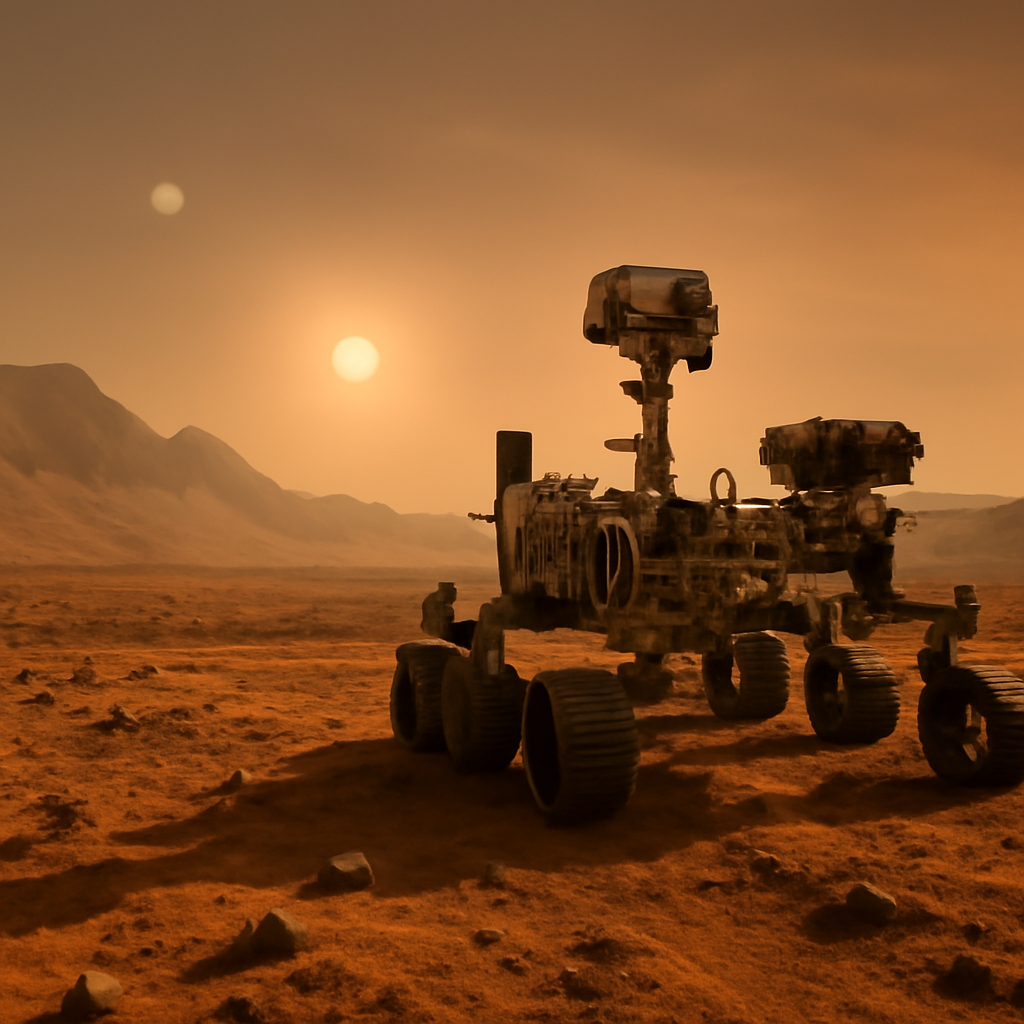
The ERNEST rover prototype represents a significant leap in Martian mobility, moving beyond the methodical pace of its predecessors like Perseverance, which recently crossed the 26.2-mile threshold. ERNEST is engineered with advanced AI-driven autonomy, allowing it to make real-time navigation decisions and adapt to complex terrain without constant human oversight. This enhanced autonomy is crucial for covering greater distances and exploring more remote regions efficiently. Its design incorporates an active suspension system, a key innovation that enables it to traverse rocky, uneven surfaces with greater speed and stability. Unlike the relatively rigid chassis of earlier rovers, ERNEST’s adaptive suspension can dynamically adjust to ground conditions, minimizing jolts and maintaining optimal tire contact. This capability, combined with a top speed of 1 km/h—a considerable increase from the typical 0.03-0.04 km/h of Mars rovers—translates to a vastly improved ability to cover ground. Such advancements are vital as NASA plans for more ambitious exploration, potentially establishing a sustained presence where rapid, reliable traversal is paramount for scientific return and operational flexibility.
Miles on Mars: Perseverance's Marathon Milestone
Perseverance’s achievement of traversing over 26.2 miles on the Martian surface represents a significant feat of engineering and operational longevity. This marathon mileage isn’t merely a number; it’s a testament to the rover's robust design, particularly its autonomous navigation capabilities and the resilience of its mobility system. The sheer distance demands a sophisticated power management system, likely a Multi-Mission Radioisotope Thermoelectric Generator (MMRTG), to provide consistent energy for locomotion, scientific instruments, and onboard computers across the varied Martian terrain and diurnal temperature swings. Furthermore, its sophisticated fault detection and recovery protocols are crucial. Operating autonomously for extended periods, the rover must be able to identify and mitigate issues, from wheel slippage on loose regolith to potential mechanical anomalies, without immediate human intervention. This level of independent operation is critical for covering such vast distances, especially considering the communication delays between Earth and Mars. The ability to navigate autonomously, assess terrain, and make real-time decisions about its path, as hinted at by advancements in rovers like ERNEST, is essential for maximizing scientific return and ensuring the rover’s continued operation over years, far exceeding initial mission expectations.
The Martian Geology Unveiled: Mantle, Magma, and Meteorite Clues
Recent findings are painting a more detailed picture of Mars' internal architecture, suggesting a planet fundamentally different from Earth's dynamic churn. A new study indicates that Mars likely possesses a fully solid mantle, devoid of the basal magma layer common beneath Earth's crust. This implies that heat transfer within the Martian interior is primarily driven by solid-state convection, a slower process that significantly impacts the planet's long-term thermal evolution and volcanic activity. This internal state is further corroborated by evidence of magmatic intrusions found beneath ancient high plains craters. These intrusions, remnants of past volcanic plumbing systems, offer direct glimpses into the subsurface magma dynamics that once shaped the Martian landscape, even if a pervasive subsurface magma ocean is absent today. Adding another layer of geological insight, the discovery of garnet grains within a Martian meteorite provides crucial mineralogical data. Garnets form under specific temperature and pressure conditions, and their presence in these extraterrestrial samples allows scientists to constrain the pressure-temperature regimes experienced deep within Mars' crust and mantle during its formation and subsequent evolution. These combined observations, from the absence of a basal magma layer to the specific mineral signatures within meteorites, are crucial for understanding why Mars cooled more rapidly than Earth and how its distinct geological history unfolded.
Orbital Manufacturing and Reentry: SpaceX's Starfall Ambitions
SpaceX's Starfall mission, slated for June 23, 2026, represents a pivotal step in the company's ambitious trajectory towards Mars, with a core focus on demonstrating advanced reentry and orbital manufacturing capabilities. The mission's disk-shaped capsule is not merely a vessel for transport but a mobile fabrication unit, designed to leverage the microgravity environment for producing complex components. This orbital manufacturing objective is crucial for future deep-space endeavors, allowing for the creation of specialized tools, spare parts, or even structural elements that are either too large or too delicate to launch from Earth. By manufacturing in orbit, SpaceX aims to circumvent the mass and volume constraints of traditional rocket launches, a significant bottleneck for constructing larger spacecraft or habitats on Mars. The subsequent reentry test is equally critical, aiming to refine the thermal protection systems and aerodynamic control necessary for robust atmospheric entry, particularly on Mars, which possesses a thin but still significant atmosphere. Successfully demonstrating these technologies on Starfall would pave the way for scaling up production and reducing the logistical burden for eventual crewed missions and sustained Martian presence, aligning with the broader trend of additive manufacturing and distributed fabrication seen in terrestrial industries.
The Commercialization of Mars Exploration: New Orbits and Launchers
NASA's increasing reliance on commercial partnerships signals a significant evolution in Mars exploration strategy. The agency recently awarded a contract to a private firm to develop and launch a Mars orbiter mission slated for 2028, a move that diversifies the launch landscape beyond traditional government-led efforts. This contract, alongside the selection of Eric Schmidt's rocket company for a future Mars mission and Relativity Space for another 2028 endeavor, underscores a deliberate pivot toward leveraging private sector innovation and capacity. These commercial entities are expected to bring agility and potentially cost efficiencies to orbital missions, a crucial step as NASA aims for more frequent and ambitious Mars campaigns. This trend is further bolstered by advancements in launch vehicle technology, exemplified by SpaceX's ongoing Starship test flights, which promise the heavy-lift capabilities necessary for extensive Martian infrastructure deployment. The burgeoning commercial space sector, with its focus on rapid development and scalable manufacturing, is thus poised to become an indispensable partner in humanity's journey to the Red Planet.
Water on Mars: Subsurface Clues and Atmospheric Mysteries
The Zhurong rover's ground-penetrating radar has unveiled a subsurface landscape hinting at a dynamic past, with distinct circular depressions, termed "pockmarks," suggesting significant ancient water activity. These formations, discovered beneath the Martian regolith, are analogous to features on Earth formed by the dissolution of soluble rock or the collapse of underground voids created by flowing water. This radar data offers a crucial three-dimensional glimpse into geological processes that unfolded millions of years ago, painting a picture of a wetter, more geologically active Mars than its current arid state. Complementing these findings, atmospheric research continues to refine our understanding of transient gases. New studies focusing on Gale Crater, leveraging sophisticated atmospheric transport models, are pinpointing optimal times and locations for detecting methane. This is critical because methane's presence, even in trace amounts, could be a biosignature – an indicator of past or present microbial life. By understanding the atmospheric currents and topographical influences within Gale Crater, scientists can maximize the chances of capturing these fleeting methane plumes with instruments like those on the Curiosity rover, refining strategies for future, more targeted searches for extant life.
Radiation's Toll: Chemical Transformations and Human Health
The Martian surface, while seemingly barren, is a dynamic chemical environment significantly altered by relentless solar and cosmic radiation. This radiation, far more intense than on Earth due to the planet's thin atmosphere and lack of a global magnetic field, plays a crucial role in the breakdown of perchlorates, salts abundant in the Martian regolith. Studies, like the recent exploration of radiation's effect on sodium perchlorate, reveal that this energetic bombardment causes the perchlorate molecule to decompose, releasing reactive chlorine species. This chemical transformation has profound implications. For future human missions, these reactive compounds could pose an inhalation hazard, potentially damaging respiratory tissues as hinted at by experiments simulating Martian regolith exposure. Furthermore, understanding perchlorate breakdown is vital for in-situ resource utilization, particularly if water ice containing these salts is to be processed for life support or propellant. The chemistry dictates how efficiently we can extract resources and what protective measures are necessary to ensure astronaut safety on a planet bathed in high-energy particles.
Today's Martian headlines underscore the inexorable march of human civilization beyond Earth. Each advancement, whether it's a rover covering marathon distances, a private entity securing a NASA Mars orbiter contract, or the sophisticated testing of reentry technologies, signifies exponential progress towards a multi-planetary future. The challenges, such as understanding pathogen survival and radiation effects, are not impediments but crucial data points in the grand engineering project of human expansion. The growing involvement of private industry, exemplified by SpaceX and Eric Schmidt's rocket company, signals the maturation of the space economy, transforming Mars from a scientific curiosity into a tangible destination for settlement and resource utilization. This era is defined by pushing boundaries, embracing complexity, and accelerating the trajectory of human destiny.
This content was produced by the news editor with AI.