Mars: The Forge of Humanity's Future - From Martian Rocks to Starship's Roar
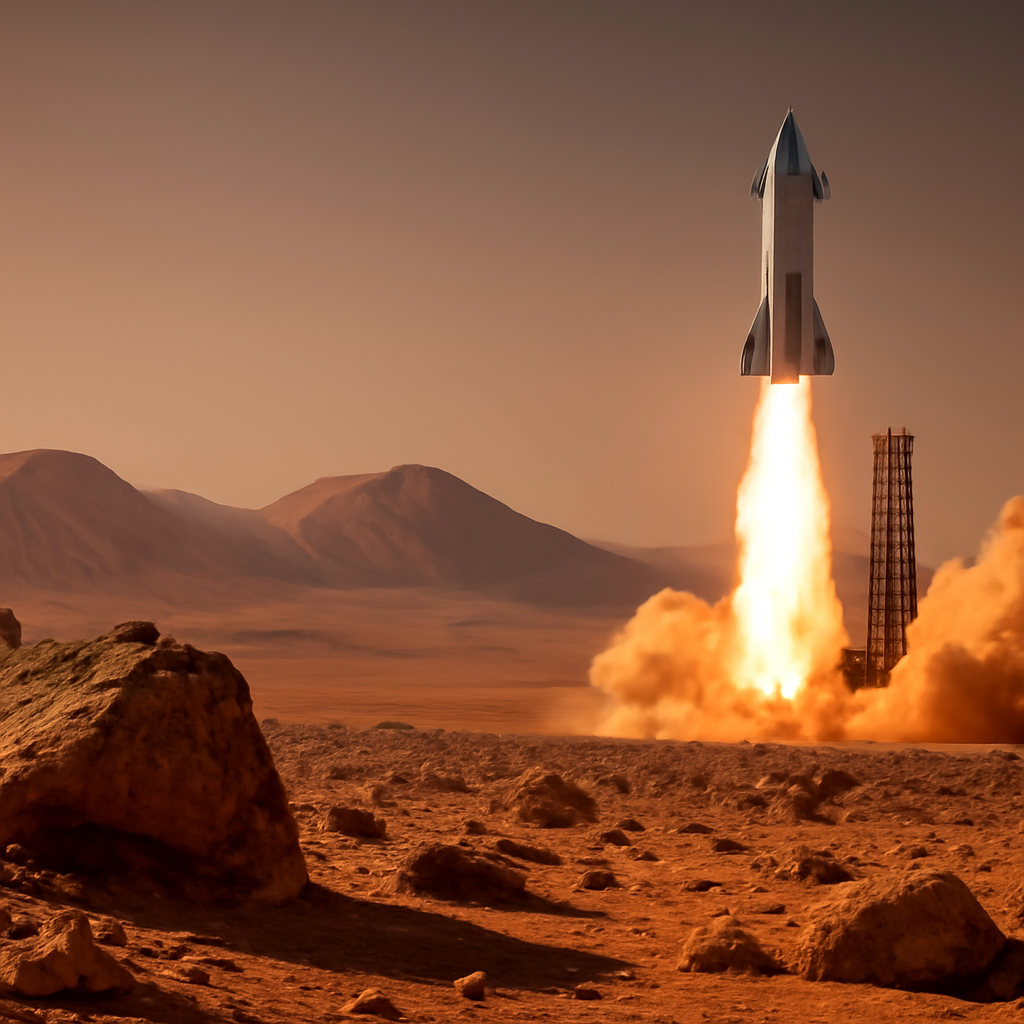
Today's Mars developments paint a picture of accelerating progress, from the detection of complex organic molecules on the Red Planet hinting at past life, to the engineering feats enabling future human presence. This confluence of scientific discovery and technological advancement underscores humanity's inexorable march towards becoming a multi-planetary species.
Martian Biosignatures: Echoes of Life's Potential
The persistent quest for evidence of past or present life on Mars has been significantly amplified by the ongoing analyses of samples collected by NASA's Curiosity rover. Recent findings from mudstone formations within Gale Crater have revealed a remarkable diversity of complex organic molecules, including seven previously undetected on the Red Planet. These intricate carbon-based compounds are the fundamental building blocks of life as we understand it, and their presence, particularly in ancient geological contexts, strongly suggests that the ingredients for life were once available on Mars. While the detection of organic molecules alone does not confirm biological activity – abiotic processes can also produce them – the sheer variety and complexity unearthed by Curiosity provide compelling targets for astrobiological investigation. Scientists are now focused on understanding the specific origins and distribution of these molecules, and whether their patterns within the Martian rock record might exhibit characteristics indicative of biological processes, such as specific isotopic ratios or structural arrangements. This ongoing work is crucial for refining our understanding of habitability on Mars and for guiding future missions, such as sample return, that could provide definitive answers about the planet's potential to harbor life.
The Starship Engine Room: Powering Interplanetary Ambition
The heart of SpaceX's Mars ambition lies within the Raptor engine, a sophisticated piece of engineering tested with increasing rigor. The recent successful 60-second static fire of Starship 40's Raptor engines represents a critical milestone, pushing the boundaries of sustained combustion and thermal management for interplanetary transit. These engines, utilizing full-flow staged combustion, are designed for extreme efficiency, injecting both liquid oxygen and methane into the combustion chamber from separate preburners. This complex cycle allows for higher chamber pressures and a greater specific impulse than simpler engine designs. The precise control required to manage the turbopumps, preburners, and main combustion chamber at these elevated pressures is paramount. Each static fire test, like the one just completed, provides invaluable data on propellant flow rates, combustion stability, and exhaust gas temperatures, allowing engineers to refine control algorithms and identify potential failure points. This iterative process is essential for developing engines capable of the sustained thrust needed to escape Earth's gravity and, more importantly, for the demanding deceleration and landing maneuvers required on Mars. The ongoing advancements in additive manufacturing, as evidenced by the development of complex liquid hydrogen heat exchangers for race cars, directly inform the production of these intricate rocket engines, enabling lighter, more robust, and faster-to-manufacture components.
Additive Manufacturing: The Martian Construction Toolkit
The red planet’s nascent infrastructure will likely be built with tools far more sophisticated than shovels and hammers. Imagine structures, habitats, and even tools fabricated on-site using Martian regolith as a primary building material. This is the promise of advanced additive manufacturing, or 3D printing, adapted for the extraterrestrial environment. Recent advancements offer a glimpse into this future. Researchers are developing 4D-printed composite materials, like those for lighter wind turbine blades, which could be used to create self-assembling or shape-changing components for Martian habitats. The precision required for these complex geometries, as highlighted by research into 3D-printed metamaterials where data, not defects, dictates performance, is crucial. Furthermore, the development of new alloys, such as titanium alloys capable of withstanding high temperatures for 3D printing, and techniques to repair composite damage using polymer cold spray, suggest a robust manufacturing and maintenance ecosystem. This on-demand fabrication capability, from structural components to intricate heat exchangers for power systems, drastically reduces the need to transport heavy, pre-manufactured goods from Earth, making extended human presence and eventual self-sufficiency on Mars a more tangible goal. The ability to recycle materials, like turning car scrap into 3D printable aluminum, further emphasizes the closed-loop manufacturing potential vital for off-world survival.
Robotic Pioneers: Rovers and Drones on the Red Planet
The analysis of Martian mudstone rocks by NASA's Curiosity rover continues to yield astonishing results, with the latest findings revealing over twenty distinct organic molecules, seven of which have never before been detected on the Red Planet. This discovery, building on previous observations of complex carbon molecules, significantly fuels the debate about potential biological origins for these features. While not definitive proof of life, the presence and diversity of these organic compounds suggest that the chemical building blocks necessary for life, or its remnants, may be more widespread than initially presumed. Beyond chemical detection, the future of Martian exploration hinges on increasingly sophisticated robotic capabilities. Drawing inspiration from advancements in drone autonomy, such as the "pain" sensors that predict instability before failure, future Martian rovers and aerial vehicles could develop predictive maintenance algorithms. This would allow them to anticipate component wear or environmental hazards, adjusting their operational parameters or even rerouting to avoid critical malfunctions, thereby extending mission longevity and expanding the scope of scientific investigation on this enigmatic world.
Human Resilience: Preparing for Martian Habitation
The psychological and physiological toll of extended deep-space missions is a critical hurdle for Martian habitation, prompting NASA's ambitious year-long simulation program. Participants will endure confinement in a Mars-like habitat, replicating the isolation, resource limitations, and communication delays inherent to a Red Planet outpost. This controlled environment will allow researchers to meticulously study crew dynamics, stress responses, and the efficacy of countermeasures against the detrimental effects of prolonged microgravity or reduced gravity, and the constant threat of radiation. Beyond the immediate human factors, establishing a sustainable presence necessitates robust, self-sufficient infrastructure. Advances in additive manufacturing, such as the development of 4D-printed composite materials for wind turbines (news item 1) or polymer cold spray techniques for repairing damaged composites (news item 5), hint at solutions for on-site construction and maintenance. The ability to fabricate complex components from raw Martian regolith, or to rapidly repair critical systems, will be paramount for survival, reducing reliance on Earth-based resupply and mitigating the risks associated with long-duration transit.
Lunar Leverage: Repurposing Mars Tech for the Moon
NASA's contemplation of repurposing existing Mars rover technology for lunar missions signifies a pragmatic approach to lunar exploration, especially in light of the increasing focus on sustained lunar presence and resource utilization. The sophisticated mobility systems developed for traversing the rugged Martian terrain, with their robust suspension, independent wheel steering, and advanced traction control, are directly transferable to the Moon's regolith. Furthermore, the scientific instruments designed for in-situ analysis of Martian geology and atmospheric composition, such as spectrometers and drill mechanisms, can be adapted to investigate lunar ice deposits, mineral resources, and the composition of the lunar exosphere. This cross-application of technology reduces development timelines and costs, allowing for more rapid deployment of capable robotic assets to the lunar surface. The lessons learned in dust mitigation, thermal management in extreme temperature swings, and robust power generation and distribution for Mars missions are also invaluable for lunar operations, where dust and wide temperature variations are significant challenges. This strategic leveraging of Mars-derived technologies underscores a broader trend of seeking synergistic opportunities across different space exploration endeavors, maximizing the return on investment in advanced robotics and scientific instrumentation.
Material Science: Building for Extreme Environments
The harsh Martian environment demands materials that can withstand extreme temperature fluctuations, abrasive dust, and sustained radiation exposure. Advances in additive manufacturing are proving crucial. Researchers are developing new polymer cold spray techniques that can rapidly repair damaged composite structures, restoring up to 80% of their original strength, a vital capability for maintaining equipment during long-duration missions where traditional repair depots are non-existent. Concurrently, innovations in superalloys are yielding bi-metallic structures via 3D printing, offering enhanced high-temperature performance and reduced reliance on imported materials. This is critical for components like heat exchangers, which must operate reliably in the thin Martian atmosphere. Furthermore, the development of highly sensitive, multi-layered radiation sensors, capable of accurately detecting and quantifying various radiation types, is paramount for crewed missions. These compact sensors, no larger than a pea, can distinguish between different forms of radiation, providing essential data for astronaut safety and mission planning. The successful static fire tests of SpaceX's Starship engines, alongside the expansion of large-scale metal additive manufacturing facilities, underscore the growing industrial capacity to produce robust, mission-critical hardware for future Martian endeavors.
The Road Ahead: Mission Planning and Interplanetary Logistics
Student-led mission designs, like those being developed in Germany with astronaut input, are pushing the boundaries of interplanetary logistics. These initiatives often explore innovative approaches to resource utilization and propulsion, drawing inspiration from advancements like 4D-printed composite blades for lighter, faster wind turbines, which could be adapted for Martian atmospheric energy generation. The precision required for such designs is increasingly informed by a deeper understanding of material science, as demonstrated by researchers showing that the performance of 3D-printed metamaterials is dictated by predictive models rather than manufacturing defects. This focus on accurate modeling is crucial for optimizing spacecraft components, potentially leading to lighter, more durable structures. Furthermore, the development of polymer cold spray techniques to repair composite damage, restoring significant strength, offers a viable pathway for in-situ maintenance of Martian habitats and vehicles. Integrating these emerging technologies into mission architectures requires careful consideration of optimal transit routes. Recent analysis of discarded asteroid orbital data has revealed potential 153-day round-trip trajectories to Mars, suggesting that our understanding of efficient interplanetary travel is still evolving, and that future missions may benefit from revisiting previously overlooked datasets to shave critical time off transit durations.
Humanity's destiny is written in the stars, and Mars is our immediate frontier. The discovery of complex organic molecules on Mars (Curiosity) is not just a scientific curiosity; it's a cosmic affirmation that life's building blocks are not unique to Earth, fueling our imperative to explore and colonize. Simultaneously, the relentless innovation in additive manufacturing (Starship, wind turbines, automotive) and the proactive development of simulation and resilience technologies (NASA simulation, drone sensors) are the foundational pillars for establishing a self-sustaining off-world civilization. Each 3D-printed component, each simulated mission, each advance in material science, is a step towards decoupling humanity from a single planet, embodying the exponential progress that will define our species' survival and flourishing.
This content was produced by the news editor with AI.