Mars: The Dawn of Autonomy and Organic Discovery
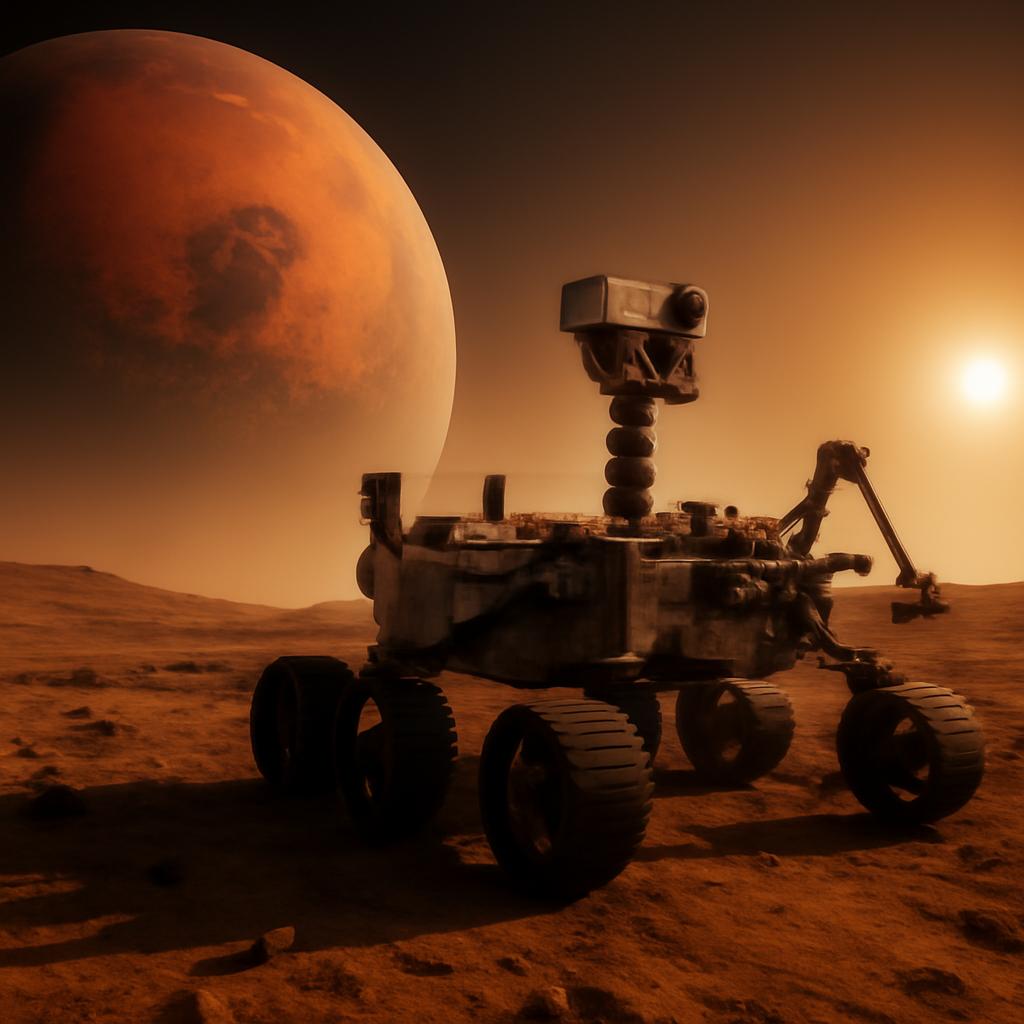
From AI-driven experiments to the detection of life's building blocks, Mars exploration is accelerating. Concurrently, advancements in autonomous robotics, additive manufacturing, and propulsion systems are laying the groundwork for humanity's multi-planetary future.
Organic Signatures: The Search for Martian Life Heats Up
The ongoing analysis of Martian rock samples by both the Curiosity and Perseverance rovers is providing an increasingly detailed picture of the Red Planet's past habitability, particularly through the detection of organic molecules. Curiosity, in a single drilled sample, identified 21 distinct organic compounds, seven of which are new to Mars. Among these are nitrogen-bearing molecules, considered crucial precursors for the building blocks of life as we know it, such as RNA and DNA. Perseverance has similarly detected complex organic carbon compounds, including macromolecular carbon, within ancient mudstones in Jezero Crater, a region known to have once hosted a river. While these discoveries are significant, they do not definitively prove the existence of past life. Organic molecules can be formed through abiotic processes, and the scientific community is focused on identifying definitive biosignatures – specific patterns or molecules that are overwhelmingly indicative of biological activity. The challenge lies in distinguishing these from non-biological sources and understanding the geological context of their preservation. Future analyses, particularly from samples returned to Earth, will be critical for confirming whether these organic signatures represent remnants of ancient Martian life or simply complex geological chemistry.
Robotic Autonomy: Empowering Mars Exploration
The relentless pace of Martian exploration is increasingly driven by advancements in robotic autonomy, a critical shift necessitated by the vast communication delays between Mars and Earth. Projects like the AutoLabs AI agent, which translates high-level scientific objectives into precise robotic commands, exemplify this trend. Instead of waiting for human operators to meticulously plan each movement or analytical step, rovers can now process complex experimental designs and execute them autonomously. This onboard intelligence, often referred to as edge computing, allows for real-time decision-making. For instance, if a rover like Perseverance, which has now covered marathon distances across the Martian surface, encounters an unexpected geological feature while searching for organic molecules, it can analyze the situation and adjust its sampling strategy without waiting for a signal from Earth. This not only accelerates scientific discovery, as evidenced by the continuous findings of diverse organic compounds, but also optimizes resource utilization and mission efficiency, making the exploration of Mars more dynamic and responsive.
Additive Manufacturing: Building the Martian Industrial Base
The realization of a Martian industrial base hinges on advanced additive manufacturing, a concept gaining traction both on Earth and in space. News of SpaceX’s Starship launch tower construction and Australia’s defense-focused additive manufacturing research underscores the growing importance of this technology. On Mars, the ability to fabricate parts and tools in-situ, using local regolith, is paramount for long-term sustainability and mission expansion. This mirrors advancements like the ShAPEretro system, which upgrades existing extrusion presses, suggesting a pathway for retrofitting Martian habitats or resource processing equipment. Furthermore, the development of dry printing methods for electronics in microgravity, as reported by researchers, directly addresses the challenges of manufacturing complex components on a planet with a thin atmosphere and limited infrastructure. This capability, combined with the potential for rapid prototyping and repair, could enable on-demand production of everything from rover spare parts to habitat modules, significantly reducing reliance on Earth-based resupply missions and paving the way for more ambitious scientific endeavors, such as those driven by the diverse organic discoveries from Curiosity and Perseverance.
Propulsion and Logistics: Paving the Way for Human Missions
The advent of reusable, heavy-lift launch systems like SpaceX's Starship, with its initial segments now being erected for a new launch tower, fundamentally alters the economics of interplanetary transit. This capability, coupled with dedicated cargo tugs such as the European Space Agency's proposed LightShip, signals a paradigm shift towards routine, cost-effective resupply missions to Mars. Starship's massive payload capacity and rapid reusability directly address the primary logistical hurdle: the sheer mass of infrastructure, propellant, and consumables required for sustained human presence. This is not merely about getting more mass to Mars; it's about reducing the per-kilogram cost to a point where establishing a permanent outpost becomes feasible. LightShip, a solar-electric tug designed for regular cargo delivery, further refines this strategy by offering a dedicated, efficient platform for ferrying resources once they are in Earth orbit. The synergy between these two developments – a high-volume launch system and a specialized orbital transfer vehicle – creates a robust supply chain, enabling the delivery of everything from habitats and life support systems to scientific equipment and the necessary propellants for return journeys, thereby paving the way for the ambitious goals of agencies like ESA's Terrae Novae initiative.
Materials Science: Innovations for Extreme Environments
The harsh Martian environment, characterized by extreme temperature fluctuations, a tenuous atmosphere, and abrasive dust, necessitates materials engineered for resilience and longevity. Recent advancements in membrane technology, inspired by terrestrial applications like oil separation, offer a promising avenue for resource utilization on Mars. Imagine advanced polymer membranes capable of selectively filtering water from brines or extracting valuable gases from the Martian atmosphere, all at ambient Martian temperatures, thereby minimizing energy expenditure. Similarly, the development of room-temperature, pressure-activated adhesives, utilizing microcapsule technology, could revolutionize in-situ repair and assembly. These adhesives would simplify construction and maintenance of habitats and equipment, eliminating the need for complex heating or curing processes often impractical in extreme cold. Furthermore, breakthroughs in composite manufacturing, such as origami-inspired mold-free additive processes that slash production costs and time, could enable the rapid fabrication of structural components and tools from local regolith. These innovations, coupled with advanced extrusion techniques that enhance material properties and on-demand electronics printing in microgravity, form the bedrock for self-sufficient Martian settlements and exploration infrastructure.
Power Generation: Sustainable Energy for the Red Planet
Future Martian habitats will demand robust and sustainable power generation systems, moving beyond the limitations of solely relying on imported hardware. Advancements in photovoltaic technology are crucial. Perovskite solar cells, for instance, offer a promising avenue. Recent research indicates that increasing light intensity to 2.3 suns can effectively accelerate aging tests for these cells without altering their fundamental characteristics, providing a more reliable method for rapid screening and development. This accelerated testing allows for quicker validation of new materials and designs, essential for optimizing performance and longevity in the harsh Martian environment. Complementing solar power, in-situ resource utilization for energy production is also vital. A scalable solar-powered reactor that converts plastic waste into hydrogen fuel and valuable chemicals, demonstrated under real-world conditions, presents a compelling waste-to-energy solution. This technology could leverage discarded materials from early missions or even process Martian resources to generate clean fuel, significantly reducing reliance on Earth-based resupply and contributing to a more circular economy on Mars. Such integrated approaches, combining advanced solar capture with local resource conversion, will be foundational for establishing self-sufficient Martian outposts.
Robotics and Mobility: Navigating the Martian Landscape
The ability of Mars rovers to navigate the planet's rugged terrain is continually being enhanced through biomimicry and advanced materials. A German engineering team, for instance, has developed novel rover wheels inspired by the locomotion of Sahara desert lizards. These wheels incorporate a flexible, multi-segmented design that allows them to conform to uneven surfaces, much like a lizard's footpads distribute weight and grip sand. This contrasts with the rigid, often problematic wheels of current rovers, which can get bogged down in loose regolith or struggle with sharp obstacles. Complementing these mechanical innovations, the burgeoning field of soft robotics offers a pathway to greater operational flexibility. Imagine a rover equipped with "tentacles" made from compliant, self-healing polymers, capable of gently manipulating delicate rock samples or squeezing through narrow crevices that would be impassable for traditional robotic arms. Such soft robotic systems, drawing parallels to the adaptable movement of an inchworm (as seen in recent research on inchworm-inspired robots), could dramatically expand the scientific objectives rovers can achieve by enabling more nuanced interaction with the Martian environment. These advancements are crucial as rovers like Perseverance push the boundaries of exploration, having now achieved marathon distances, further highlighting the need for robust and adaptable mobility solutions.
Terraforming and Habitation: Long-Term Vision
The long-term vision for Mars extends beyond mere exploration; it encompasses the aspirational goal of making the planet habitable for humanity, a concept explored in new interactive games and scientific initiatives. This endeavor, often termed terraforming, hinges on fundamental scientific and engineering challenges. For instance, understanding the Martian atmosphere's composition and density is crucial. Current research into new membrane technologies for separating gases, similar to those developed for crude oil, could eventually be adapted to extract or concentrate atmospheric components like nitrogen or oxygen on Mars. Similarly, the recent detection of diverse organic molecules, including potential precursors to RNA and DNA by the Curiosity rover, fuels the debate about past life and the planet's potential for future biological activity. The prospect of establishing self-sustaining human settlements also relies heavily on in-situ resource utilization. Advances in additive manufacturing, such as the development of dry printing methods for space and retrofit systems for extrusion technology, are paving the way for on-demand construction and manufacturing using local Martian materials, reducing reliance on Earth-based supply chains, as exemplified by SpaceX's ongoing Starship infrastructure development. The European Space Agency's Terrae Novae initiative, with its focus on robotic and human exploration, highlights a coordinated, multi-faceted approach to advancing our capabilities for long-duration extraterrestrial presence.
Today's Mars headlines paint a vivid picture of humanity's accelerating march towards becoming a multi-planetary species. The detection of complex organic molecules by Perseverance, coupled with AI advancements for robotic experimentation, directly addresses the fundamental question of life beyond Earth, a crucial step in justifying and enabling sustained off-world presence. Simultaneously, progress in additive manufacturing, autonomous systems, and reusable space tugs like ESA's LightShip signifies the development of the industrial and logistical base required for a self-sustaining Martian civilization. This convergence of scientific discovery and technological capability reinforces the exponential trajectory of space exploration, transforming the Red Planet from a distant dream into an increasingly tangible frontier for human expansion and innovation.
This content was produced by the news editor with AI.