Mars: The Dawn of a Multi-Planetary Era - From Viking's Legacy to Starship's Ascent
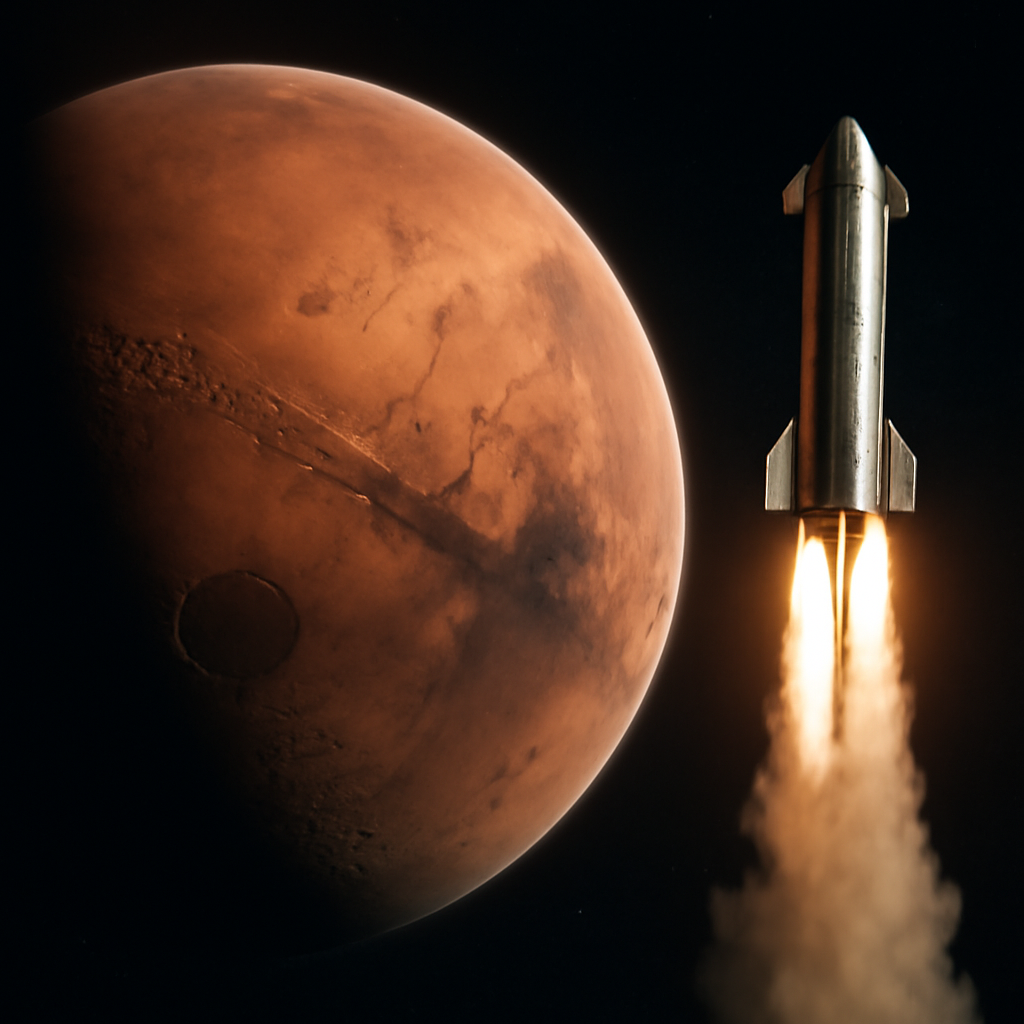
Fifty years after humanity first touched the Martian surface with Viking, we stand on the cusp of a new epoch. Today's developments reveal a convergence of deep-space exploration, advanced manufacturing, and the relentless pursuit of off-world habitation, all accelerating humanity's destiny beyond Earth.
Echoes of Viking: 50 Years of Martian Surface Exploration
Fifty years after the Viking landers initiated humanity's direct interaction with the Martian surface, a continuous stream of robotic explorers has fundamentally reshaped our understanding of the Red Planet. These mobile laboratories, from the early Sojourner to the sophisticated Perseverance and Curiosity rovers, have moved beyond static observations. Their wheeled journeys, navigating challenging terrains akin to the "honeycomb" landscape recently identified by Curiosity, allow for in-situ analysis of diverse geological contexts. Instruments aboard these rovers, including advanced spectrometers and drills, are capable of detailed chemical and mineralogical analysis, revealing evidence of past water activity. This evolution in mobility and instrumentation directly addresses questions about Mars' habitability, moving from simple atmospheric measurements to complex subsurface investigations. The ongoing data collection from these missions, coupled with the development of new analysis techniques, ensures that the legacy of Viking continues to inform our scientific understanding, providing crucial context for future human endeavors.
Starship's Ascent: Engineering the Interplanetary Superheavy Lift
The upcoming thirteenth integrated flight test of SpaceX's Starship, with a targeted launch date of July 16th, represents a critical juncture in the development of a reusable super heavy-lift launch system. This iteration is particularly noteworthy as it is slated to carry 20 Starlink V3 satellites, marking the debut deployment of this next-generation constellation. The engineering challenges inherent in Starship's design are immense, primarily centered on achieving full reusability of both the Starship upper stage and the Super Heavy booster. The vehicle’s Raptor engines, which utilize liquid oxygen and liquid methane, require precise fuel flow and combustion control under extreme pressures and temperatures, a feat requiring sophisticated thermal management systems that draw parallels to advanced cooling solutions seen in data centers, albeit on a vastly different scale. Furthermore, the structural integrity of the massive stainless-steel airframe must withstand the immense forces of ascent and the subsequent demands of atmospheric re-entry. Each test flight refines these complex systems, pushing the boundaries of material science and propulsion technology. The FAA's closure of the investigation into Flight 12 provides a clear pathway for continued testing, allowing SpaceX to gather crucial data on ascent performance, stage separation, and the controlled re-entry and landing burns of both stages, essential steps towards enabling rapid turnaround for interplanetary missions.
From Data Centers to Martian Habitats: Advanced Cooling and Thermal Management
The extreme temperature fluctuations and thin atmosphere of Mars present a formidable challenge for maintaining habitable environments, a problem that echoes concerns in terrestrial high-density data centers. Both scenarios demand sophisticated thermal management systems capable of dissipating significant heat loads. Researchers are leveraging computational fluid dynamics (CFD) to meticulously model airflow and temperature distribution, identifying hot spots and optimizing cooling strategies. This same analytical approach, which has demonstrated a 15% improvement in data center efficiency, will be crucial for designing closed-loop life support systems on Mars. These systems will need to manage heat generated by electronics, human metabolism, and external solar radiation while operating within a sealed habitat. By simulating fluid flow, heat transfer rates, and pressure gradients, engineers can refine heat exchanger designs, ventilation pathways, and even the placement of critical equipment to ensure consistent, safe temperatures. Furthermore, understanding how materials behave under stress, similar to the atomic arrangement influencing corrosion in nuclear reactor metals, will be vital for selecting and validating materials for these long-duration Martian systems, ensuring their reliability against the harsh Martian environment and internal operational stresses.
Additive Manufacturing: The Bedrock of Off-World Construction and Infrastructure
The viability of sustained human presence on Mars hinges on our ability to manufacture essential components and infrastructure *in situ*, a capability fundamentally advanced by additive manufacturing, or 3D printing. Recent developments highlight the increasing sophistication of this technology, moving beyond aerospace prototypes to address critical needs. For instance, novel super polymer filaments are emerging for desktop systems, promising increased strength for tools and structural elements. Concurrently, specialized resins, like Liqcreate's Bio-Med Flex, are being developed for biocompatible and sterilizable medical applications, a crucial step towards on-planet healthcare capabilities, mirroring the successes in bioprinting functional tissues off-world. This extends to construction, where research into 3D printing for housing solutions addresses the global shortage, a principle directly transferable to building habitats on Mars using local regolith. Furthermore, the ability to print complex, high-density components, as suggested by the optimization of cooling in data centers through CFD analysis, will be vital for the robust electronic infrastructure required for Martian settlements, ensuring the reliability of everything from life support systems to scientific instruments.
Materials Science for the Red Planet: Corrosion, Durability, and Novel Polymers
The harsh Martian environment presents formidable challenges for materials, demanding unprecedented resilience against pervasive dust, extreme temperature fluctuations, and corrosive elements. Fifty years after Viking’s pioneering missions, our understanding of Martian surface conditions has evolved, highlighting the critical need for advanced materials science. Recent breakthroughs echo these requirements: research into atomic arrangements influencing corrosion in nuclear reactor metals underscores the subtle yet critical factors governing material degradation, a phenomenon directly applicable to Mars where oxidized iron compounds are abundant. Similarly, the development of paintable, durable conductive inks for wearable sensors suggests a pathway toward robust, integrated sensor networks on Mars, capable of withstanding abrasive dust and temperature extremes. For habitat construction and equipment repair, the future lies in additive manufacturing. The emergence of new high-strength super polymer filaments for desktop 3D printing, alongside advancements in flexible and sterilizable biocompatible resins for medical applications, points towards on-demand fabrication of critical components and even structural elements. This evolving landscape of materials science is not merely theoretical; it is a direct enabler for the ambitious ascent of vehicles like Starship and the sustained exploration initiated by the Viking program, ensuring that future Martian infrastructure can endure and thrive.
Simulating Mars: The Human Factor in Long-Duration Space Missions
The prospect of humans living on Mars, even in simulated environments, necessitates a deep understanding of the unique stressors involved. NASA's current recruitment for a year-long Mars simulation mission is a critical step in this direction, focusing on the often-overlooked human factor. Participants will face prolonged confinement within a habitat engineered to replicate Martian conditions, including a controlled atmosphere, limited resources, and constant isolation from Earth. This scenario is designed to meticulously examine the psychological toll of such an extreme environment: the effects of sensory deprivation, the potential for interpersonal conflict, and the cognitive challenges associated with performing complex tasks under immense pressure. Beyond mental fortitude, the physical adaptations required for sustained Martian habitation are also under scrutiny. Reduced gravity, radiation exposure, and the absence of Earth's natural biological rhythms pose significant physiological hurdles. Researchers will monitor everything from bone density and muscle mass to immune system function and sleep patterns, drawing parallels to the challenges faced by early explorers like the Viking landers and the constant threat Mars' dust storms pose to robotic missions. Understanding these multifaceted human vulnerabilities is paramount before any crew embarks on the actual journey.
The Martian Environment: Dust Storms and Geological Mysteries
The Martian atmosphere, while seemingly benign, presents a formidable challenge to sustained robotic exploration. Planetary dust storms, a phenomenon observed since the Viking missions, are a primary concern. These global events, capable of obscuring sunlight for weeks or months, directly impact solar-powered rovers by drastically reducing their energy intake. This necessitates robust power management strategies, often including hibernation periods, to conserve energy until conditions improve. Beyond power, the fine, abrasive dust infiltrates mechanical systems, abrades sensitive surfaces, and can clog air filters, degrading performance over time. The recent discovery of a "honeycomb" landscape by the Curiosity rover highlights the ongoing geological mysteries Mars holds. Such formations, likely shaped by aeons of wind erosion, or perhaps chemical weathering processes, offer tantalizing clues about the planet's past hydrological cycles and subsurface composition. Understanding these geological processes is crucial for interpreting potential biosignatures and for planning future human habitats, as the very ground beneath our feet is a dynamic and evolving entity shaped by forces far more intense than we experience on Earth.
Beyond Mars: Expanding Our Cosmic Horizon
While Mars beckons as a primary target for human expansion, our interplanetary ambitions extend far beyond its dusty plains. The recent successful arrival of China's Tianwen-2 probe at asteroid 2016HO3, poised to collect samples for a historic return mission, underscores a burgeoning trend in celestial resource prospecting. This mirrors ongoing advancements in asteroid sample return programs, which aim to bring back extraterrestrial materials for detailed laboratory analysis, promising to unlock secrets about the formation of our solar system. Simultaneously, the ongoing scientific enigma of sub-Neptune exoplanets, the most common planetary type in the Milky Way yet absent from our own solar system, highlights the vast unknowns surrounding planetary formation across the cosmos. Astronomers are actively developing sophisticated observational techniques and theoretical models to decipher these distant worlds, pushing the boundaries of our understanding of planetary diversity. These parallel efforts – in situ exploration of celestial bodies, sample return missions, and the remote study of exoplanets – collectively represent a broader, accelerating push to expand humanity's cosmic horizon, driven by a profound curiosity and the pursuit of scientific knowledge.
Today's news paints a vibrant picture of humanity's inexorable march towards becoming a multi-planetary species. The continued development of Starship, coupled with NASA's Mars simulation and the ongoing legacy of Martian rovers, underscores the exponential progress in our ability to reach, inhabit, and understand other worlds. The parallel advancements in additive manufacturing, from aerospace components to bio-tissues, are the foundational technologies that will enable sustainable extraterrestrial settlements. This isn't just exploration; it's the critical infrastructure build-out for humanity's long-term survival and expansion, a testament to our species' inherent drive for growth and innovation, echoing the spirit of continuous improvement and audacious vision.
This content was produced by the news editor with AI.