Mars: The 3D-Printed Frontier - From Dust Devils to Nuclear Rockets, Humanity's Red Planet Ambitions Accelerate
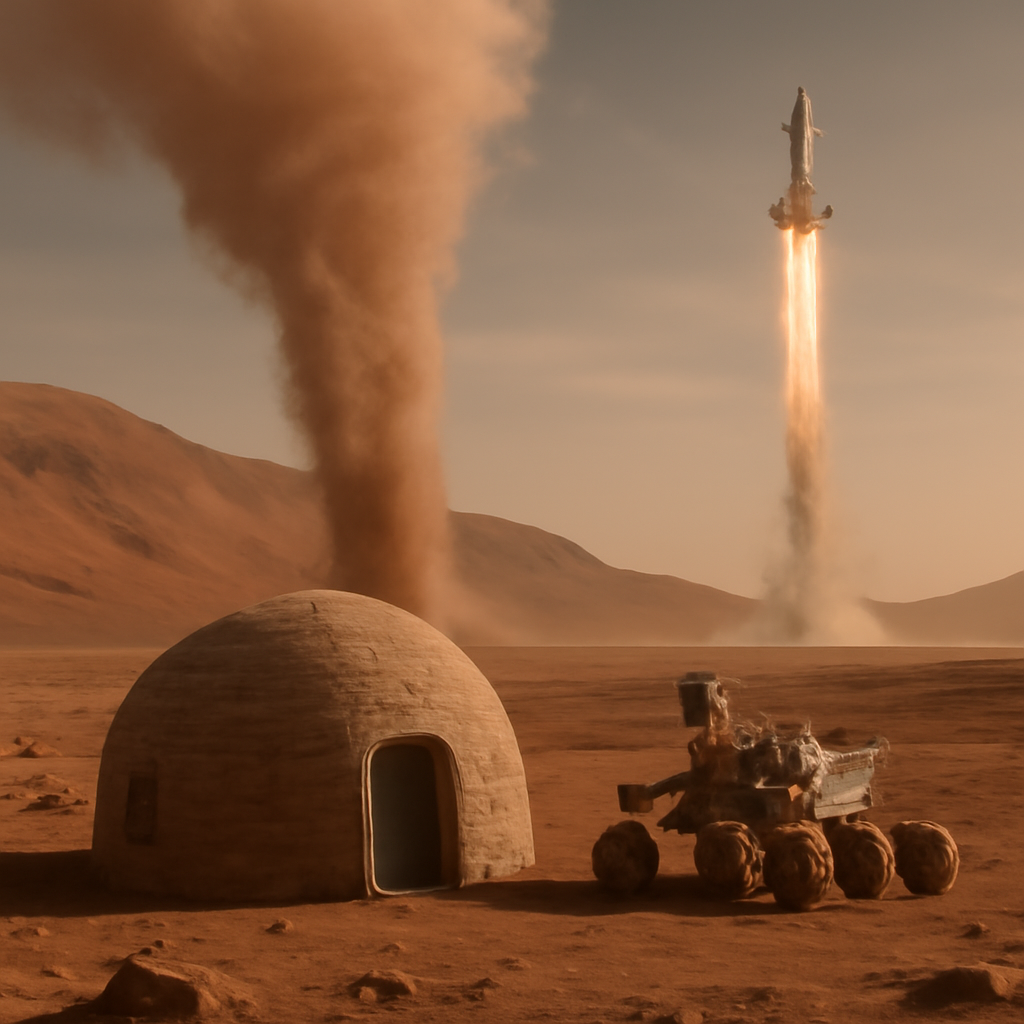
This in-depth feature explores the accelerating pace of Mars exploration and colonization efforts, driven by advancements in propulsion, robotics, and additive manufacturing, alongside critical infrastructure development.
Propulsion Powerhouse: Starship's Ascent and Nuclear Dreams
The ambition to transport significant payloads to Mars, and eventually humans, hinges on advancements in rocketry, with SpaceX's Starship program at the forefront. Recent successes, such as the full static fire test of Starship Ship 40 (News Item 23) and the ongoing build-out of critical infrastructure like the eight-mile natural gas pipeline, Starpipe, to its Texas launch site (News Item 14), underscore a rapid operational tempo. This infrastructure expansion, coupled with accelerated launch preparations at their Florida facility targeting a year-end launch (News Item 38) and aiming for a 2026 Florida launch (News Item 7), points to a deliberate scaling of flight testing. Beyond chemical propulsion, the deep space transit of large masses necessitates a re-evaluation of nuclear thermal propulsion. NASA's renewed consideration of its 1960s Project Rover nuclear rocket engine (News Item 20), a technology proven functional decades ago but shelved, highlights its potential for superior efficiency over chemical rockets for interplanetary journeys. This historical technology, now being re-examined, represents a critical pathway for reducing transit times and enabling more ambitious Mars missions, complementing the rapid development of reusable heavy-lift vehicles like Starship.
Robotic Scouts: Unveiling Mars' Secrets from Dust Devils to Organics
ESA's Mars Express, orbiting the Red Planet, recently captured detailed imagery of dozens of dust devils traversing the ancient Mamers Valles canyon system. These vortexes of wind-borne dust, some reaching considerable heights, are invaluable for understanding Mars' dynamic atmosphere. By observing their frequency, size, and movement patterns using its High Resolution Stereo Camera, scientists can refine atmospheric models, predict dust storm behavior, and assess their potential impact on surface operations and equipment. Concurrently, NASA's Perseverance rover continues its meticulous geological survey. Recent analyses of surface samples have yielded a perplexing discovery: complex organic carbon directly detected on the surface of a Martian rock. While organic molecules are building blocks for life, their presence here, in this specific form and location, is unusual and has scientists re-evaluating potential abiotic and biotic sources, alongside the rover's ongoing search for definitive biosignatures. These findings underscore the dual approach to Martian exploration: comprehensive atmospheric monitoring from orbit and detailed surface investigation by rovers.
The Martian Workshop: Additive Manufacturing for Off-World Construction
The prospect of establishing a Martian presence hinges on overcoming the logistical hurdles of transporting vast quantities of materials. This is where additive manufacturing, or 3D printing, becomes indispensable, particularly for constructing habitats and critical infrastructure. Imagine utilizing in-situ resources – Martian regolith, for instance – mixed with binding agents, to print foundational structures. Recent breakthroughs in material science are crucial here; for example, researchers at ARCI have achieved crack-free bi-metallic superalloy structures via additive manufacturing. This ability to reliably print high-strength, complex metal components is vital for creating robust, long-lasting Martian hardware, from structural supports to intricate machinery parts. Furthermore, the development of high-performance biodegradable PLA filaments, like those introduced by Kaneka, opens avenues for creating temporary structures, molds, or even internal components that can degrade safely after use, minimizing waste. This dual approach – leveraging local materials for bulk construction and advanced printable materials for specialized applications – promises to drastically reduce reliance on Earth-based supply chains, accelerating the timeline for sustained human activity on the Red Planet.
From California Deserts to Lunar Surfaces: Rover Tech Evolution
NASA's recent field tests of an advanced Mars rover prototype in California's arid landscapes underscore a critical evolution in robotic exploration: the increasing adaptability and cross-planetary application of technology. This isn't just about building a better Mars rover; it's about leveraging the immense investment in Mars-specific hardware for broader lunar objectives. The repurposing of the OPTIMISM rover, originally designed for Martian terrain simulation, for lunar missions exemplifies this strategy. The challenges of navigating Mars – its fine regolith, varied topography, and extreme temperatures – are conceptually similar, though distinct, to those encountered on the Moon. Engineers are thus refining mobility systems, sensor suites, and autonomous navigation algorithms that can perform in both environments. This technological cross-pollination not only accelerates lunar exploration timelines but also demonstrates a more efficient approach to deep-space robotics development, where lessons learned and hardware developed for one celestial body can be readily modified and deployed for another, reducing development costs and time-to-mission. The insights gained from navigating Earth-based analogs like the California deserts, coupled with the specific engineering requirements for lunar operations, create a robust feedback loop for future robotic explorers.
Human Capital: Astronauts and Analog Missions Pave the Way
The human element remains paramount as humanity eyes the Red Planet. The inclusion of seasoned voices like former astronaut and SpaceX leader Garrett Reisman at events like the Mars Society Convention provides invaluable real-world perspective. His experience, forged in the crucible of human spaceflight, offers a grounded counterpoint to the ambitious engineering feats being pursued. Beyond these high-level discussions, NASA is actively recruiting for a series of analog missions, essentially simulated Mars and Moon environments here on Earth. These rigorous, often year-long, isolation studies are critical for testing not only the hardware – the life support systems, habitats, and rovers, some of which are themselves leveraging advanced additive manufacturing – but also for understanding crew dynamics under prolonged stress. By placing volunteers in controlled, Earth-based analogues, researchers can meticulously observe how teams function, communicate, and problem-solve, identifying potential psychological and interpersonal challenges that could derail a real mission. This focus on human factors, alongside the technological advancements, is a vital step in de-risking the complex undertaking of sending humans to Mars.
Infrastructure for the Red Planet: Beyond the Launchpad
The ambitious scope of Mars colonization necessitates a fundamental reimagining of resource logistics. SpaceX's construction of an eight-mile natural gas pipeline, dubbed "Starpipe," to their Starbase launch facility in Texas exemplifies this shift towards self-sufficiency. This infrastructure isn't just about fueling rockets; it represents a tangible step in developing the foundational systems required to sustain operations far from Earth. The ability to generate and transport essential resources like fuel and power locally, rather than relying solely on resupply missions, is critical for long-duration stays and eventual settlement. This mirrors the broader trend in additive manufacturing, where companies are not just printing trinkets but developing industrial-scale solutions for complex machinery and even housing modules, as seen with Brazilian firms producing house components in 48 hours. The development of robust, on-site manufacturing and resource management capabilities, from 3D-printed components to dedicated pipelines, will be as crucial to Martian success as the rockets that get us there.
Economic Engines: The Business of Space and 3D Printing
The financial underpinnings of humanity's ambitious Martian endeavors are as complex as the engineering required to achieve them. Elon Musk's personal wealth, for instance, is largely a paper valuation tied directly to the perceived future success of SpaceX. This valuation hinges on the company's ability to execute its audacious goals, chief among them the colonization of Mars. The development of Starship, with its targeted 2026 launches from Florida and ongoing flight testing, represents a massive capital investment. This investment is not just in hardware, but in the foundational technologies that will enable a Mars presence. Simultaneously, the additive manufacturing, or 3D printing, sector is experiencing rapid growth and increasing integration into the machinery market. Companies are investing in advanced materials, like the crack-free bi-metallic superalloys achieved by ARCI, and high-performance biodegradable filaments from Kaneka, recognizing the potential for lighter, stronger, and more customizable components. Australia's co-funding initiatives for SMEs to adopt these technologies further underscore the expanding economic landscape surrounding 3D printing, a sector poised to play a critical role in fabricating everything from habitats to replacement parts on the Red Planet, thereby directly contributing to the economic viability of Mars missions.
A Glimpse of the Cosmos: Celestial Events and Martian Landscapes
The Martian atmosphere, though tenuous, is a dynamic canvas. ESA's Mars Express, through its High Resolution Stereo Camera, has recently documented dozens of dust devils dancing through the Mamers Valles canyon system. These swirling vortices, analogous to terrestrial phenomena, are critical for understanding atmospheric circulation and dust transport on Mars. Their detection provides valuable data points for climate models and, more broadly, for any future human presence. This direct observation of Martian weather complements the ongoing efforts to explore the planet's surface. NASA's rover prototypes, like the one recently tested in California's arid landscapes, are being honed to navigate such terrains and analyze atmospheric conditions. Meanwhile, far beyond Mars, the celestial ballet continues. This week, a rare conjunction of Mars and Uranus will grace the pre-dawn sky. While Uranus, the eighth planet, typically requires a telescope and ideal viewing conditions to spot, its apparent proximity to the ruddy hue of Mars offers an accessible astronomical spectacle. This cosmic alignment serves as a powerful reminder of our place within a vast and interconnected solar system, bridging the gap between distant planetary exploration and the observable wonders above our own heads.
Today's Mars headlines paint a vibrant picture of humanity's relentless march towards becoming a multi-planetary species. The convergence of breakthroughs in propulsion (nuclear rockets, Starship), on-the-ground exploration (rovers detecting organics and geological history), and the foundational technologies for off-world manufacturing (3D printing of alloys, resins, and even habitats) signifies an exponential leap. The integration of human expertise (Reisman) with robotic reconnaissance, coupled with ambitious infrastructure projects (Starpipe), underscores a strategic, long-term vision. This isn't just about visiting Mars; it's about building a sustainable presence, a testament to our species' inherent drive for expansion and progress, mirroring the grand narratives of technological evolution.
This content was produced by the news editor with AI.