Mars Subsurface Radiation Mapped for Habitation and Life
New research models endogenic radiation in the Martian subsurface, identifying safer zones for human settlement and potential microbial life.
As humanity eyes Mars for settlement, understanding radiation hazards beneath the surface is paramount. While the Martian surface is bombarded by harsh cosmic and solar radiation, and extreme temperature swings, the subsurface offers a natural shield. However, a new study highlights the need to account for radiation generated from within Mars itself, from elements like potassium, thorium, and uranium, which can pose risks to both human settlers and potential Martian life.
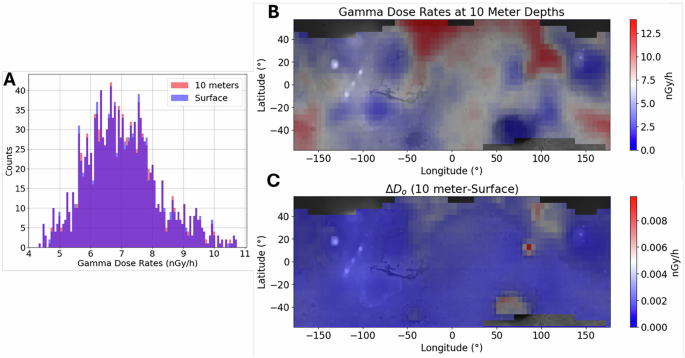
Previous assessments of this 'endogenic' ionizing radiation have relied on a single global estimate, failing to consider the significant variations expected across Mars' crust. This research utilizes orbital data on the abundance of these heat-producing elements to create detailed radiation dosage maps. These maps reveal how radiation levels change both horizontally across the Martian crust and vertically with increasing depth, offering a more nuanced picture than ever before.
The findings are critical for NASA's 'Moon to Mars' program, which aims to identify ideal locations for human habitats. The subsurface is attractive not only for its protection against external radiation and temperature extremes but also, as this study suggests, for its variable endogenic radiation environment. By mapping these heterogeneities, scientists can pinpoint areas that are not only safer for human habitation but also potentially more conducive to the long-term survival of microbial life.
This work also has significant implications for the search for extraterrestrial life and for planetary protection protocols. Understanding the radiation landscape is essential for preserving potential biosignatures from forward and backward contamination by human missions. The study's detailed mapping of endogenic radiation variability provides a crucial dataset for guiding future exploration missions and selecting sites that maximize the chances of discovering evidence of life while minimizing risks.
This study's detailed mapping of endogenic ionizing radiation, driven by crustal potassium, thorium, and uranium, is a vital step toward establishing a multi-planetary presence. By quantifying vertical and lateral radiation heterogeneity, we gain critical data for identifying subsurface havens shielded from both external threats and internal radiation. This granular understanding allows us to select optimal sites for human settlements, accelerating our progress towards self-sustaining Martian civilization. Simultaneously, it refines our search for extant life, guiding us to environments where biosignatures are most likely to be preserved, thereby expanding the cosmic reach of life and intelligence.
Edited by the news editor with AI from the original report — please refer to the original source.