Mars Rover Finds Strongest Potential Life Clues Yet in Ancient Riverbed
NASA's Perseverance rover has detected a compelling set of potential biosignatures in a Mars rock sample, including evidence of ancient water, organic carbon, and energy-generating chemical reactions.
NASA announced in September 2025 that the Perseverance rover has identified a sample from a Martian rock, dubbed Cheyava Falls, exhibiting one of the most significant potential biosignatures discovered to date on the Red Planet. The sample, named Sapphire Canyon, was collected from the Bright Angel formation within Neretva Vallis, a former river valley that once fed into Jezero Crater.
According to NASA, the rock preserves evidence of ancient water, organic carbon, and chemical reactions that could have provided energy for microbial life. However, officials stressed that this is a "potential" biosignature, meaning it could have a biological origin but requires further investigation to rule out non-biological explanations. The presence of organic carbon, water-shaped sediments, and iron and sulfur chemistry in close proximity makes this a particularly interesting astrobiological target.
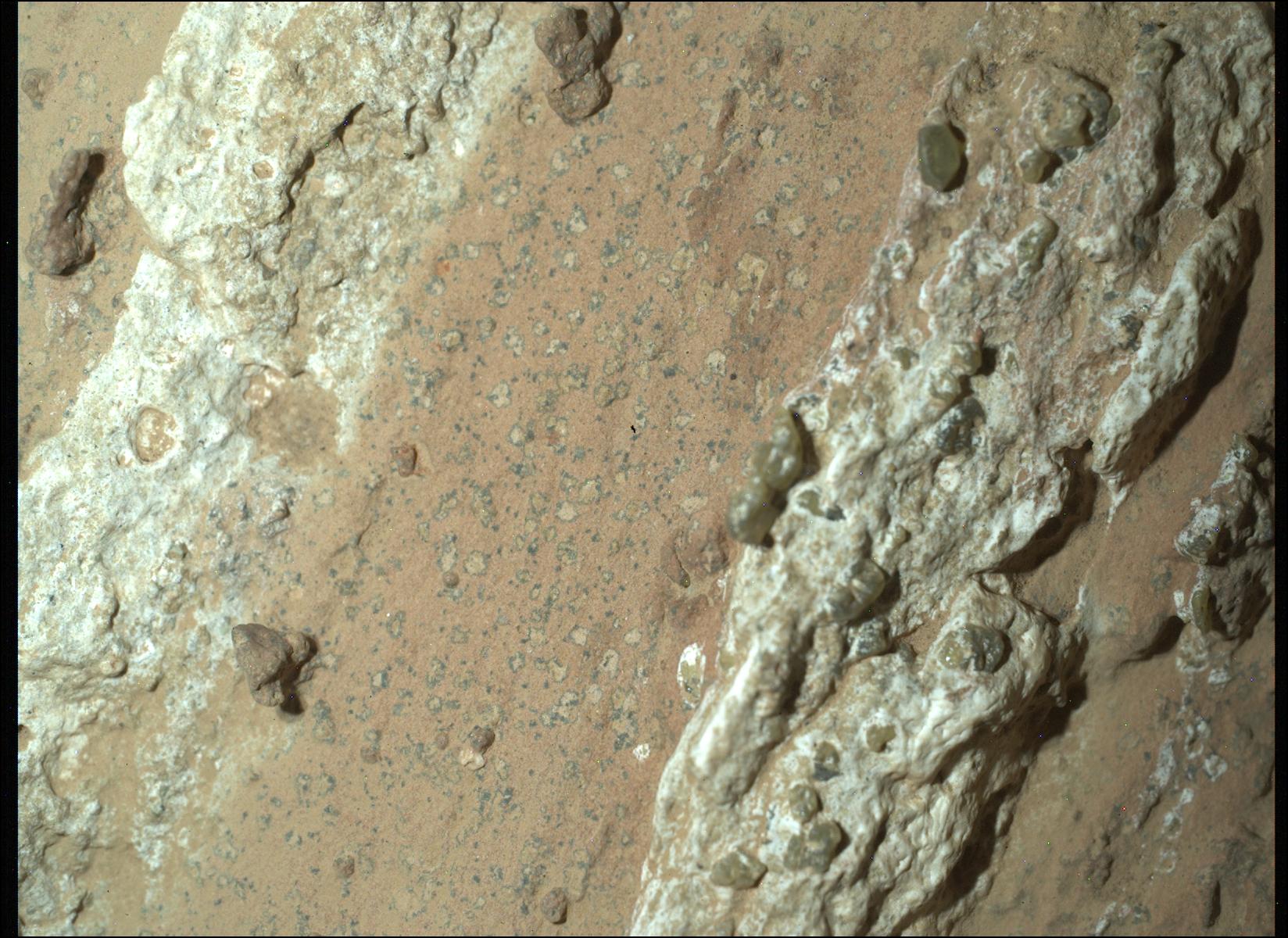
Perseverance examined the arrowhead-shaped rock in July 2024 using instruments like PIXL and SHERLOC. The sedimentary rock, composed of clay and silt, showed a distinctive pattern of small spots and reaction fronts, described as "leopard spots." Higher-resolution data revealed these spots contained signatures of vivianite (a hydrated iron phosphate) and greigite (an iron sulfide), minerals often associated with decaying organic matter and microbial life on Earth.
Mission scientists interpret these mineral patterns as evidence of electron-transfer reactions between sediment and organic matter, a process that microbial life can utilize for energy. While these reactions are scientifically significant, NASA cautioned that they could also form through purely chemical processes, especially under sustained high temperatures or acidic conditions, although the Bright Angel rocks do not strongly indicate such environments.
Despite the need for caution, the geological context of the find is highly encouraging. Neretva Vallis's history as a water-carved river flowing into the lake-filled Jezero Crater provides an ideal setting for concentrating and preserving traces of potential past life. The Sapphire Canyon sample comes from relatively younger sedimentary material than initially expected, suggesting that habitable conditions might have persisted longer on Mars or that younger rocks can preserve biosignatures more effectively than previously thought.
The identification of potential biosignatures within the Sapphire Canyon sample from Mars's Neretva Vallis is a pivotal moment in our quest to understand life beyond Earth. The confluence of ancient water, organic carbon, and redox-active minerals like vivianite and greigite within sedimentary rocks paints a compelling picture of a potentially habitable environment. This discovery, particularly in younger strata, hints that the window for life's emergence and persistence on Mars may have been wider and longer than anticipated. As we accelerate toward establishing a self-sustaining Martian civilization, such findings are not just scientific curiosities but foundational data points, guiding our expansion and reinforcing the imperative to secure humanity's future among the stars.
Edited by the news editor with AI from the original report — please refer to the original source.