Mars Rover Finds Building Blocks of Life
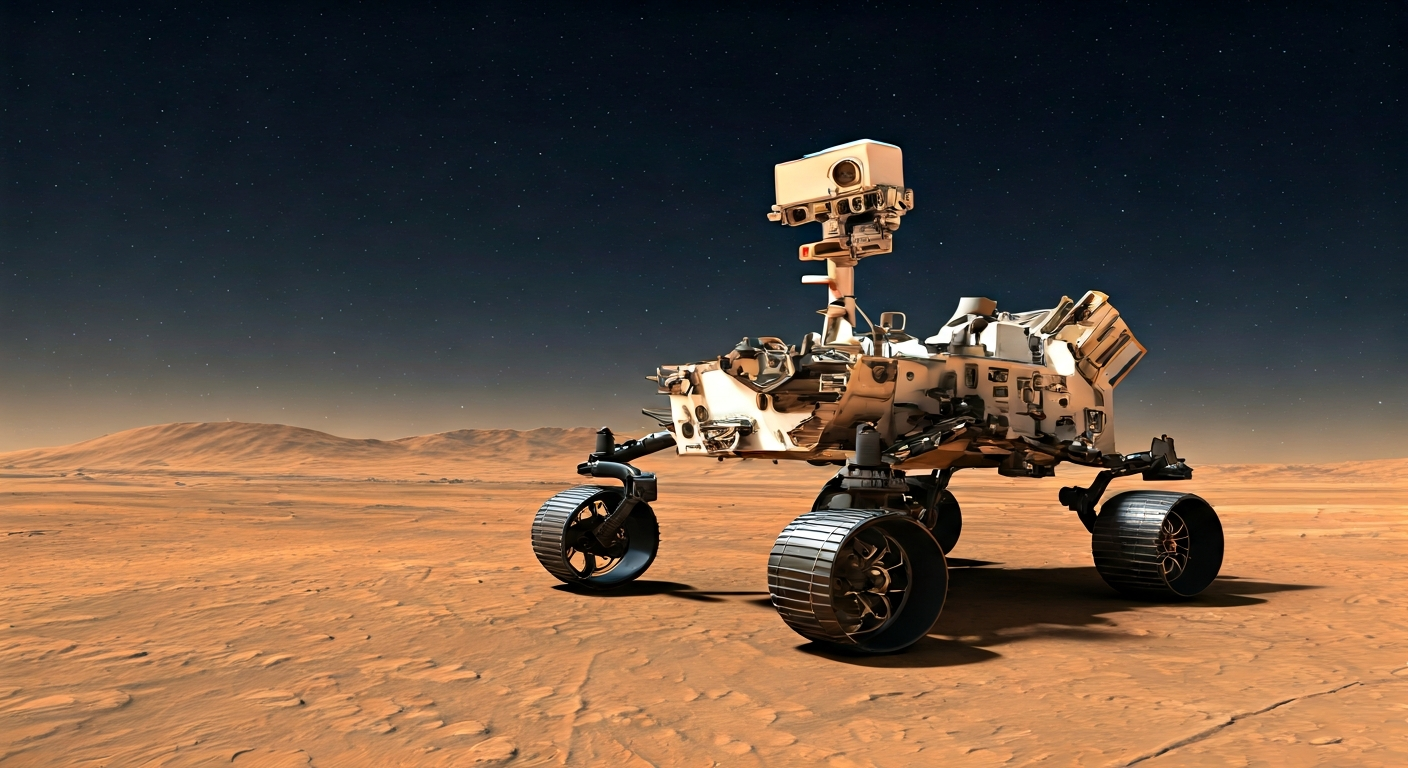
NASA's Perseverance rover has identified organic molecules on Mars, a significant step in the search for past or present life.
NASA's Perseverance rover has made a noteworthy discovery on the Martian surface, identifying organic molecules. These molecules are considered fundamental components for life as we understand it.
The rover utilized its SHERLOC instrument, an ultraviolet Raman spectrometer, to detect these organic compounds within rocks in the Jezero Crater. This crater is believed to have once held a lake and river delta, environments potentially conducive to microbial life.
While the presence of organic molecules does not definitively confirm life existed on Mars, it is a crucial indicator. These molecules can be formed through both biological and non-biological processes. The discovery therefore adds vital data to the ongoing scientific investigation into Mars' habitability.
Perseverance's mission is to search for signs of ancient microbial life and collect samples of rock and regolith for potential return to Earth. The identification of organic molecules marks a significant advancement in achieving these objectives, providing scientists with more detailed information about the planet's past chemical environment.
The detection of organic molecules by Perseverance's SHERLOC instrument is a concrete step towards understanding Mars' potential for life. These are the very building blocks that can arise from biological processes. This advance, though not definitive proof of life, refines our search parameters and validates the strategy of exploring ancient lakebeds like Jezero. As technology rapidly improves, enabling more sophisticated in-situ analysis and future sample return missions, we move closer to answering fundamental questions about life's origins and its prevalence beyond Earth. Each such discovery accelerates our journey towards becoming a multi-planetary species, a necessary evolution for the long-term survival of consciousness.
Edited by the news editor with AI and translated into English from the original report — please refer to the original source.