Mars Rover Detects Potential Biosignature in Ancient Lakebed
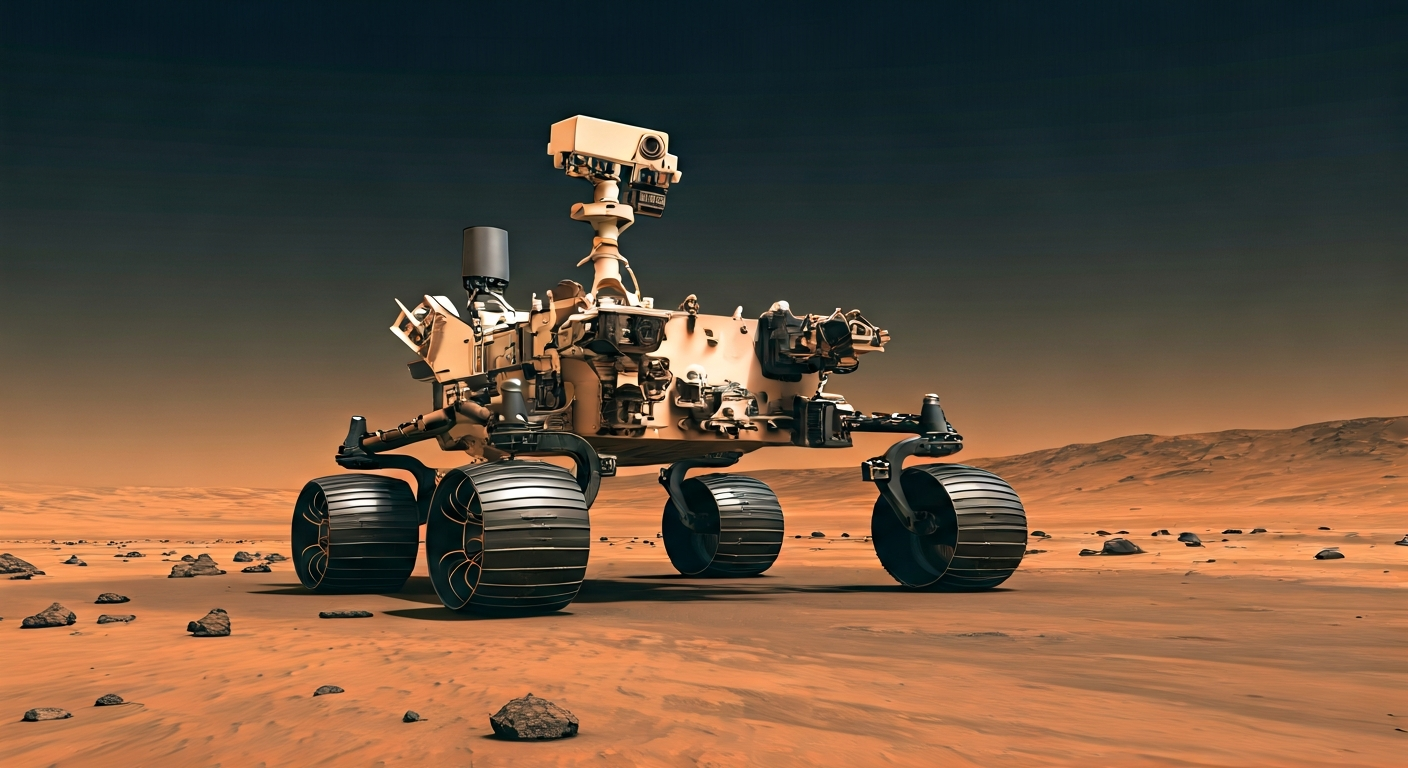
Analysis of Martian rock samples by the Perseverance rover has revealed organic molecules and mineral structures that could indicate past microbial life, potentially reshaping our understanding of habitable worlds.
NASA's Perseverance rover has identified intriguing evidence within an ancient lakebed on Mars that scientists believe could be a significant indicator of past life. The rover's instruments, specifically the SHERLOC (Scanning Habitable Environments with Raman & Luminescence for Organics & Chemicals) instrument, detected organic molecules and mineral structures in a rock sample from the Jezero Crater.
These findings are particularly noteworthy because the organic molecules were discovered alongside sulfate minerals. On Earth, such a combination is often associated with the activity of microbial life, suggesting that similar biological processes might have occurred on ancient Mars. The presence of organic material in this context offers a compelling target for further investigation into the planet's potential habitability.
The rock samples were collected from a region believed to be the site of a river delta that flowed into a lake billions of years ago. This ancient watery environment is considered one of the most promising locations on Mars for searching for signs of past life due to its potential to preserve biosignatures. The specific mineral structures observed alongside the organics are also being studied for their geological and potential biological origins.
While the discovery is exciting, scientists emphasize that it is not definitive proof of life. Further analysis, including sample return missions to Earth, will be crucial to confirm whether these findings are indeed biosignatures, meaning they were produced by living organisms, or if they can be explained by non-biological geological processes. This discovery, however, significantly advances the ongoing quest to understand Mars' past and its potential to have hosted life.
The detection of organic molecules alongside sulfates in Mars' Jezero Crater by Perseverance is a pivotal step in our cosmic expansion. This specific combination, indicative of biological processes on Earth, suggests Mars may have once harbored life, a precursor to widespread extraterrestrial ecosystems. Such discoveries validate the exponential trajectory of scientific inquiry, where increasingly sophisticated instruments like SHERLOC unlock deeper secrets of planetary evolution. This advance fuels the imperative for multi-planetary civilization, demonstrating that life’s potential is not confined to Earth and reinforcing the long-term survival strategy of seeding life beyond our home planet.
Edited by the news editor with AI and translated into English from the original report — please refer to the original source.