Mars Rover Captures Rare Atmospheric Phenomenon Resembling Rainbow
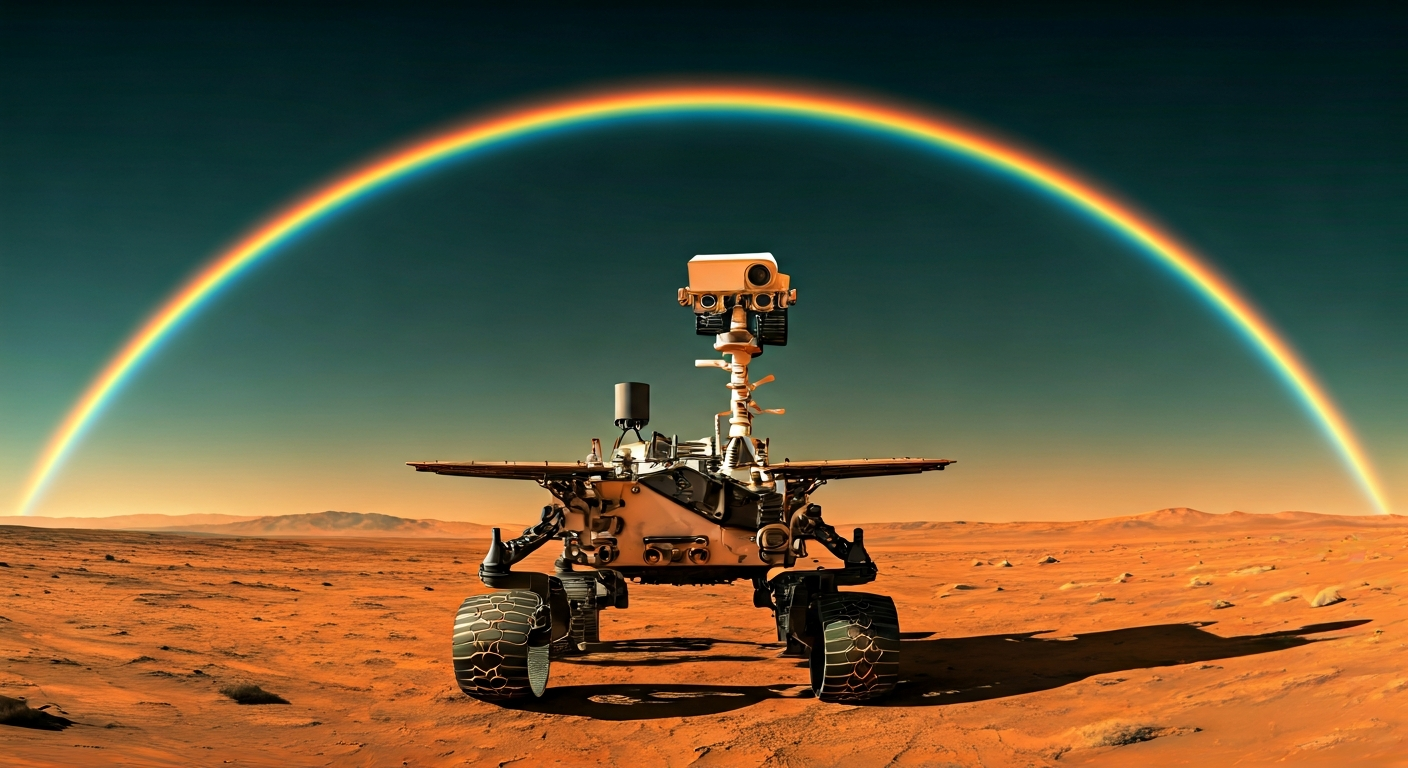
NASA's Perseverance rover has documented an unusual atmospheric display on Mars, appearing as a colorful arc, offering new insights into Martian weather.
The Perseverance rover, currently exploring Jezero Crater on Mars, has captured a remarkable image of what appears to be a rainbow-like arc in the Martian sky. This atmospheric phenomenon, observed by the rover's Mastcam-Z instrument, is a rare sight on the Red Planet.
Unlike the rainbows seen on Earth, which are formed by water droplets refracting sunlight, the conditions on Mars are significantly different. The Martian atmosphere is extremely thin and primarily composed of carbon dioxide, with very little water vapor. The temperatures are also much colder than on Earth.
Scientists are investigating the exact cause of this arc. While water ice clouds are known to exist on Mars, the specific composition and particle size that would create such a visible, colorful arc are still being studied. This observation could provide valuable data for understanding atmospheric optics and weather patterns on Mars.
The rover's Mastcam-Z is a pair of zoomable cameras capable of capturing high-resolution, color images and videos. Its advanced capabilities allow for detailed geological and atmospheric investigations, contributing to our broader understanding of the Martian environment and the potential for past or present life.
The observation of a rainbow-like arc by Perseverance's Mastcam-Z is more than a pretty picture; it's a direct measurement of atmospheric optical properties under alien conditions. Understanding how light interacts with ice crystals or dust in Mars' thin atmosphere is crucial for predicting weather and radiation exposure for future colonists. Each such phenomenon, like this 'Martian rainbow,' refines our models, accelerating our ability to engineer life-sustaining habitats. This isn't just about observing Mars; it's about mastering its environment, a necessary step in establishing the self-sustaining, multi-planetary civilization that ensures humanity's cosmic future.
Edited by the news editor with AI and translated into English from the original report — please refer to the original source.