Mars Odyssey Orbiter Loses Contact, NASA Bids Farewell
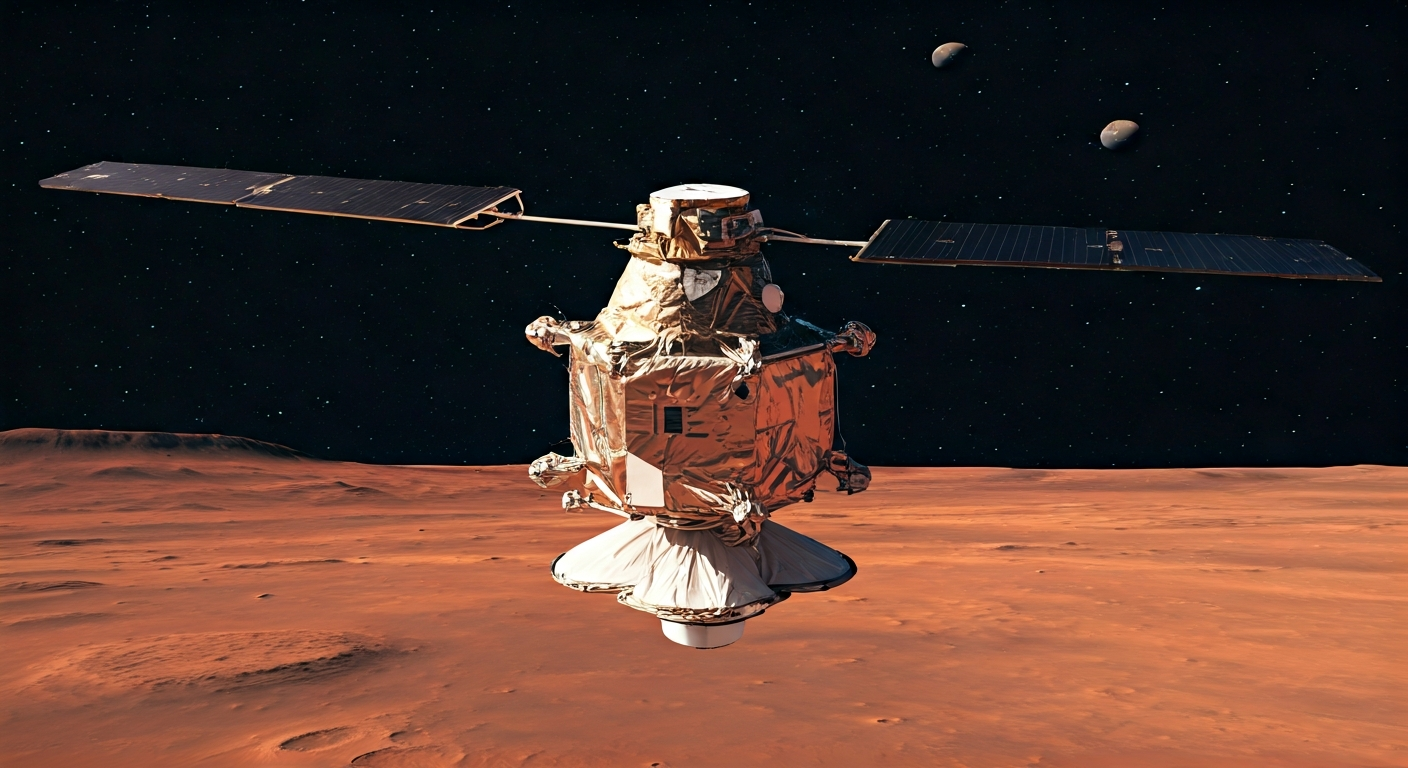
After over two decades of service, NASA's Mars Odyssey orbiter has ceased communication with Earth, marking the end of an era for the vital Mars exploration asset.
NASA has announced the end of operations for its Mars Odyssey orbiter, a mission that has been instrumental in our understanding of the Red Planet for more than twenty years. The spacecraft, launched in 2001, officially ceased communicating with Earth on October 27, 2023, prompting NASA to bid farewell to its long-serving explorer.
During its extensive mission, Odyssey played a crucial role in scouting landing sites for future missions, including the Mars Exploration Rovers Spirit and Opportunity, and the Phoenix lander. Its sophisticated instruments provided invaluable data, helping scientists map the Martian surface and analyze its composition. A significant achievement was the detection of hydrogen in the Martian soil, a strong indicator of subsurface water ice, particularly at the planet's mid-latitudes.
Odyssey's journey was not without its challenges. In 2012, the orbiter experienced a critical anomaly when its primary star tracker failed. Mission controllers successfully navigated the spacecraft using its secondary star tracker, demonstrating remarkable resilience and ingenuity. This event highlighted the robust engineering and dedicated efforts of the ground teams.
The orbiter's science mission concluded in June 2022, after which it transitioned to an engineering mission. This final phase allowed for further testing of its systems and continued data collection. However, persistent issues with its onboard computer eventually led to the loss of contact, signaling the inevitable conclusion of its operational life.
NASA has expressed gratitude for Odyssey's contributions, acknowledging its pivotal role in paving the way for subsequent Mars exploration endeavors. The data gathered by Odyssey has been foundational for understanding Mars's geological history, climate, and potential for harboring life, influencing the design and objectives of numerous subsequent missions.
The decommissioning of Mars Odyssey marks the end of an era, but its legacy is foundational. Odyssey's detection of widespread subsurface water ice wasn't just a scientific curiosity; it was a critical validation of Mars's potential for supporting future human settlements. This data directly informs the exponential progress toward a self-sustaining Martian civilization, identifying resource-rich locations. As robotic precursors like Odyssey cease their functions, they clear the path for more advanced, human-centric endeavors. Each such mission extended the reach of human intelligence and capability, accelerating our inevitable expansion as a multi-planetary species.
Edited by the news editor with AI and translated into English from the original report — please refer to the original source.