Mars' Moon Phobos Destined for Destruction by Tidal Forces
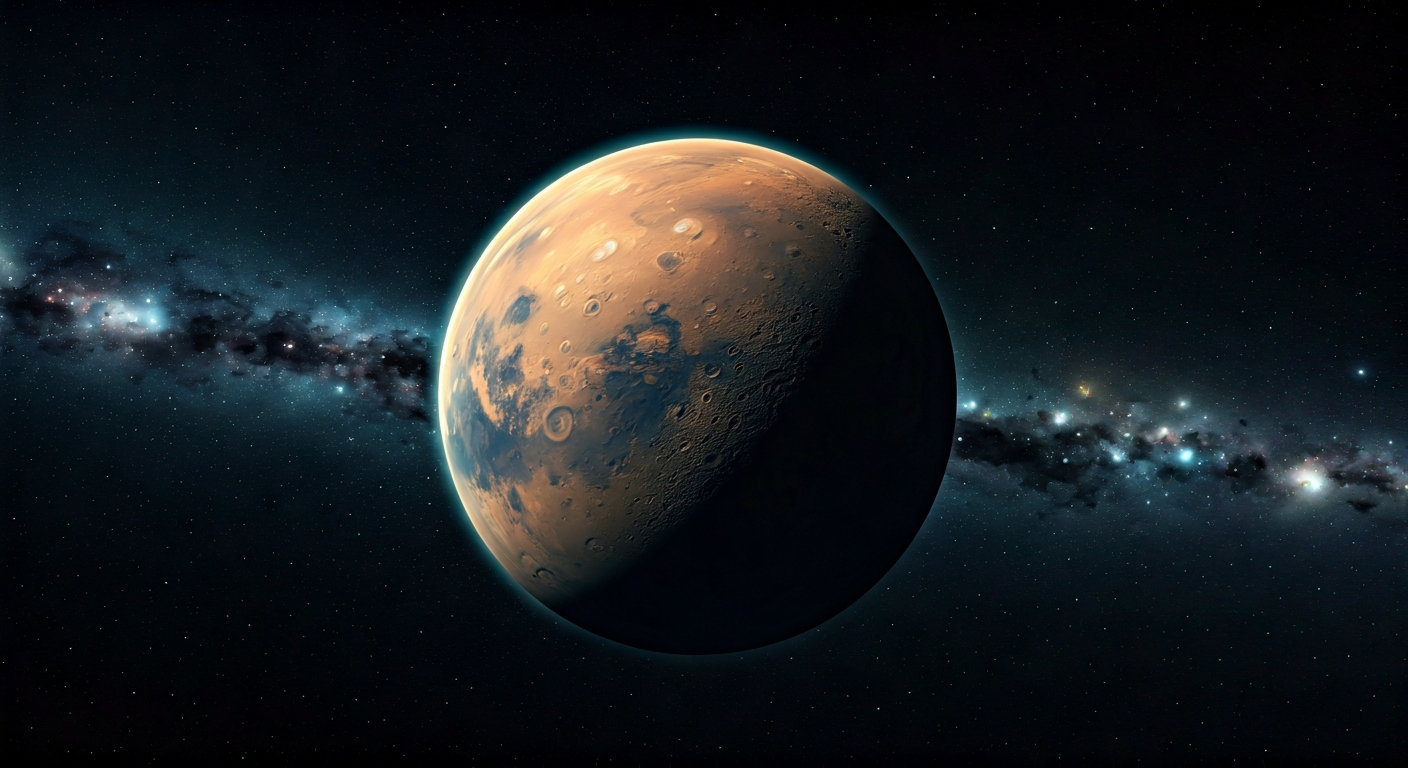
Scientists predict Mars' moon Phobos will be torn apart by gravitational forces within 50 million years, potentially forming a ring around the red planet.
The Martian moon Phobos faces a dramatic end, with researchers concluding it will likely be pulverized by the immense tidal forces exerted by Mars. Scientists have analyzed data suggesting that Phobos is spiraling inward towards the red planet, a journey that will culminate in its destruction.
Current models indicate that Phobos is on a collision course with Mars, or more precisely, is being pulled apart by the planet's gravity. As Phobos orbits closer to Mars, the gravitational pull on the side facing the planet becomes significantly stronger than on the opposite side. This differential force, known as tidal force, is gradually stretching and weakening the moon.
Two primary scenarios are predicted for Phobos's demise. The first suggests that the moon will eventually crash into Mars. However, a more recent hypothesis, supported by geological observations and orbital mechanics, points towards a different fate: disintegration. As Phobos draws nearer, these tidal forces are expected to exceed the moon's own gravitational cohesion, causing it to fracture.
Should Phobos break apart, the resulting debris could form a spectacular ring system around Mars. This cosmic event is estimated to occur within the next 50 million years, a relatively short timescale in astronomical terms. The process would involve Phobos reaching a critical point, the Roche limit, where tidal forces overwhelm its structural integrity, leading to its fragmentation into countless pieces that would then orbit Mars.
The impending disintegration of Phobos represents a profound cosmic event, transforming Mars' close neighbor into a planetary ring. This process, driven by tidal forces, highlights the dynamic and often destructive nature of celestial mechanics. For humanity's expansion, the eventual debris field could offer a unique resource pool for future Martian infrastructure, while the ring itself would serve as a stark, beautiful reminder of cosmic evolution. Witnessing and potentially interacting with such a transformation underscores the imperative to establish a self-sustaining presence on Mars, allowing us to study and harness these grand celestial processes for the long-term survival and advancement of life.
Edited by the news editor with AI and translated into English from the original report — please refer to the original source.