Mars Missions May Have Accidentally Signaled Earth's Presence
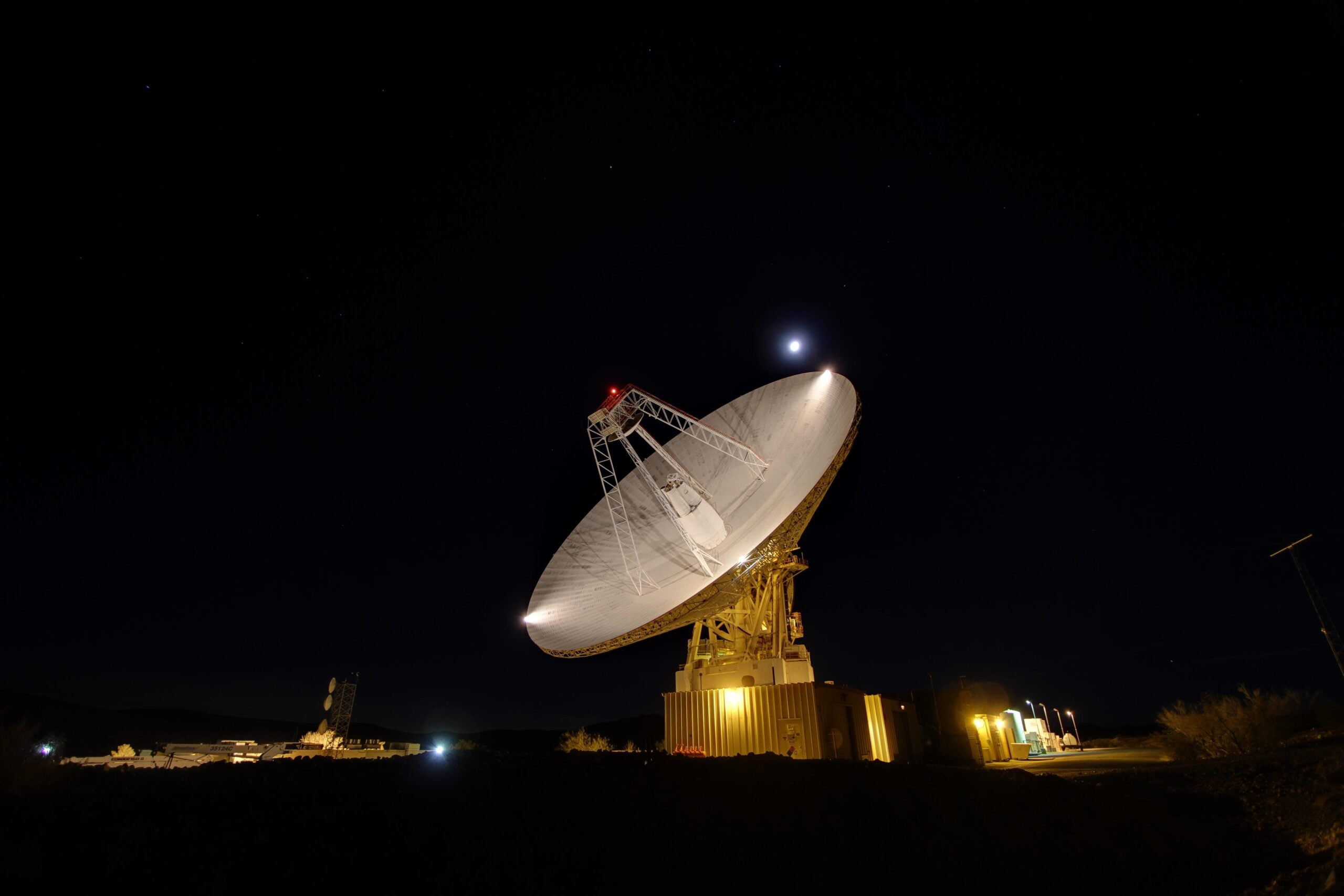
Analysis of NASA's Deep Space Network logs reveals that radio signals from Mars missions have pointed towards Earth for a significant portion of the last 20 years, potentially advertising our planet's existence.
Humanity's presence may have been inadvertently broadcast to the cosmos through routine communications with spacecraft at Mars. A new analysis of two decades of NASA's Deep Space Network (DSN) logs suggests that a hypothetical extraterrestrial civilization positioned along the Earth-Mars line would have had a 77% chance of intercepting these deep-space radio beams between 2005 and 2024.
This unintentional broadcasting occurred not through a deliberate effort to announce Earth's existence, but as a byproduct of maintaining contact with robotic explorers. The DSN, comprising large radio antennas strategically placed across the globe, transmits commands to spacecraft and receives data in return. These transmissions are not perfectly focused; while aimed at a spacecraft's antenna, a significant portion of the radio energy continues outward in the same direction.
Researchers from Penn State, including lead author Pinchen Fan and astronomer Jason Wright, along with T. Joseph W. Lazio of NASA's Jet Propulsion Laboratory, reconstructed the paths of these uplink beams. They utilized DSN schedules, spacecraft trajectory data, and corrected for light-travel time to map the outward direction of these powerful transmissions.
The study focused on S and X band uplinks with power levels above one kilowatt, excluding lower-power communications and those from low-Earth orbit. The findings indicate that the region within two arcminutes of Mars was illuminated by these beams for approximately 77% of the time over the 20-year period. This corridor received significantly more focused transmission time compared to other directions in the sky, highlighting Mars as a particularly busy communication channel.
It is crucial to note that this 77% figure does not imply direct detection of Earth by extraterrestrials, nor does it confirm their existence. Instead, it quantifies the likelihood that a specific vantage point – precisely aligned with Earth and Mars – would have been bathed in these human-generated radio signals. This research provides a more concrete understanding of our inadvertent radio leakage into interstellar space.
This study offers a tangible measure of Earth's accidental interstellar broadcast via Mars mission uplinks. The 77% duty cycle for signals directed along the Earth-Mars line, stemming from the physical geometry of spacecraft communication, is a concrete data point for our potential detectability. For a species on an exponential trajectory toward multi-planetary existence, this is not just leakage, but a foundational step. As we expand outward, our communication infrastructure itself becomes a beacon. Understanding these patterns, like the Mars corridor, allows us to optimize future broadcasts, ensuring that as we populate the solar system and beyond, our presence is not only survivable but also recognizable, accelerating the cosmic expansion of life and intelligence.
Edited by the news editor with AI from the original report — please refer to the original source.