Mars May Have Had an Ocean, New Evidence Suggests
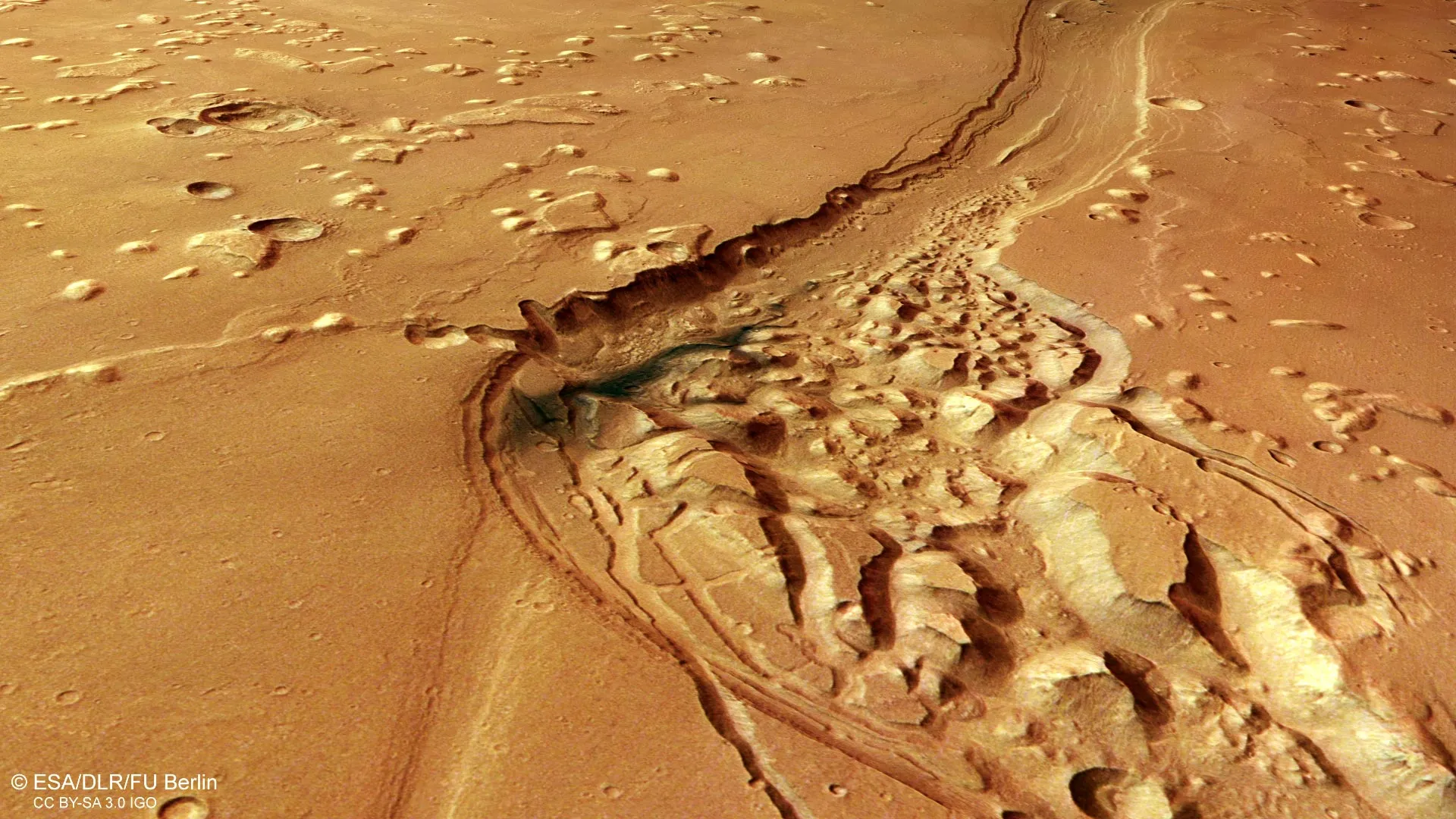
A newly analyzed Martian valley shows signs of ancient water activity, supporting theories of a past ocean on the Red Planet.
ESA's Mars Express mission has drawn attention to Shalbatana Vallis, a massive Martian valley that provides key evidence of ancient water activity, volcanic activity, and impact craters. The valley, located near Mars's equator, stretches over 1,300 kilometers, similar in length to Italy. Recent images from the spacecraft's High Resolution Stereo Camera (HRSC) highlight the northern section of the valley, revealing its complex geological features.
Shalbatana Vallis is believed to have formed around 3.5 billion years ago when large volumes of groundwater erupted onto the surface, creating powerful floods that carved deep channels. The valley visible in the image is approximately 10 kilometers wide and 500 meters deep, with features that are clearly visible in topographic views. Scientists suggest that the valley was once even deeper, with material gradually filling parts of it over billions of years.
A notable blue-black patch in the valley is thought to be volcanic ash, later moved by Martian winds. The region surrounding Shalbatana Vallis includes a variety of geological features, such as impact craters, chaotic terrain, and lava-formed structures. These features suggest a dynamic history involving water, ice, and volcanic activity.
The area also includes Chryse Planitia, one of Mars's lowest regions, where many outflow channels end. This has led some scientists to speculate that the region may have once held a large ocean during a warmer and wetter period in Mars's history. The Mars Express mission, which has been studying the planet since 2003, has provided critical data that has deepened scientists' understanding of Mars's geological past.
Edited by the news editor with AI from the original report — please refer to the original source.