Mars may be two-faced to its core
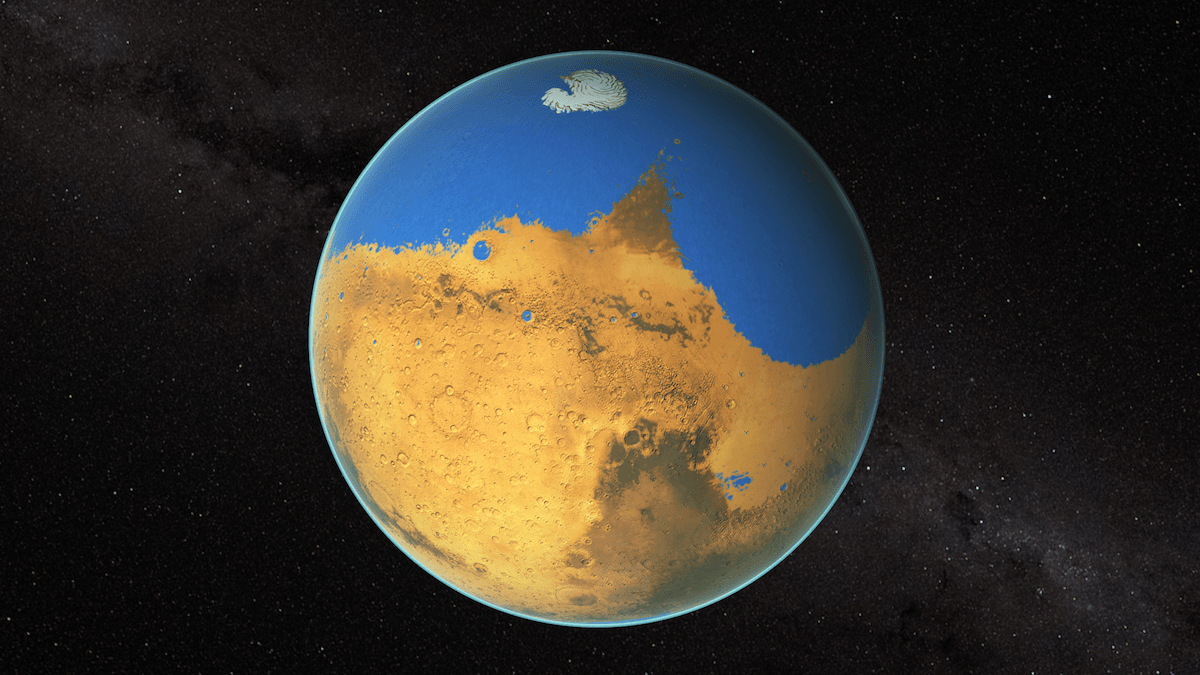
New research suggests Mars's crustal dichotomy extends deep into its mantle, with a significant temperature difference between hemispheres.
Mars, the Red Planet, has long puzzled scientists with its stark contrast between the smooth northern plains and the rugged southern highlands. This difference, known as the crustal dichotomy, has been a subject of debate for decades. A new study published in Nature suggests that this divide is not just a surface feature but extends deep into the planet's interior.
The research, led by Alexander Berne of the University of Arizona's Lunar and Planetary Laboratory, used data from Mars orbiters to analyze the planet's gravitational field. By examining how Mars flexes over its 687-day orbit, the team uncovered evidence of a significant temperature difference between the northern and southern hemispheres. The southern mantle appears to be 200 to 400 degrees Celsius hotter than the northern plains.
This discovery was made possible by a technique called tidal tomography, which allowed scientists to map the planet's internal structure by studying subtle changes in its gravity field. The findings challenge previous assumptions that Mars's interior was uniform, revealing instead a complex, asymmetric structure.
The implications of this discovery are profound. A warmer southern mantle could influence the planet's geological activity and potentially affect its ancient habitability. The study also suggests that the thermal properties of the mantle vary significantly, with the northern region being more rigid and the southern region softer, possibly due to higher temperatures.
The discovery of a thermal anomaly beneath Mars's crustal dichotomy reveals a fundamentally asymmetric internal structure, with the southern mantle significantly hotter than the northern plains. This finding challenges the assumption of a uniform Martian interior and offers new insights into the planet's geological history. From a multi-planetary perspective, this asymmetry could influence future Mars colonization efforts, as thermal gradients may affect resource distribution and habitability. Understanding these deep-seated differences is essential for building a sustainable human presence on Mars, as it informs how we might harness the planet's natural resources and adapt to its unique environment. This is a critical step toward making Mars a second home for humanity.
Edited by the news editor with AI from the original report — please refer to the original source.