Mars' Future Forged in Fire and Code: From Ancient Rivers to Orbital Factories
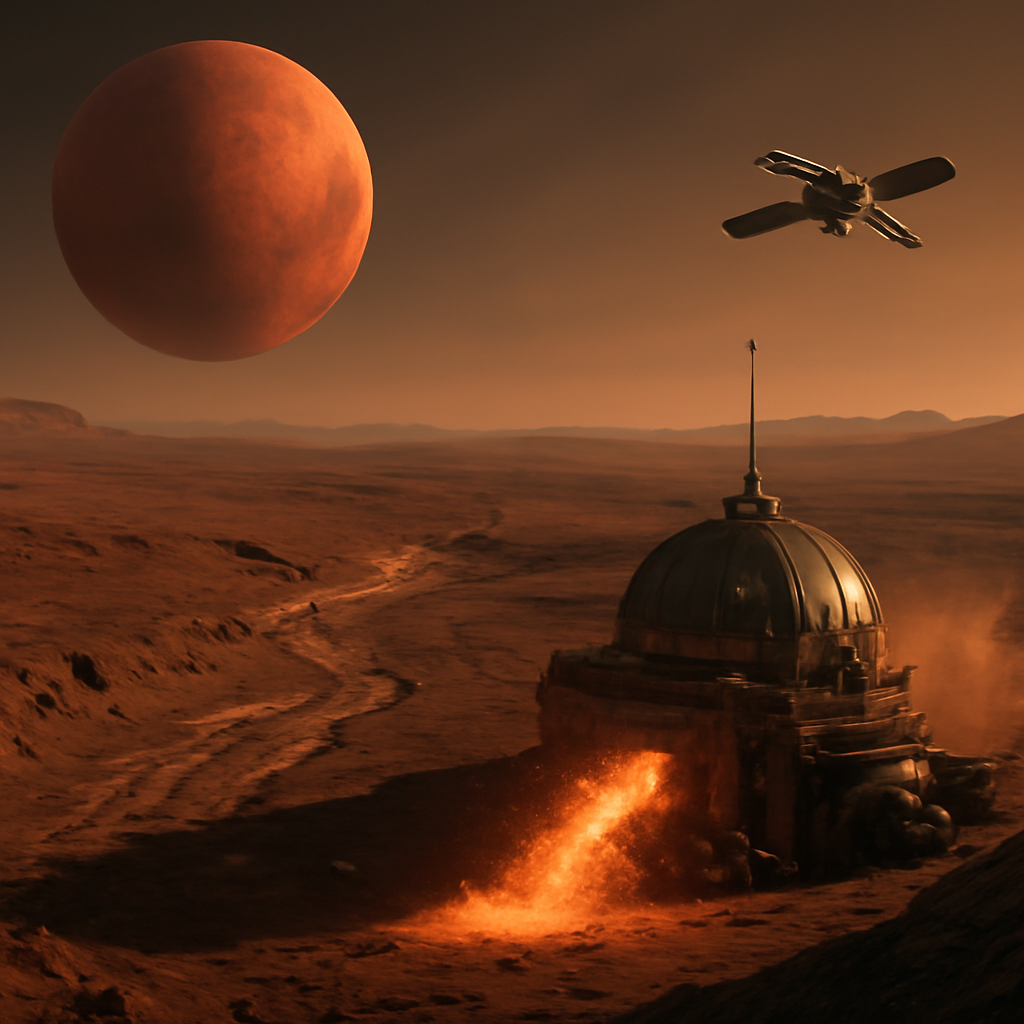
This deep dive explores the accelerating convergence of advanced manufacturing, AI, and space exploration, revealing how innovations today are paving the way for humanity's multi-planetary future on Mars, from understanding its past water cycles to building advanced infrastructure.
Echoes of Water: Reconstructing Mars' Ancient Hydrosphere
The enduring presence of liquid water on Mars for extended geological timescales is now supported by a growing body of evidence, fundamentally reshaping our understanding of the Red Planet's past habitability. Analysis of orbital and rover data, including high-resolution imagery and spectral analyses of mineral deposits, indicates that Mars was not merely sporadically wet, but hosted persistent river systems, extensive lake basins, and potentially a vast northern ocean for millions of years. This duration is ecologically significant, comparable to the period during which complex multicellular life evolved on Earth. The implications extend beyond mere habitability; these long-lived hydrological systems would have facilitated the transport and concentration of essential chemical ingredients necessary for life, and potentially provided stable environments for nascent microbial ecosystems to emerge and persist. Understanding the dynamics of these ancient water bodies, their salinity, and their eventual disappearance is crucial for identifying prime locations for future astrobiological exploration. This new understanding, bolstered by ongoing observations from missions like Mars Odyssey, which has now completed over 60,000 orbits, provides a more robust framework for assessing Mars' potential to have harbored life.
Orbital Watchdogs: Odyssey's Longevity and TGO's Cloud Climatology
The enduring presence of aging Mars orbiters continues to be a cornerstone of our understanding of the Red Planet. Mars Odyssey, for example, recently surpassed 60,000 orbits, a testament to its robust engineering and sustained operational capability. For over two decades, this spacecraft has been instrumental in mapping mineral resources, studying atmospheric composition, and providing crucial relay support for surface missions. Its longevity underscores the value of building durable, long-lasting scientific platforms, a principle increasingly relevant as we consider prolonged human presence. Complementing this, the European Space Agency's Trace Gas Orbiter (TGO), equipped with instruments like NOMAD-UVIS, has delivered an unprecedented four-year climatology of Martian ice clouds. By meticulously tracking these formations, TGO is building a detailed picture of atmospheric dynamics, energy transport, and their influence on the planet's climate. This granular data, now consolidated in archives like ARCO-Mars, is vital for refining climate models and understanding the complex interplay of atmospheric processes, informing everything from weather forecasting for future astronauts to assessing the potential for subsurface water.
In-Situ Fabrication: The Blueprint for Martian Industry
The development of robust, localized manufacturing capabilities is paramount for sustained human presence on Mars. Systems like ExOne's S-Print Pro and ADDiTEC's HYBRiD-X represent critical advancements in this domain, moving beyond simple prototyping towards the fabrication of functional components. Binder jetting, a core technology in these systems, involves selectively depositing a liquid binder onto a powder bed of raw material, precisely building up a three-dimensional object layer by layer. For Mars, this means utilizing regolith, the local Martian soil, as a primary feedstock. The binder, which could be a polymer or even a mineral-based cement, cures the regolith particles, creating solid structures. This process offers significant advantages over transporting finished goods from Earth, drastically reducing launch mass and associated costs. The S-Print Pro's smaller footprint makes it suitable for initial, more constrained Martian outposts, while the HYBRiD-X's demonstrated material versatility, processing multiple metal alloys, hints at the potential for fabricating more complex and durable parts, from structural elements to tools and even spare components for rovers like the Ernest prototype. This in-situ fabrication capability is not merely about convenience; it's a fundamental enabler of self-sufficiency, mirroring the drive for onsite manufacturing seen in terrestrial defense and robotics sectors.
Robotics and AI: The Intelligent Workforce of Tomorrow
The increasing sophistication of Martian exploration hinges on the integration of advanced robotics and artificial intelligence. On Mars, AI systems akin to the National Taiwan University’s blueprint-matching technology could revolutionize site assessment. Instead of relying on manual input or unreliable GPS signals in varied terrain, an AI could analyze orbital imagery and rover-generated scans, cross-referencing them with pre-defined geological blueprints or habitat construction schematics. This allows for precise identification of safe landing zones, optimal resource extraction sites, and ideal locations for future infrastructure, all without direct human oversight for every decision. Complementing this intelligent navigation is the development of highly capable robotic platforms. NASA's Ernest rover prototype, with its independent wheel control and obstacle-climbing prowess, represents a leap in mobility across Mars' rugged landscapes. Similarly, the development of biomimetic drones like 'Floaty,' which achieve efficient flight by mimicking bird wing movements, offers novel aerial survey capabilities. These drones, potentially built using in-situ fabrication methods to reduce launch mass, could map vast areas or conduct detailed inspections of geological formations, collecting data far more efficiently than ground-bound rovers alone. This synergy of AI-driven analysis and advanced robotic mobility is crucial for maximizing scientific return and laying the groundwork for sustained human presence.
Additive Manufacturing for Spacecraft and Infrastructure
The burgeoning field of additive manufacturing, or 3D printing, is poised to revolutionize how we construct everything from essential spacecraft components to the foundational infrastructure of extraterrestrial bases. Companies like Relativity Space and SpaceX are already leveraging this technology for orbital fabrication, with SpaceX’s Starship program, in particular, hinting at advanced in-space manufacturing capabilities for its payloads. This mirrors advancements seen on Earth, where firms like Continuous Composites are securing contracts, such as a multi-year deal with the U.S. Army for missile component production using their CF3D technology. The development of specialized materials is crucial; Stratasys has introduced flame-retardant nylon for demanding rail applications, while Markforged offers glass fiber-filled nylon for color-coded factory tooling, enhancing operational efficiency. Quality control is also advancing rapidly, with Phase3D securing significant funding for its in-situ inspection systems for metal additive manufacturing, ensuring the integrity of critical parts during the printing process. This progress is not limited to complex aerospace applications; ExOne's new binder jetting system makes sand printing accessible to smaller foundries, and the drone market's rapid growth is directly fueled by additive manufacturing innovations. As Mars Odyssey continues its decades-long mission, the lessons learned from Earth-based additive manufacturing will be invaluable for future Martian endeavors, enabling the creation of tools, spare parts, and even habitats directly on the Red Planet, reducing reliance on costly Earth-based resupply missions.
Energy and Habitability: The Subsurface Equation
New research published today casts a shadow over one of the most compelling potential energy sources for subsurface Martian life: radiolytic energy. This process, driven by the decay of radioactive elements within Mars' crust and the subsequent interaction of emitted particles with subsurface water or ice, generates hydrogen and oxidants. These molecules could theoretically serve as a metabolic fuel for microbial ecosystems, similar to how some chemosynthetic life thrives in Earth's deep subsurface. However, the latest findings suggest that in shallower regions, the concentration of these radiolytic byproducts might not be sufficient to sustain a robust biosphere. The energy yield diminishes significantly with depth, and the rate at which these gases are produced might not keep pace with their consumption by hypothetical Martian microbes. This limitation has significant implications for astrobiological exploration, potentially narrowing the focus of future missions to deeper subsurface environments, which are considerably more challenging to access and study. The current understanding of Mars' subsurface geology and geochemistry, further refined by ongoing observations from spacecraft like Mars Odyssey (which recently completed its 60,000th orbit), suggests that while water was present for extended periods, the conditions for sustained radiolytic energy production might be spatially and temporally constrained.
Launchpad to the Red Planet: Evolving Launch Capabilities
The ambitious journey to Mars hinges on the evolution of our launch capabilities, a critical bottleneck that requires significant infrastructure investment and a refined development philosophy. While facilities at Kennedy Space Center are being assessed for their readiness to support the demands of future super heavy-lift rockets, the iterative approach championed by companies like SpaceX offers a blueprint for rapid advancement. Their Falcon 9, now poised for its 25th flight, exemplifies a system honed through consistent operation and learning from every mission, even early setbacks like those encountered with the Falcon 1, which stemmed from a series of minor component issues rather than fundamental design flaws. This philosophy is being directly applied to Starship, where each test flight is treated not as a final product but as an integral part of a continuous development cycle, akin to software updates. This "build, test, learn, repeat" methodology allows for swift identification and correction of issues, accelerating the path toward reliable, high-cadence access to space. The recent substantial AI computing power deal secured by SpaceX further underscores their commitment to leveraging advanced technologies in their development and operational processes, potentially streamlining complex simulations and data analysis essential for rocket design and flight.
Beyond Mars: Broader Implications for Multi-Planetary Expansion
The burgeoning capabilities in additive manufacturing, exemplified by advancements like ADDiTEC's HYBRiD-X and ExOne's S-Print Pro, are not confined to terrestrial applications; they represent a crucial foundation for sustained extraterrestrial presence. The ability to fabricate complex components from multiple metal alloys on-site, as demonstrated for defense sustainment, directly translates to building infrastructure and repairing equipment on Mars or the Moon, mitigating the prohibitive cost and logistical burden of Earth-based resupply. This mirrors the development of advanced robotic systems, such as NASA's Ernest rover prototype, designed for extreme terrains, which will require localized manufacturing of replacement parts or specialized tools. Furthermore, the recent SpaceX Starship payload speculation, hinting at in-space manufacturing, underscores a broader industry pivot towards orbital factories. This trend is echoed in the drone market's additive manufacturing growth, where lightweight, customizable components are paramount. Even the development of new materials, like Stratasys' flame-retardant nylon for rail or Markforged's color-coded tooling, holds relevance for creating safer, more efficient off-world habitats and operational environments. The lessons learned from terrestrial applications of binder jetting, material versatility, and in-process inspection, as highlighted by Phase3D's funding, are directly applicable to establishing self-sufficient, resource-efficient operations beyond Earth.
The relentless march of technological progress, evident in today's headlines, underscores a singular, imperative destiny: humanity's expansion beyond Earth. Each breakthrough in additive manufacturing, AI-driven automation, and resilient hardware development isn't merely an incremental improvement; it's a critical stepping stone towards establishing a self-sustaining civilization on Mars. The ability to fabricate complex components in situ, optimize resource utilization through AI, and ensure mission resilience via iterative design mirrors the foundational principles required for off-world colonization. The past habitability of Mars, now increasingly understood, serves not as a historical footnote but as a compelling invitation. These advancements collectively represent the exponential acceleration needed to transform Mars from a scientific curiosity into humanity's second home, fulfilling our inherent drive for exploration and survival.
This content was produced by the news editor with AI.