Mars: From Ancient Ice to Starship Sails – Charting Humanity's Red Frontier Ascent
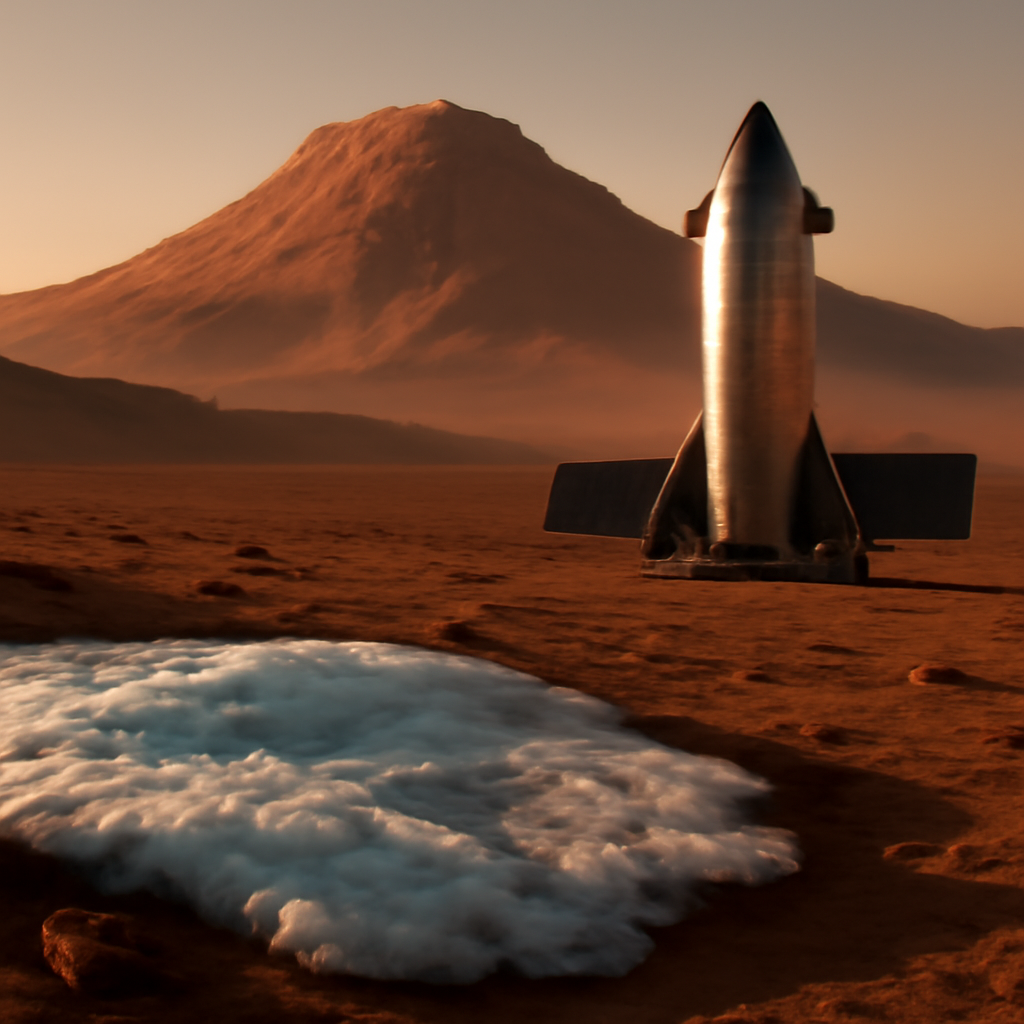
This in-depth feature explores the multifaceted progress towards Mars, from understanding its ancient past and water reserves to the cutting-edge engineering of Starship and the foundational technologies enabling a sustained human presence. We delve into the critical role of in-situ resource utilization, advanced manufacturing, and the ongoing human factors research shaping our interplanetary future.
Unearthing Martian Water: A Foundation for Life
The recent Icarus review on Martian ice reservoirs, particularly focusing on the Amazonian epoch, underscores a critical resource for future human endeavors. Understanding the distribution, accessibility, and volume of this ice is paramount for in-situ resource utilization (ISRU), a concept central to establishing a self-sustaining presence on Mars. Water ice is not merely a source of potable water; it can be electrolyzed to produce breathable oxygen and hydrogen propellant for rockets, as highlighted by news regarding SpaceX's Starship program and its ambitious Mars goals. The challenge lies in extracting this ice efficiently. Current research suggests significant subsurface ice deposits, especially at mid-latitudes, but accessing them will likely require advanced drilling and excavation techniques. The development of technologies capable of robustly operating in the Martian environment, such as those explored in Mars analogue missions, will be crucial. Furthermore, the ability to process regolith, which often contains hydrated minerals, could offer an alternative or supplementary source of water, further reducing reliance on Earth-based resupply. This integration of resource prospecting and extraction technologies forms the bedrock for any long-term human settlement.
Echoes of the Early Solar System: Impact History on Mars
The Perseverance rover's discovery of layered bedrock formations dating back over 3.9 billion years provides a tangible link to Mars's ancient, violent past. This geological record offers critical insights into the Late Heavy Bombardment, a period of intense asteroid and comet impacts that reshaped the inner solar system. The evidence found by Perseverance, such as shock metamorphism in minerals and the distinctive brecciated textures characteristic of impactites, allows scientists to reconstruct the energy and scale of these ancient collisions. This isn't just a story about Mars; it's a chapter in the broader narrative of planetary formation. Similar impact evidence is found on the Moon and Mercury, suggesting a common, chaotic genesis for the terrestrial planets. Understanding the frequency and intensity of these early impacts on Mars helps refine models of solar system evolution, including the distribution of volatile elements like water, which are crucial for potential human habitability and resource utilization. The data from Perseverance, therefore, serves as a planetary time capsule, offering a window into the very processes that sculpted our cosmic neighborhood billions of years ago.
Starship's Ascent: Engineering for Interplanetary Transit
The journey to Mars for Starship is a monumental engineering undertaking, marked by incremental progress and the inevitable setbacks that accompany ambitious development. SpaceX's iterative testing philosophy, exemplified by the upcoming Flight 13 launch targeting July 23, is designed to systematically address the complex challenges of interplanetary transit. This includes mastering the intricate choreography of orbital ascent, the extreme thermal stresses of atmospheric re-entry, and the precise landing maneuvers required on another celestial body. The development of the Raptor engines, crucial for both ascent and descent, has seen recent difficulties, with a static fire test failure reported, highlighting the demanding nature of achieving reliable, high-thrust propulsion for a vehicle of Starship's scale. Furthermore, the construction of a 13-kilometer pipeline to support fuel logistics at Starbase underscores the significant infrastructure investments necessary to sustain frequent launch operations. While the program has faced recent market valuation adjustments, the focus remains on advancing the vehicle's capabilities, with successful static fire tests indicating continued forward momentum towards orbital readiness, a critical precursor for any Mars mission.
Resource Revolution: Mining Mars for Survival
The vision of humanity establishing a permanent presence on Mars hinges on a concept known as in-situ resource utilization, or ISRU. This isn't merely about convenience; it's a fundamental requirement for survival and sustainability. The vast quantities of water ice identified, particularly in subsurface reservoirs and polar caps, are paramount. This frozen resource can be melted for drinking water, used for agriculture in controlled environments, and critically, electrolyzed to produce breathable oxygen for habitats and rocket propellant. Atmospheric carbon dioxide, abundant in Mars' thin atmosphere, can also be processed to yield oxygen and methane, another key propellant component, through reactions like the Sabatier process. Beyond life support, Martian regolith – the loose soil and rock covering the surface – offers a readily available building material. Advances in 3D printing, evidenced by ongoing developments in concrete structures and composite materials on Earth, provide a blueprint for utilizing processed regolith to construct habitats, radiation shielding, and landing pads, drastically reducing the mass that must be transported from Earth. This shift from Earth-dependent logistics to Martian self-sufficiency is the bedrock upon which a Red Planet outpost will be built.
Additive Manufacturing: Building the Red Planet Brick by Brick
The ability to fabricate components and structures on-demand, directly on Mars, is a cornerstone of sustainable off-world habitation, moving beyond the limitations of Earth-based supply chains. This is where additive manufacturing, or 3D printing, becomes indispensable. Leveraging in-situ resources, as highlighted by the emphasis on water ice, regolith, and atmospheric oxygen, is key. Martian regolith, a fine, powdery soil, can be sintered or mixed with binders to create construction materials, potentially forming habitats or radiation shielding, much like MIT's work on optimizing concrete structures for 3D printing. Beyond bulk construction, 3D printing offers unparalleled flexibility for creating custom tools, replacement parts for critical machinery like the Raptor engines experiencing issues, or even complex scientific instruments needed for exploration. Imagine a scenario where a vital component fails; rather than waiting months or years for a replacement from Earth, an astronaut could print a functional replica within hours. Furthermore, additive manufacturing can be applied to life support systems, from creating specialized filters to fabricating parts for water recycling units. The development of novel, sustainable filaments, like those derived from plant waste, also hints at future possibilities for reducing the environmental footprint of Martian operations, even as the hobbyist sector grapples with its own waste challenges. This technology is not just about replicating Earth-based manufacturing; it's about enabling a new paradigm of adaptable, resource-efficient operations on another world.
The Human Factor: Sustaining Life in Isolation
The psychological and physiological toll of sustained isolation on a Mars mission is a critical area of research, directly informing the design and operational parameters for future human expeditions. Analog missions, such as the one recently led by a Peruvian doctor in Brazil and NASA's ongoing recruitment for a year-long simulated habitat stay, are designed to meticulously study these effects. Participants in these controlled environments undergo rigorous testing to assess how factors like confinement, limited social interaction, and constant exposure to a monotonous, high-stakes setting impact mood, cognitive function, and interpersonal dynamics. Physiological monitoring includes tracking sleep patterns, immune system responses, and the effects of simulated Martian gravity or microgravity on bone density and muscle mass. Understanding these impacts is vital for developing effective countermeasures, from specialized psychological support and communication protocols to optimized life support systems and exercise regimens. The data gathered directly influences mission planning, crew selection, and the development of technologies intended to mitigate these inherent challenges, ensuring the well-being and operational effectiveness of astronauts on the long journey to and from the Red Planet.
Data Streams from the Red Planet: New Imaging and Science
The relentless stream of data from Mars continues to reshape our understanding of the Red Planet, with recent orbital and rover observations painting an ever-more detailed picture of its geological evolution and atmospheric dynamics. The Perseverance rover, for instance, has uncovered layered bedrock formations dating back over 3.9 billion years, providing crucial evidence for the planet's tumultuous early history and its likely exposure to the intense bombardment that characterized the nascent Solar System. This discovery aligns with ongoing research into Martian ice reservoirs, particularly concerning their volume and history during the Amazonian epoch, suggesting that while much ice may have been lost to space, significant reserves likely persist beneath the surface. Meanwhile, the Mars Express orbiter has captured images of unusual dunes exhibiting a metallic sheen, a phenomenon scientists are investigating for clues about the composition of the Martian regolith. These geological insights, combined with atmospheric data from missions like the Psyche spacecraft's recent flyby, which captured an evolving Martian crescent, offer a dynamic, multi-faceted view of a world that, while seemingly desolate, still harbors profound scientific mysteries waiting to be unraveled.
Navigating the Interplanetary Economy: Valuations and Investments
The financial underpinnings of ambitious Mars ventures are evolving. SpaceX, a prime mover in this arena, has reportedly seen its valuation adjust downwards from its peak, a shift prompting market analysis regarding whether this represents a temporary fluctuation or a more sustained trend. This recalibration underscores the inherent volatility in the space sector, where technological leaps, while promising, are often accompanied by significant development costs and the inherent risks of novel engineering. Recent setbacks, such as the abort of Starship Flight 13 due to Raptor engine issues, highlight these developmental hurdles. However, the continued pursuit of Starship’s orbital capabilities, alongside ongoing investments in infrastructure like the 13km fuel pipeline at Starbase, signals a long-term commitment. This investment strategy aligns with the fundamental economic drivers for Mars exploration, such as the potential for resource utilization—tapping into Martian ice, regolith, and atmospheric oxygen—to enable self-sufficiency. The projected growth in the 3D-enabled devices market, particularly in industrial additive manufacturing, also suggests a broader technological ecosystem supporting future off-world construction and manufacturing, a critical component for any sustained presence. The financial landscape, therefore, is a complex interplay of speculative excitement, fundamental technological progress, and the tangible, albeit challenging, economics of interplanetary expansion.
Today's Mars developments paint a vivid picture of humanity's inexorable march towards becoming a multi-planetary species. The persistent exploration of Martian ice, the discovery of ancient impact evidence, and the challenges faced by Starship all underscore the exponential progress in both scientific understanding and technological capability. The focus on resource utilization (water, oxygen) and advanced manufacturing (3D printing for habitats, tools, and even food production via composting) highlights the crucial shift from mere visitation to sustainable settlement. SpaceX's ambitious launch cadence, despite setbacks, exemplifies the iterative, rapid-prototyping ethos necessary for exponential growth. The investment in analog missions and human factors research directly addresses the long-term viability of human presence, mirroring historical expansionary drives. This is not just about reaching Mars; it's about building a new branch of civilization.
This content was produced by the news editor with AI.