Mars Express Spots Swarms of Dust Devils in Mamers Valles
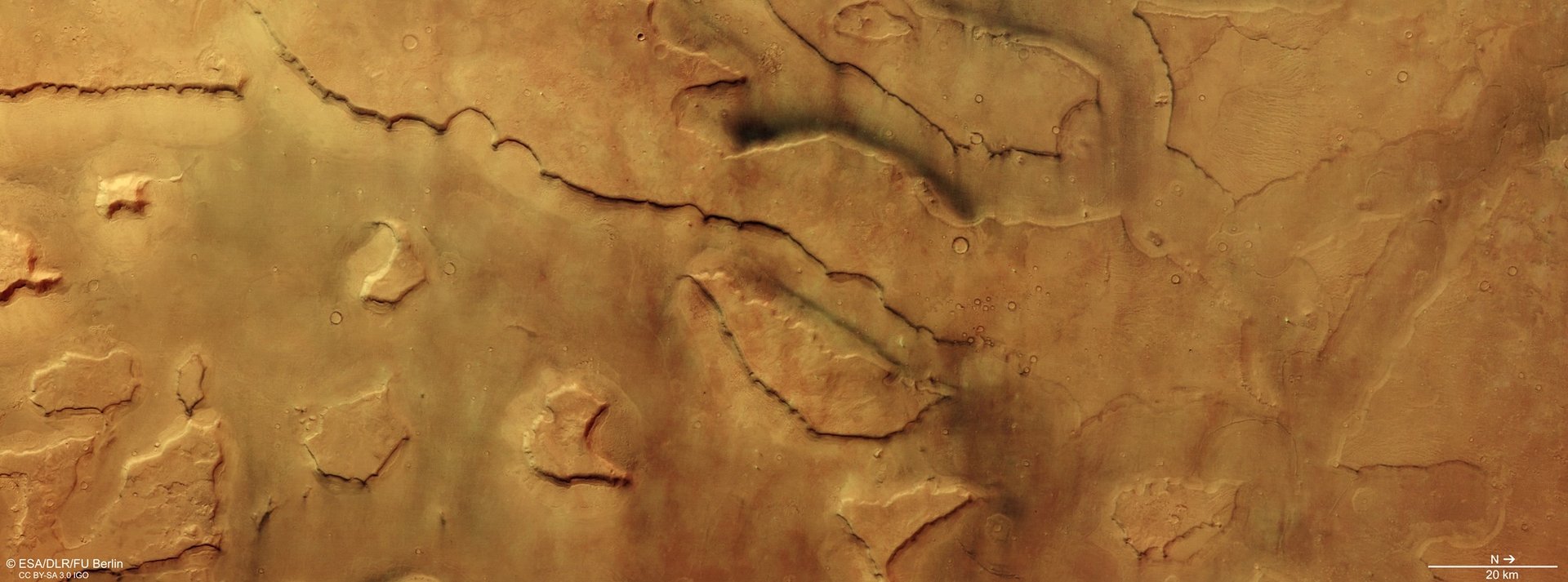
ESA's Mars Express probe has captured images of numerous dust devils swirling within the vast Mamers Valles canyon system on Mars, offering insights into the planet's atmospheric dynamics and geological history.
The European Space Agency's Mars Express orbiter has observed dozens of active dust devils traversing the Martian landscape, specifically within the extensive Mamers Valles canyon system located in Arabia Terra.
These Martian whirlwinds, analogous to terrestrial dust devils, form when solar heating warms surface areas, causing air to rise and spin. Mars' lower gravity, approximately 38% of Earth's, allows these phenomena to grow significantly larger, potentially reaching up to 8 kilometers in height and achieving wind speeds of 45 meters per second. They play a crucial role in the planet's weather by distributing dust across its surface.
The images were acquired by the High Resolution Stereo Camera (HRSC) aboard Mars Express, an instrument that has been mapping the Red Planet since 2003. By combining data from up to nine camera channels, scientists can detect movement on the surface and calculate the speed and direction of these dust devils. This technique was employed to capture the swirling activity within Mamers Valles.
Mamers Valles itself is a considerable geological feature, stretching about 1,000 kilometers and reaching depths of up to 1.2 kilometers. The region surrounding the valley exhibits diverse features, including mesas, cliffs, and buried water ice glaciers. Dark material lining some channels is thought to be volcanic sand, potentially deposited by wind. These geological indicators suggest past water flow, lava activity, or ice presence, consistent with the valley's age dating back to the late Noachian period, approximately 3.8 billion years ago, a time when Mars was transitioning from a wetter, warmer climate to its current cold and arid state.
The Mars Express observation of numerous dust devils in Mamers Valles, enabled by the HRSC's multi-channel imaging for motion detection, directly illuminates Mars' dynamic atmospheric processes. Understanding these dust devils' size and speed in lower gravity is key to characterizing the planet's weather. This data is crucial for future human missions, informing environmental forecasts and operational safety. As we expand life beyond Earth, detailed knowledge of planetary atmospheric phenomena on Mars, like these dust devils, is a vital step in mastering extraterrestrial environments and building self-sustaining civilizations, paving the way for humanity's multi-planetary future.
Edited by the news editor with AI from the original report — please refer to the original source.