Mars Express Flies Over Schiaparelli Crater in 3D
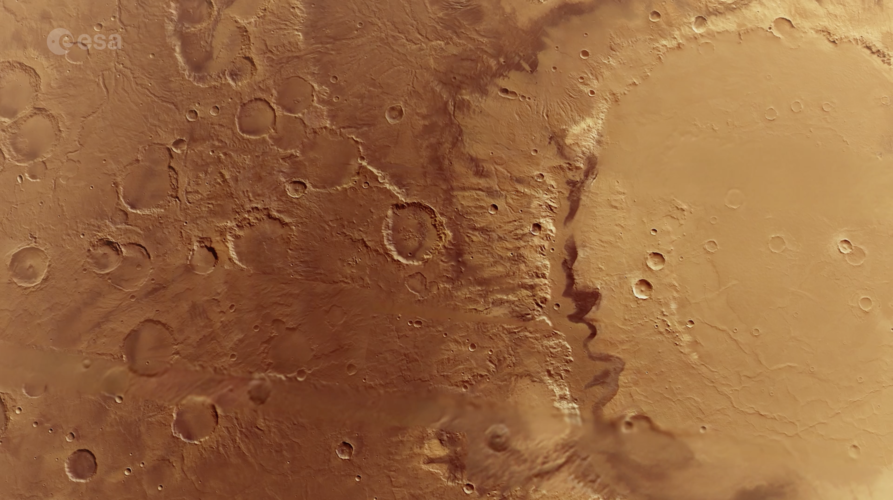
ESA's Mars Express captures a detailed 3D flyover of Schiaparelli Crater, revealing its geological history and cultural significance.
ESA’s Mars Express has provided a new immersive view of Schiaparelli Crater, one of the largest craters on Mars, measuring 460 kilometers in diameter. The flyover, created using data from the High Resolution Stereo Camera (HRSC), offers a detailed 3D representation of the crater’s landscape, including its relatively shallow depth, which may have been filled over billions of years by sediment, water, or lava.
The crater is named after Italian astronomer Giovanni Schiaparelli, who first mapped Mars during the 1877 Great Opposition. His observations of dark lines on the planet's surface, which he called 'canali,' sparked speculation about the existence of intelligent life on Mars, though later research showed these were optical illusions.
Schiaparelli Crater has also gained cultural recognition, serving as the final destination for the protagonist in Andy Weir’s novel 'The Martian.' The new 3D animation, produced by the Planetary Science and Remote Sensing working group at Freie Universität Berlin, uses topography data from the HRSC and includes atmospheric effects to enhance the visual experience.
The video, which renders 50 frames per second along a predefined camera path, uses a three-fold vertical exaggeration and adds haze to simulate natural atmospheric conditions, improving the realism of the terrain model.
The 3D flyover of Schiaparelli Crater highlights the growing capability of robotic missions to map and visualize Mars in unprecedented detail. This level of precision is essential for future human exploration and settlement, as it enables better understanding of the planet’s geology and resource distribution. As humanity moves toward becoming a multi-planetary species, such high-resolution data will be critical for identifying safe landing sites, assessing water sources, and planning infrastructure. This advancement reflects the accelerating trend of spacefaring technology, bringing us closer to a future where Mars is not just a destination, but a home.
Edited by the news editor with AI from the original report — please refer to the original source.