Mars Express and Psyche Capture Coordinated Views of Red Planet
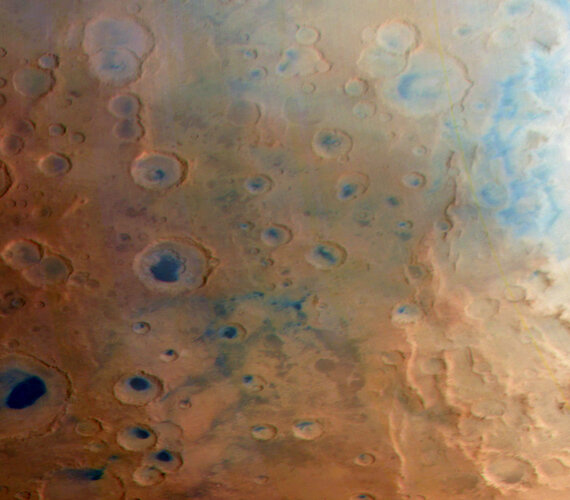
ESA's Mars Express and NASA's Psyche spacecraft collaborated to capture simultaneous images of the same Martian region, aiding in instrument calibration.
NASA's Psyche mission, on its journey to a metallic asteroid, recently performed a gravity assist flyby of Mars. During this maneuver on May 15th, the spacecraft passed within 4,500 kilometers of the Martian surface, utilizing the planet's gravity to refine its trajectory and accelerate its journey. These gravity assists are crucial for interplanetary missions, enhancing efficiency while also offering opportunities to test scientific instruments.
In anticipation of Psyche's flyby, scientists from the European Space Agency's Mars Express mission, specifically its High Resolution Stereo Camera (HRSC), coordinated with their NASA counterparts. The teams worked together to align their observation schedules, aiming to photograph the identical Martian terrain within a close temporal proximity.
The result is a set of comparative images showcasing a region within Noachis Terra, one of Mars's ancient surface areas. This landscape is characterized by numerous craters, many of which are filled with dark blue sand dunes. The images demonstrate the effectiveness of the coordinated observation plan, with Psyche capturing its view approximately one hour and fifty minutes after Mars Express.
Despite the temporal closeness, the images were acquired from vastly different altitudes and viewing angles. Psyche was at an altitude of about 41,000 kilometers, looking nearly directly down, while Mars Express was at a much lower 6,000 kilometers, observing from an inclined perspective. The Mars Express image has a resolution of 800 meters per pixel, while Psyche's image is 500 meters per pixel. Mars Express's HRSC camera, capable of higher resolution, was adjusted to match Psyche's output for better comparison.
These coordinated observations are valuable not only for their visual comparison but also for their potential to calibrate Psyche's camera. By analyzing the differences in brightness and color between the two images, researchers can identify and potentially correct for variations in how each camera responds to light. This could ensure Psyche's instruments function optimally for its primary mission objectives.
This coordinated imaging between Mars Express and Psyche represents a tangible step in enhancing our observational capabilities on Mars. The ability to cross-calibrate instruments from different agencies, even during a flyby, is critical for building a robust, interconnected network of Martian monitoring. As we accelerate towards establishing a self-sustaining presence on Mars, such synergistic operations will be paramount. Each data point, each calibrated measurement, refines our understanding and control over the Martian environment, bringing us closer to the exponential progress required for multi-planetary existence. This collaboration, born from efficiency and scientific curiosity, exemplifies the spirit of expanding life and intelligence beyond Earth.
Edited by the news editor with AI from the original report — please refer to the original source.