Concordia Researchers Use 4D Printing of Composites for Wind Turbine Blades
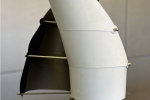
Concordia University researchers have developed a novel 4D printing method using carbon fiber composites to create curved wind turbine blades on flat molds, potentially reducing manufacturing costs and improving performance.
Researchers at Concordia University have devised an innovative approach to manufacturing curved vertical-axis wind turbine blades using a 4D printing technique with carbon fiber-reinforced epoxy. This method, detailed in Polymer Composites, allows the blades to be formed on a flat mold, eliminating the need for complex, curved tooling that typically matches the final blade geometry. The process involves stacking layers of continuous-fiber composite prepreg, which then curve into shape as they cool after curing due to differences in thermal expansion.
The Concordia team's method diverges from conventional 4D printing that often relies on stimulus-responsive materials. Instead, it leverages the anisotropic properties of carbon/epoxy laminates, where the orientation of continuous fibers dictates behavior. By employing an asymmetrical stacking sequence, internal forces are generated during the cooling phase of the epoxy curing process. These forces cause the initially flat laminate to bend into a predetermined curved shape.
This new study reverses the traditional design workflow by starting with the desired blade geometry and working backward to determine the specific laminate stacking sequence required to achieve it. The researchers applied this inverse procedure to design segments for a commercial Savonius-type vertical-axis wind turbine. Using a carbon/epoxy prepreg, they modeled and selected a three-ply [0/90₂] configuration, which effectively produced the necessary curvature while minimizing material usage.
Tests on the manufactured blade segments revealed they were significantly lighter than the original aluminum components, with an approximate 80% mass reduction per segment. Airflow tests comparing turbines fitted with aluminum blades versus the new composite blades showed higher rotational speeds for the composite version. While these tests did not measure electrical output, the reduced weight is identified as a key factor contributing to the enhanced rotational performance.
This development in inverse 4D printing of composites offers a significant advancement for manufacturing complex aerodynamic structures. By eliminating the need for specialized curved molds, it reduces tooling costs and lead times. The resulting lightweight, high-performance composite blades for wind turbines demonstrate the potential for additive manufacturing to improve energy generation efficiency and opens avenues for lighter, more robust components in aerospace and other demanding applications.
Edited by the news editor with AI from the original report — please refer to the original source.