Mars' Double Storm Problem
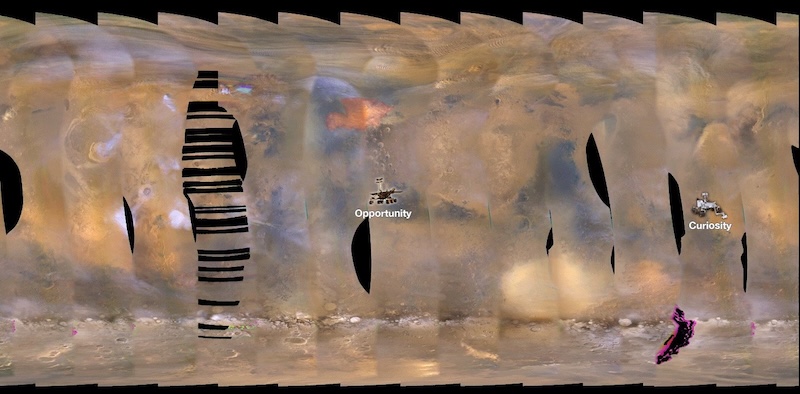
A study reveals possible interactions between solar storms and Martian dust storms, suggesting a new factor in understanding the planet's weather patterns.
A team of scientists from Lancaster University, the University of Leicester, and Spain's Instituto de Astrofisica de Andalucia made an unexpected discovery while investigating the effects of solar storms on Mars' atmosphere. Their initial goal was to determine whether solar energetic particle events could heat the lower atmosphere of Mars, where weather phenomena occur.
Mars' thin atmosphere and lack of a strong global magnetic field make it particularly vulnerable to solar activity. The researchers analyzed five solar particle events, but only one—occurring in June 2018—produced a measurable heating effect in the lower atmosphere. This event coincided with a massive global dust storm, which was also responsible for the demise of NASA's Opportunity rover.
The heating pattern observed during the 2018 event did not align with the expected effects of a dust storm alone. Instead, it suggested a potential interaction between solar particles and the dust storm, with both factors contributing to atmospheric heating. The researchers caution that more data is needed to confirm this hypothesis, but the findings raise the possibility that Martian weather is influenced by the combined effects of solar activity and dust storms.
The study highlights the complexity of Martian weather and the need for more integrated models that account for multiple factors. The team's unexpected discovery underscores the value of exploring unanticipated phenomena in space science, which could lead to a better understanding of how Mars' environment functions.
This study reveals a critical interaction between solar storms and Martian dust storms, suggesting that atmospheric heating on Mars may be influenced by the combined effects of solar particles and airborne dust. This finding challenges existing models that treat these phenomena in isolation, pointing to a more interconnected climate system. For humanity's long-term goal of becoming a multi-planetary species, understanding these interactions is essential for predicting environmental conditions on Mars. As we move toward sustained human presence on the Red Planet, such insights will help in designing resilient habitats and ensuring the safety of future explorers. This discovery exemplifies the exponential progress in space science, where unexpected findings open new pathways for technological and scientific advancement.
Edited by the news editor with AI from the original report — please refer to the original source.