Mars' Deep Past & Our Multi-Planetary Future: From Ancient Magma to the 3D-Printed Frontier
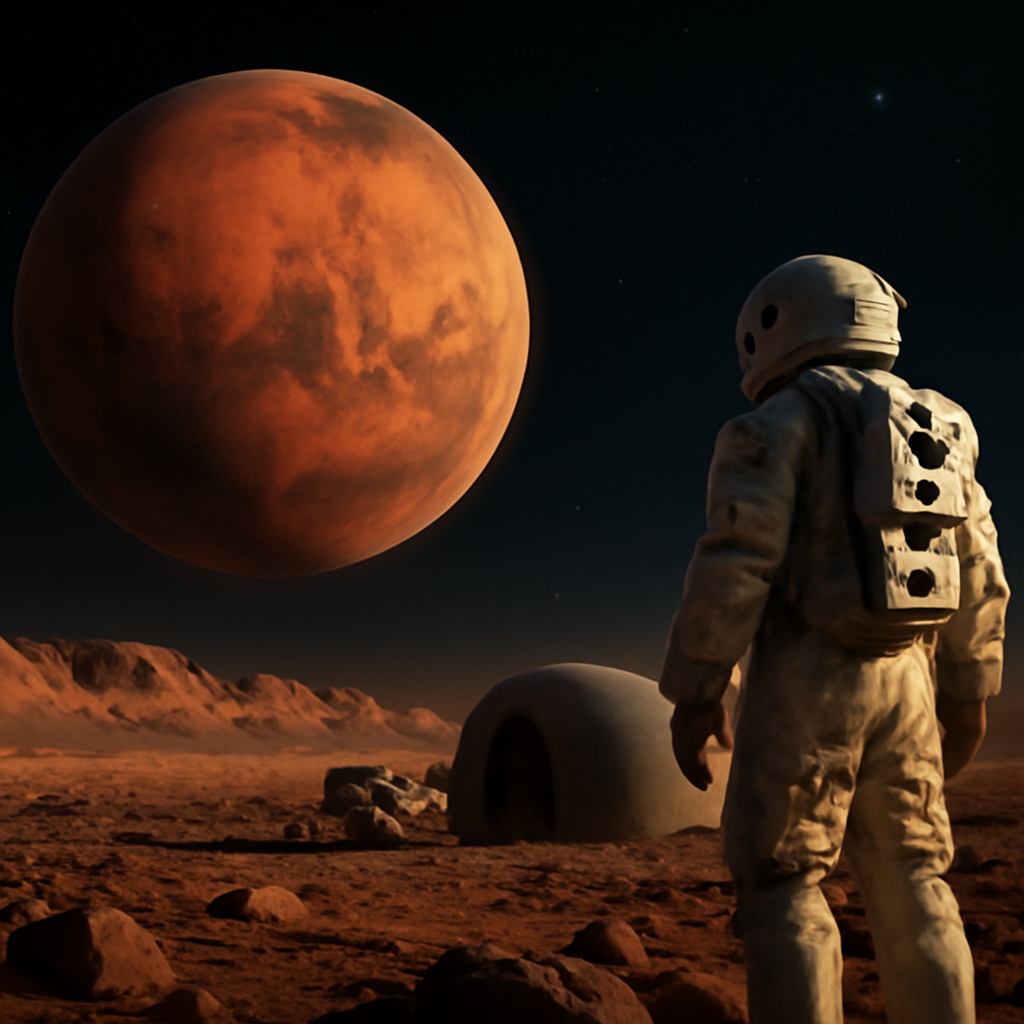
Recent InSight data reveals Mars once hosted vast magma systems, hinting at a more dynamic past. Simultaneously, breakthroughs in 3D printing and advanced materials, from biopolymers to recycled plastics, are not only revolutionizing terrestrial industries but are also laying the foundational technologies for humanity's inevitable expansion beyond Earth.
Echoes of a Fiery Past: Reconstructing Martian Magma Dynamics
The seismic data collected by NASA's InSight lander is fundamentally reshaping our understanding of Mars' internal evolution, particularly its ancient magmatic history. Previously, scientists largely assumed that the extensive magma systems fueling planetary crust formation, akin to Earth's, required active plate tectonics. However, InSight's seismometer, by analyzing the echoes of marsquakes through the planet's interior, has revealed evidence of deep, widespread magma chambers and conduits that persisted for eons, even in the absence of mobile crustal plates. This suggests that Martian volcanism and differentiation were driven by internal heat sources and mantle dynamics, rather than surface-level geological activity. The analysis indicates that these magma systems were not merely transient phenomena but formed a complex, interconnected network that significantly influenced the planet's crustal structure and composition over billions of years. Understanding these subsurface processes is crucial for reconstructing Mars' early climate and assessing its potential for past habitability, providing a vital contrast to Earth's dynamic geological evolution.
The Organic Enigma: Perseverance's Quest for Martian Biosignatures
Perseverance’s advanced suite of instruments is meticulously analyzing the composition of Jezero Crater’s rocks, searching for tell-tale signs of ancient microbial life. Recent findings reveal the rover has detected complex carbon molecules directly on the surfaces of two rocks and, more significantly, within ancient mudstones. These aren't simple hydrocarbons; they are macromolecular structures, suggesting a level of chemical complexity that could hint at biological origins. What makes these discoveries particularly compelling is their association with specific minerals. The rover’s SHERLOC (Scanning Habitable Environments with Raman & Luminescence for Organics & Chemicals) instrument has identified patterns where organic carbon is intricately linked with minerals like sulfates. This co-occurrence is a crucial piece of the puzzle. On Earth, such organic-mineral associations are common in environments where life has existed, as minerals can preserve organic matter and protect it from degradation. The presence of these patterns on Mars, coupled with the detection of complex carbon, presents a strong candidate for a biosignature – evidence that could indicate past life. However, scientists remain cautious. Abiotic (non-biological) processes can also produce organic molecules, and further analysis is required to definitively rule out non-biological explanations and confirm if these are indeed the remnants of Martian life.
3D Printing: The Backbone of Off-World Habitats and Infrastructure
The prospect of establishing a permanent human presence on Mars hinges on leveraging advanced manufacturing capabilities, and 3D printing stands as a cornerstone technology. Beyond simply creating spare parts, additive manufacturing offers a pathway to constructing habitats and essential infrastructure using in-situ resources. Researchers have developed biopolymer formulas that enable the reliable 3D printing of earthen materials like clay and sand, a critical step towards utilizing Martian regolith for construction. This approach, coupled with advancements in ultra-high-performance concrete that slash costs by up to 75%, could see the creation of durable, localized shelters and facilities. Furthermore, the ability to recycle plastic waste into valuable materials like graphite for battery anodes, as demonstrated by recent breakthroughs, suggests a closed-loop manufacturing system for power storage. Even complex metal components, vital for everything from life support systems to rovers, can be fabricated on-demand, reducing reliance on Earth-based resupply missions. The development of advanced 3D printing systems, capable of handling diverse materials including metals and polymers, alongside sophisticated quality assurance tools like in-situ inspection and depowdering software, are all essential enablers for this off-world manufacturing frontier.
Powering the Red Planet: Innovations in Energy Storage
Powering the persistent human presence on Mars will demand energy storage solutions far beyond what we rely on today. While early missions like Viking provided foundational data, future endeavors will require robust, lightweight, and highly efficient power banks. Recent breakthroughs offer promising avenues. Researchers have developed a novel zinc-ion hybrid battery that utilizes a three-dimensional printed electrode structure. This intricate, porous design dramatically increases the surface area available for electrochemical reactions, leading to a sevenfold improvement in energy storage capacity compared to conventional designs. Furthermore, this 3D-printed architecture enhances the battery's longevity, a critical factor for long-duration missions where component reliability is paramount. Complementing this, a sustainable approach to anode material production is emerging: converting waste PET plastic bottles into high-quality synthetic graphite. This process not only addresses plastic pollution but also yields a key component for advanced battery anodes, offering a dual benefit of resource recovery and advanced energy storage material creation. These innovations, focusing on enhanced capacity and sustainable material sourcing, are vital for a multi-planetary future.
Robotics and Automation: Tools for Exploration and Construction
The exploration of Mars is increasingly reliant on sophisticated robotic systems, pushing the boundaries of what's possible in extreme environments. Recent advancements in bio-inspired robotics, such as the development of a flexible, 3D-printed diving suit for cyborg cockroaches, hint at future capabilities for underwater exploration on icy moons like Europa, and could even inspire designs for highly maneuverable probes capable of navigating potential subsurface water reservoirs on Mars, should they exist. Similarly, a robotic bird mimicking kestrel flight to study turbulence mitigation offers insights into aerial maneuverability in thin Martian atmospheres, potentially leading to more agile aerial survey drones than current rotorcraft. These technological leaps are not just about observation; they are foundational for future construction. The ability to 3D print durable materials, as demonstrated by advancements in zinc-ion batteries with 3D-printed electrodes and the recycling of plastic bottles into graphite for anodes, suggests that future Martian habitats and infrastructure could be built using local regolith and recycled materials, significantly reducing the mass required for Earth-based resupply. This parallels the growing application of additive manufacturing in terrestrial defense and industry, where on-site 3D printing is reducing downtime and addressing parts obsolescence, a critical lesson for establishing a sustained presence on another planet.
The Evolving Space Economy: Investment and Competition
The burgeoning commercial space sector is experiencing a significant influx of investment and a sharpening competitive edge, driven by new initiatives and strategic acquisitions. The recent partnership between NASA and the Small Business Administration to launch the SBIC-NASA Initiative underscores a concerted effort to channel capital into U.S. companies vital for space exploration and development. This move directly addresses the need for robust financial backing in a field demanding substantial upfront investment. Concurrently, major players are consolidating their positions and expanding their reach. Rocket Lab's $8 billion acquisition of Iridium, for instance, transforms the company into a vertically integrated space powerhouse, explicitly positioning it as a direct competitor to established giants like SpaceX. This consolidation, coupled with ongoing advancements in enabling technologies like additive manufacturing—evidenced by the UK Ministry of Defence's investment in Project Tampa to combat parts obsolescence and the Royal Navy's deployment of on-site 3D printing for submarine readiness—signals a maturing industry. These developments collectively indicate a dynamic landscape where both established entities and emerging ventures are vying for dominance, fueled by increasing financial support and the relentless pursuit of technological innovation.
Human Endurance on a New World: The Martian Marathon Milestone
The recent Martian marathon milestone, captured by the Mars Reconnaissance Orbiter, represents more than just a symbolic distance covered. It underscores the fundamental physiological challenges and triumphs inherent in establishing a human presence on another world. Running on Mars requires astronauts to contend with approximately 38% of Earth's gravity, a significant reduction that impacts biomechanics, bone density, and cardiovascular load. The Martian atmosphere, while thin and composed primarily of carbon dioxide, necessitates fully enclosed environmental suits that provide life support, regulate temperature, and offer protection from radiation. These suits, while advanced, add mass and restrict movement, making even a casual stroll an exertion. The marathon's successful completion signifies that human bodies, with appropriate training and technological support, can endure such demanding conditions for extended periods. This feat is a critical data point for future habitation, informing the design of habitats, exercise regimens, and the very pace of settlement, proving that sustained human activity, not just robotic exploration like that initiated by Viking, is within reach.
Bridging Earth and Mars: Technological Synergies for Multi-Planetary Life
The establishment of a sustainable human presence on Mars hinges on our ability to effectively leverage and adapt terrestrial technological breakthroughs. Advancements in additive manufacturing, for instance, are directly applicable to the Red Planet's challenges. Recent developments in 3D-printed batteries, such as the zinc-ion hybrid boasting a sevenfold energy storage increase, offer a pathway to more efficient power systems crucial for Martian habitats. Furthermore, the recycling of waste plastic bottles into high-quality graphite for battery anodes presents a dual solution: mitigating terrestrial waste while providing essential materials for off-world energy storage. The exploration of binder-jetting technology for large-format concrete printing, alongside new strategies for reducing the cost of ultra-durable concrete, directly informs potential construction methods for Martian infrastructure, utilizing in-situ resources. Even innovations in shape-shifting surfaces for intuitive human-machine interaction, or bio-inspired robotic designs mimicking natural flight for turbulence mitigation, hint at how we might engineer more adaptable and efficient systems for extraterrestrial environments. The ongoing development of full-color 3D printers and bioprinting facilities on Earth also suggests future capabilities for creating complex tools, medical supplies, and even biological tissues on Mars, reducing reliance on costly Earth-based resupply missions. These synergistic technological leaps underscore a unified approach to overcoming the unique hurdles of Martian colonization.
The convergence of these Mars-centric discoveries and terrestrial technological leaps underscores a singular, exponential trajectory: humanity's destiny as a multi-planetary species. The confirmation of complex organic molecules and ancient magma systems on Mars fuels our existential imperative to explore and colonize. Concurrently, advancements in additive manufacturing, sustainable materials, and energy storage are not mere industrial upgrades; they are the critical enablers for off-world construction, resource utilization, and independent civilization. Each innovation, from 3D-printed batteries to biopolymer-infused earth construction, represents a vital step in decoupling human progress from Earth's constraints, accelerating our evolution into a species that thrives across the solar system.
This content was produced by the news editor with AI.