Mars Beckons: The Dawn of a Multi-Planetary Civilization Fueled by 3D Printing and Nuclear Power
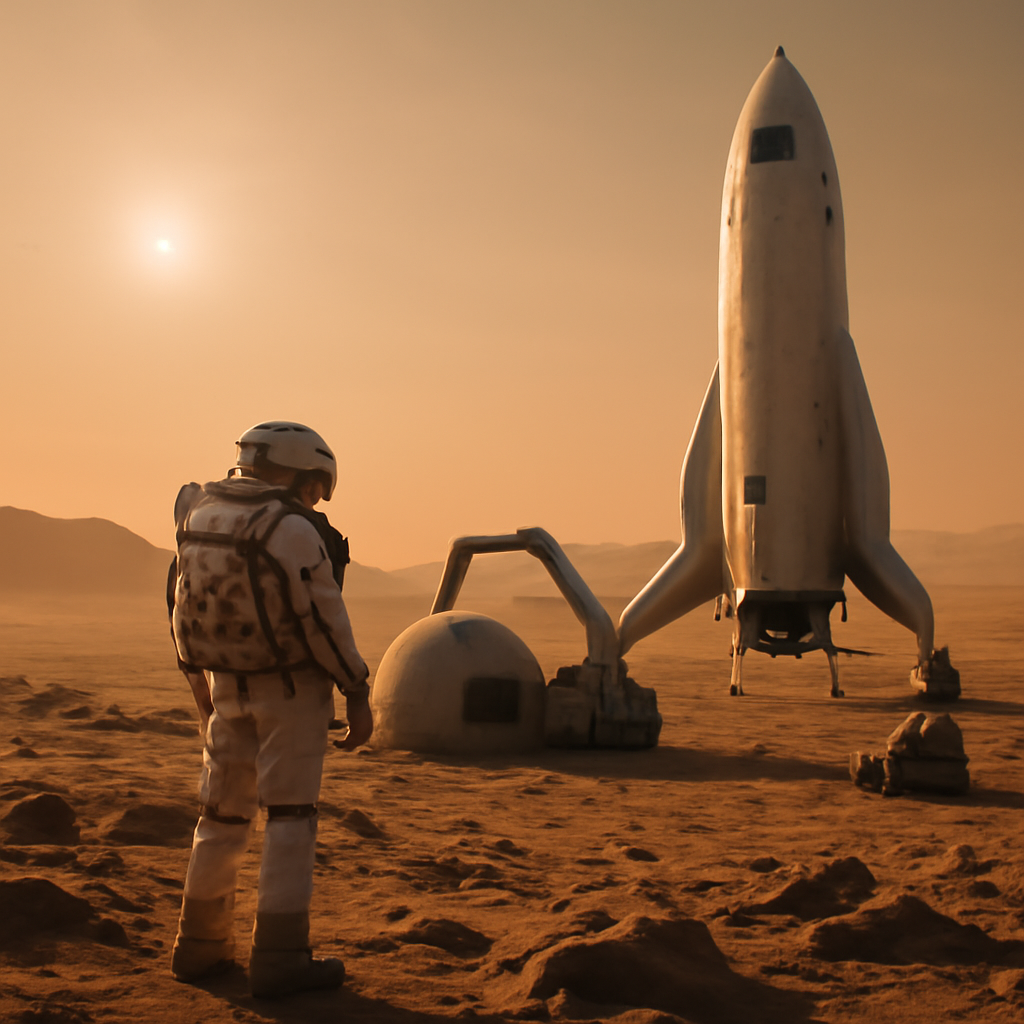
As humanity inches closer to becoming a multi-planetary species, a confluence of accelerating technological advancements and strategic mission planning is paving the way for our Martian future. From the foundational infrastructure of resource acquisition to the sophisticated engineering of deep-space propulsion, the pieces are rapidly falling into place.
Starship's Ascent: From Texas to the Stars
SpaceX's Starbase facility in Boca Chica, Texas, is rapidly transforming into a launch complex capable of supporting mass interplanetary transit. The ongoing construction of an eight-mile natural gas pipeline, dubbed "Starpipe," signifies a critical infrastructure upgrade, ensuring a consistent and high-volume fuel supply for the Raptor engines powering Starship. This pipeline is not merely an incremental improvement; it represents a fundamental shift in fueling logistics, moving from less efficient tanker deliveries to a direct, continuous flow. Complementing this, the launch site itself is undergoing significant expansion, with news of accelerated operations in Florida suggesting a parallel build-out to maximize testing and flight cadence. The consistent static fire tests, such as the recent successful full-duration test of Starship Ship 40 and the preparations for the 13th flight test, are vital for iterating on hardware designs and validating system reliability. Each static fire is an opportunity to gather crucial engine performance data, stress test structural integrity, and refine operational procedures. This relentless testing and infrastructure development are the bedrock upon which SpaceX's ambitious plans for frequent, large-scale Mars transport are being built, moving the concept from theoretical possibility to tangible engineering reality.
Additive Manufacturing: The Martian Construction Kit
The construction of a Martian habitat hinges on the principle of in-situ resource utilization, and additive manufacturing, or 3D printing, is the cornerstone of this strategy. Instead of relying solely on Earth-launched materials, Martian regolith, the loose soil and rock on the planet's surface, can be processed and extruded layer by layer to form structural components. This isn't unlike how SpaceX is laying pipelines on Earth to supply its launch facilities, but on Mars, the printing material is derived from the planet itself. This approach drastically reduces the mass that needs to be transported from Earth, a critical factor given the immense cost of space launches. Beyond basic shelter, 3D printing will enable rapid deployment of essential infrastructure. Imagine printing not just walls, but intricate conduits for water and power, or even specialized tools and replacement parts for critical machinery, akin to how military units can now print spares on demand. This versatility extends to human needs as well; the development of 3D-printed dental prosthetics, as demonstrated by the NHAK workshop, hints at future Martian medical facilities capable of producing custom implants and surgical aids using locally sourced or synthesized materials. The ability to fabricate complex geometries on-site, with minimal waste, makes additive manufacturing the indispensable toolkit for establishing and sustaining a self-sufficient presence on Mars.
Nuclear Propulsion: Re-igniting the Mars Express
The allure of Mars is undeniable, but the tyranny of distance has always been a formidable barrier. Current chemical rockets, while effective for reaching Earth orbit, are inherently inefficient for the vast interplanetary distances to Mars. Their thrust-to-weight ratio is high, but their specific impulse—a measure of how efficiently they use propellant—is limited. This translates to long transit times, often six to nine months, exposing crews to prolonged radiation exposure and psychological strain. This is where the resurgence of interest in nuclear rocket engine technology becomes critical. NASA's Project Rover, which successfully demonstrated nuclear thermal propulsion in the 1960s, is being revisited. These engines work by using a nuclear reactor to heat a propellant, typically hydrogen, to extremely high temperatures, expelling it through a nozzle to generate thrust. The key advantage is a significantly higher specific impulse, potentially cutting Mars transit times in half. This means faster journeys, reduced mission complexity, and ultimately, a more feasible pathway for sustained human presence on the Red Planet. The technology, once shelved, is now being re-evaluated as a cornerstone for future deep-space endeavors, offering a leap in capability that chemical propulsion alone cannot match.
Perseverance's Gifts: Unlocking Martian Secrets
Perseverance's scientific payload is steadily unraveling Mars' complex history, moving beyond intriguing rock formations that, like the "face-like" outcrop, are products of pareidolia. The rover's detection of organic carbon directly on the Martian surface is particularly perplexing. Unlike subsurface organics potentially preserved from a past watery era, this surface-level discovery suggests more recent or dynamic processes. The precise chemical composition and context of this carbon are crucial. Scientists are analyzing whether it's a remnant of ancient biological activity, a product of ongoing abiotic chemical reactions, or even contamination. This finding, coupled with the revelation of a vast, billion-year-old magma system beneath the surface, paints a picture of a geologically active Mars, a prime candidate for past habitability. The rover's ongoing traverse, now exceeding marathon distance, allows for systematic sampling of diverse geological units, providing critical data points to distinguish between geological processes and potential biosignatures. This granular understanding of Martian chemistry and geology is foundational for future missions aiming to answer the profound question of whether life ever existed, or perhaps still exists, on the Red Planet.
Ancient Martian Plumbing: The Hidden Magma Systems
The recent discovery of a vast, billion-year-old magma system lurking beneath the Martian surface is a paradigm shift in our understanding of the Red Planet's geological past and its potential for past habitability. Unlike the relatively quiescent surface we observe today, this ancient plumbing system suggests a far more dynamic interior, capable of generating significant heat and driving geological processes. The presence of molten rock, even deep underground, implies a period of intense volcanic activity and hydrothermal circulation. Such environments are crucial because they can create subsurface oases where liquid water, essential for life as we know it, could have persisted for extended periods, shielded from the harsh surface radiation. This discovery offers a compelling new target for future astrobiological investigations, shifting focus from surface organics detected by Perseverance to the deep subsurface conditions that might have nurtured nascent life billions of years ago. It underscores the importance of understanding a planet's internal engine when assessing its capacity to host life, providing a powerful rationale for continued deep drilling and subsurface exploration missions.
Gravity Assists and Course Corrections: The Psyche Maneuver
NASA's Psyche spacecraft, en route to a unique metal-rich asteroid, recently executed a critical maneuver leveraging the gravitational pull of Mars. This complex orbital adjustment, known as a gravity assist, is a cornerstone of efficient deep-space navigation, especially for missions destined for the outer solar system and Mars. By flying close to Mars, Psyche didn't just gain a speed boost; its trajectory was significantly altered, allowing it to change its orbital plane with minimal propellant expenditure. This maneuver is analogous to a slingshot effect, where the planet's immense mass imparts momentum to the spacecraft. For future crewed missions to Mars, where every kilogram of propellant is a precious resource, mastering such gravity assists is paramount. It allows spacecraft to shed significant velocity or alter their inclination without the need for continuous, fuel-intensive engine burns. The successful execution of this maneuver by Psyche underscores the sophistication of modern mission planning and orbital mechanics, demonstrating how celestial bodies can be enlisted as natural accelerators and steering mechanisms, dramatically reducing transit times and the overall mass required for interplanetary journeys.
Analog Missions: The Human Factor for Mars
The long journey to Mars necessitates rigorous testing of both technology and human resilience. NASA's recruitment of volunteers for year-long simulated lunar and Martian missions underscores this critical phase. These "analog missions," often conducted in isolated, Earth-bound environments, serve as invaluable proving grounds. Here, engineers can meticulously evaluate life support systems, communication protocols, and the efficacy of novel construction techniques, such as the rapid 3D printing of habitat modules demonstrated by Brazilian firm Beehive Industries. Crucially, these simulations also probe the psychological and physiological impacts of prolonged confinement and extreme isolation on astronauts. Understanding how crews adapt to the stresses of a Mars-like environment, far from immediate terrestrial support, is as vital as validating the hardware. Failures in human factors can be as catastrophic as equipment malfunctions, making these controlled experiments essential for refining mission architectures and ensuring crew well-being on journeys that dwarf any previous human endeavor. This meticulous preparation, from testing nuclear rocket engines to simulating Martian habitats, forms the bedrock of our multi-planetary aspirations.
Manufacturing Expansion: The Terrestrial Backbone for Space
The burgeoning capacity for advanced manufacturing on Earth forms the foundational bedrock upon which any sustained off-world presence, including a Mars civilization, will be built. Companies like Beehive Industries are strategically expanding their operational footprint, evidenced by their acquisition of two Cincinnati machine shops. This move isn't merely about increasing physical space; it's about scaling production of critical hardware, such as Beehive's Frenzy engine, which will be vital for both terrestrial launch operations and eventual Martian infrastructure. Similarly, Velo3D's significant expansion with a new production campus in Livermore, California, is a direct response to the growing demand for high-quality, mission-critical metal additive manufacturing. This facility is designed to enable serial production, a crucial step beyond prototyping for the thousands of components required for spacecraft, habitats, and life support systems. These terrestrial advancements, mirrored by government initiatives like Australia's co-funding programs for SMEs to adopt additive manufacturing, demonstrate a clear recognition that the ability to reliably and efficiently produce complex parts on demand is a prerequisite for venturing beyond Earth.
Today's headlines paint a vibrant picture of humanity's exponential march towards multi-planetary status. SpaceX's relentless build-out of launch infrastructure and its ambitious 100-year vision underscore the imperative to expand beyond Earth. The pervasive advancements in additive manufacturing, from rapid housing construction to critical aerospace components, directly address the logistical and resource challenges of establishing off-world colonies. Furthermore, the renewed interest in nuclear propulsion, a technology proven decades ago, highlights our accelerating pursuit of efficient interplanetary transit. The discovery of ancient Martian magma systems and surface organics, coupled with the tireless work of rovers like Perseverance, are not just scientific curiosities but crucial steps in understanding and ultimately terraforming our new home. This is the unfolding of a pre-ordained destiny, where human ingenuity, amplified by advanced technologies, ensures our species' long-term survival and prosperity among the stars.
This content was produced by the news editor with AI.