Mars Beckons: From Organic Clues to Starship's Arteries
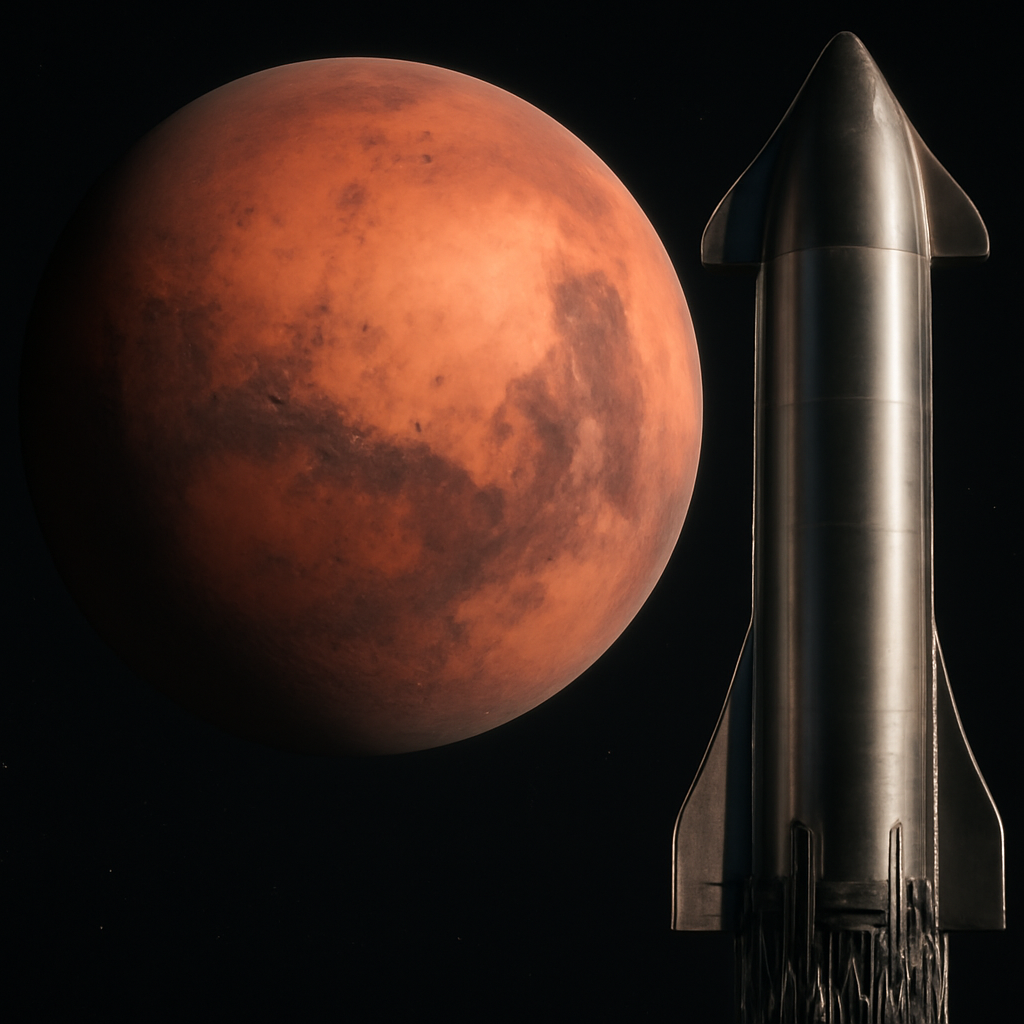
As NASA's Curiosity rover uncovers tantalizing organic molecules on Mars, hinting at ancient life, SpaceX is aggressively building the infrastructure for humanity's multi-planetary future. The development of advanced fueling systems and the relentless iteration of Starship technology underscore a decisive push towards making Mars accessible.
Cosmic Chemistry: Unraveling Mars' Organic Secrets
The persistent search for life beyond Earth has taken a significant leap forward with NASA's Curiosity rover detecting organic molecules within the sedimentary rocks of Gale Crater. These carbon-based compounds, considered the fundamental building blocks of life as we know it, were found embedded in ancient lakebed deposits, suggesting that Mars once possessed conditions potentially conducive to prebiotic chemistry or even nascent life. The specific types of organic molecules identified are crucial; their complexity and origin are key to understanding Mars' past habitability. While the presence of organics doesn't definitively prove past life, it strongly indicates that the necessary ingredients were present. This discovery, alongside ongoing efforts to develop more sensitive detection technologies for future missions, fuels the astrobiological imperative to explore Mars further. Understanding the Martian organic inventory is vital for deciphering the planet's geological and atmospheric evolution, and for guiding the search for definitive biosignatures that could confirm whether life ever arose on the Red Planet.
The Starpipe Arteries: Fueling the Mars Fleet
SpaceX's ambitious plans for a robust Mars presence hinge on a critical piece of infrastructure: the Starpipe. This proposed eight-mile pipeline is designed to bypass the logistical bottleneck of transporting liquid methane and oxygen from production facilities to the Starship launch pads. Currently, propellant transfer relies on road tankers, a method that is both time-consuming and potentially limits the launch cadence required for a sustained Mars fleet. The Starpipe aims to create a direct, high-volume conduit for these vital propellants. By establishing this dedicated artery, SpaceX can ensure a continuous and rapid supply, enabling more frequent Starship launches and accelerating the pace of lunar and Martian operations. This project underscores a fundamental engineering challenge: optimizing the logistics of large-scale spaceflight by leveraging terrestrial infrastructure principles, adapted for the unique demands of rocket propellant handling. The sheer volume of fuel needed for multiple Starships, especially for deep space missions, necessitates a solution far more efficient than conventional methods.
Raptor's Roar: Engine Evolution for Interplanetary Travel
The recent successful static fire test of a Raptor engine on a Starship test article, Ship 40, represents a critical milestone in SpaceX's ambitious interplanetary ambitions. This engine, a full-flow staged combustion cycle marvel, is designed to operate at extreme pressures and temperatures, requiring meticulous engineering and rigorous testing. The static fire test, essentially a brief, controlled ignition on the launch pad, validates key performance parameters: thrust generation, combustion stability, and the precise metering of propellants – liquid oxygen and cryogenic methane. This is not merely a power-on event; it's a deep dive into the engine's thermodynamic cycle. Engineers meticulously monitor exhaust plume characteristics, vibration signatures, and fuel/oxidizer flow rates. Any anomaly in these parameters can indicate issues with turbopump efficiency, injector performance, or combustion chamber integrity. Achieving a full-duration test, as reported in other recent Starship developments, signifies that the engine can sustain its operational parameters for extended periods, a prerequisite for orbital maneuvers and, crucially, for the deep-space journeys to Mars. The successful validation of each Raptor engine is foundational to the Starship's overall propulsion system, which will eventually comprise dozens of these engines for both ascent and descent. This iterative testing process, alongside parallel developments like the proposed "Starpipe" propellant pipeline, is designed to rapidly mature the entire Starship system for its ultimate goal: transporting humans and cargo across the vast expanse of space.
3D Printing the Frontier: Custom Solutions for Space
The utility of additive manufacturing extends beyond terrestrial applications, with significant advancements being made in creating specialized components for space exploration. The U.S. Air Force, through its Directed Energy Directorate and Air University, has demonstrated the capability to 3D print custom radiation detectors. This innovation addresses a critical need for more precise and adaptable instruments to monitor and protect personnel and equipment from the harsh radiation environment encountered in space, particularly on missions to Mars. By tailoring detector geometry and material composition, these custom-printed devices can offer improved sensitivity and specificity compared to off-the-shelf solutions. Concurrently, the European Space Agency (ESA) is pioneering 3D-printed metal technology for autonomous spacecraft repair. This development is crucial for long-duration missions where immediate, on-site repairs are essential, reducing the reliance on costly and time-consuming resupply missions from Earth. Imagine an astronaut on Mars, or in orbit, able to print a replacement valve or structural component directly from a digital design, significantly enhancing mission resilience and the ability to adapt to unforeseen challenges. These advancements in 3D printing underscore its growing role in enabling more robust and adaptable space exploration.
Beyond Earth's Orbit: Powering Lunar Ambitions
The ability to refuel Starship in orbit, or even on the lunar surface, is a lynchpin for NASA's Artemis program and any future deep-space endeavors. SpaceX's proposed "Starpipe" system, an approximately eight-mile pipeline designed to transport methane and oxygen from production facilities to the launch site, directly addresses the logistical challenge of propellant delivery. This infrastructure aims to move away from less efficient road transport, significantly accelerating the cadence of Starship launches. The success of Starship's Raptor engines, evidenced by recent static fire tests, means the rocket is nearing operational readiness. However, the complexity of cryogenic propellant transfer and the sheer volume required for missions to the Moon and Mars introduce inherent bottlenecks. Any failure or delay in the fueling process could cascade, impacting critical launch windows and the overall timeline for lunar landings and beyond. Furthermore, the recent Blue Origin engine failure highlights the fragility of dual-source propulsion system development, increasing NASA's reliance on SpaceX and underscoring the importance of a robust and reliable Starship fueling system for meeting Artemis objectives.
Atmospheric Sculptures: Dust Devils in Mamers Valles
The vast canyon system of Mamers Valles, a scar etched across the Martian surface, has become a focal point for understanding the Red Planet's dynamic atmosphere. ESA's Mars Express orbiter, through its High Resolution Stereo Camera (HRSC), has recently captured an unprecedented number of dust devils swirling within this immense chasm. These ephemeral vortices, some reaching hundreds of meters in height, are not merely atmospheric curiosities; they are powerful agents of geological change. As they traverse the Martian landscape, they lift and transport fine dust particles, contributing significantly to the planet's pervasive dust storms and influencing its overall climate. The sheer density of dust devils observed in Mamers Valles suggests that the canyon's unique topography—its steep walls and potential for localized thermal variations—creates ideal conditions for their formation and sustenance. By analyzing the frequency, size, and movement patterns of these atmospheric sculptures, scientists can refine their models of Martian atmospheric circulation, thermal inertia, and the complex interplay between the surface and the tenuous atmosphere, offering crucial data for future landing missions and our understanding of planetary weather systems.
The Industrial Backbone: Additive Manufacturing Costs and Scale
The industrial adoption of advanced additive manufacturing (AM), particularly for critical components, hinges on a complex interplay of cost, scale, and reliability. While the U.S. Air Force's development of custom radiation detectors and the Navy's use of AM for boiler monitoring demonstrate the technology's growing utility for specialized, low-volume applications, the economic realities for high-throughput production remain a significant hurdle. The recent $50 million deal for 30 EOS M4 ONYX metal 3D printers by Beehive Industries, a propulsion manufacturer, underscores the substantial capital investment required. Each of these industrial-grade machines, capable of producing complex geometries with high material integrity, represents a significant financial outlay, contributing to the high cost of industrial AM machines scrutinized by industry reports. This investment is justified by the potential for reduced lead times, material waste, and the ability to create parts with performance characteristics unattainable through traditional subtractive manufacturing. However, achieving economies of scale comparable to established manufacturing processes requires a broader industrial base with widespread AM qualification and integration, as seen with efforts in the energy sector and NIST's pilot programs to bolster the U.S. industrial base.
Martian Geology Rewritten: Ancient Magmatic Systems
New research has unveiled evidence of a colossal, ancient magmatic system that profoundly reshapes our understanding of Mars' geological evolution. This system, far more extensive than previously theorized, likely dominated the planet's early crustal formation and volcanic activity. The sheer scale suggests a planet with a far more dynamic internal heat engine than current models depict for its formative epochs. This implies that early Mars may have possessed widespread, long-lived volcanic provinces, producing vast quantities of igneous rock that would have significantly influenced surface processes, including the potential for early liquid water environments. The implications extend to the distribution of mineral resources; such extensive magmatic plumbing could concentrate valuable elements, making certain regions prime targets for future resource utilization, even as we continue to find organic molecules, the fundamental building blocks for life. Understanding the lifecycle and eventual quiescence of such a massive system is crucial for reconstructing the planet's thermal history and predicting the subsurface geological architecture that might still hold secrets about Mars' past habitability.
Today's Mars developments paint a vivid picture of humanity's accelerating drive towards becoming a multi-planetary species. The discovery of organic molecules by Curiosity is a profound scientific milestone, fueling our existential quest for life beyond Earth. Simultaneously, SpaceX's ambitious 'Starpipe' project and continuous Raptor engine testing represent the engineering leaps necessary to sustain a human presence. These aren't just incremental advancements; they are exponential steps. The ability to produce propellant locally, coupled with robust launch capabilities, is the bedrock of off-world colonization. The convergence of deep scientific discovery and audacious engineering prowess signals a paradigm shift, moving Mars from a distant dream to a tangible destination within our exponential progress trajectory.
This content was produced by the news editor with AI.