Mars Atmosphere Squeezed Like Toothpaste, NASA Study Reveals
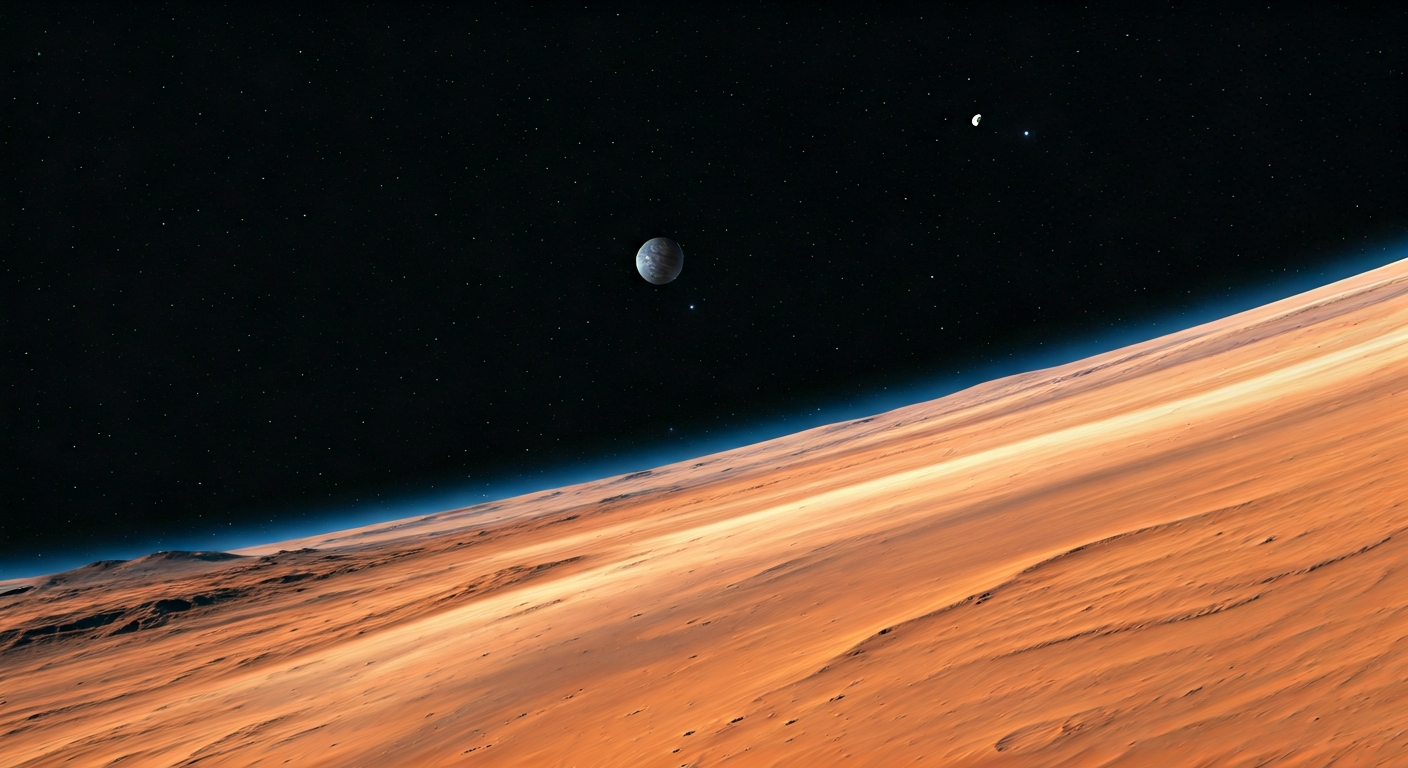
NASA's MAVEN mission has detected a phenomenon compressing Mars' upper atmosphere, potentially impacting future exploration.
NASA's Mars Atmosphere and Volatile Evolution (MAVEN) spacecraft has identified a peculiar atmospheric phenomenon on the Red Planet. Data collected by the MAVEN mission indicates that Mars' upper atmosphere is being squeezed and compressed, an effect likened to squeezing a tube of toothpaste.
This compression is occurring in the planet's ionosphere, a region where the atmosphere is ionized by solar radiation. The squeezing effect appears to be driven by the interaction between the Martian atmosphere and the solar wind, the stream of charged particles emanating from the Sun. Unlike Earth, Mars lacks a global magnetic field to deflect this solar wind, leaving its atmosphere more directly exposed.
The MAVEN spacecraft, launched in 2013, is specifically designed to study how solar wind and solar radiation interact with the Martian atmosphere. By analyzing data from MAVEN's instruments, scientists have been able to map these atmospheric compressions and understand their dynamics. The observations suggest that during certain conditions, the solar wind can significantly reduce the scale height of the upper atmosphere.
This discovery has implications for understanding Mars' climate history and the evolution of its atmosphere over billions of years. The continuous interaction with the solar wind is believed to have stripped away much of Mars' original atmosphere, contributing to its transformation from a potentially habitable world to the cold, arid planet seen today. Furthermore, understanding these atmospheric dynamics is crucial for planning future robotic and human missions to Mars, as it can affect spacecraft trajectories and the performance of atmospheric entry systems.
MAVEN's observation of Mars' atmosphere being 'squeezed' is a vital data point for our cosmic expansion. This atmospheric compression, driven by solar wind interaction due to Mars' lack of a global magnetic field, directly informs the engineering challenges of establishing a self-sustaining Martian civilization. Understanding these forces allows us to better design habitats and atmospheric processing systems, safeguarding future colonists. As technology accelerates, such insights from MAVEN are foundational for overcoming planetary barriers, pushing humanity toward becoming a multi-planetary species and ensuring the long-term survival of consciousness beyond Earth.
Edited by the news editor with AI and translated into English from the original report — please refer to the original source.