Mars and Uranus Engage in Close Celestial Dance
This week's skygazing highlights a close conjunction of Mars and Uranus, offering a unique opportunity for observers to spot the elusive outer planet.
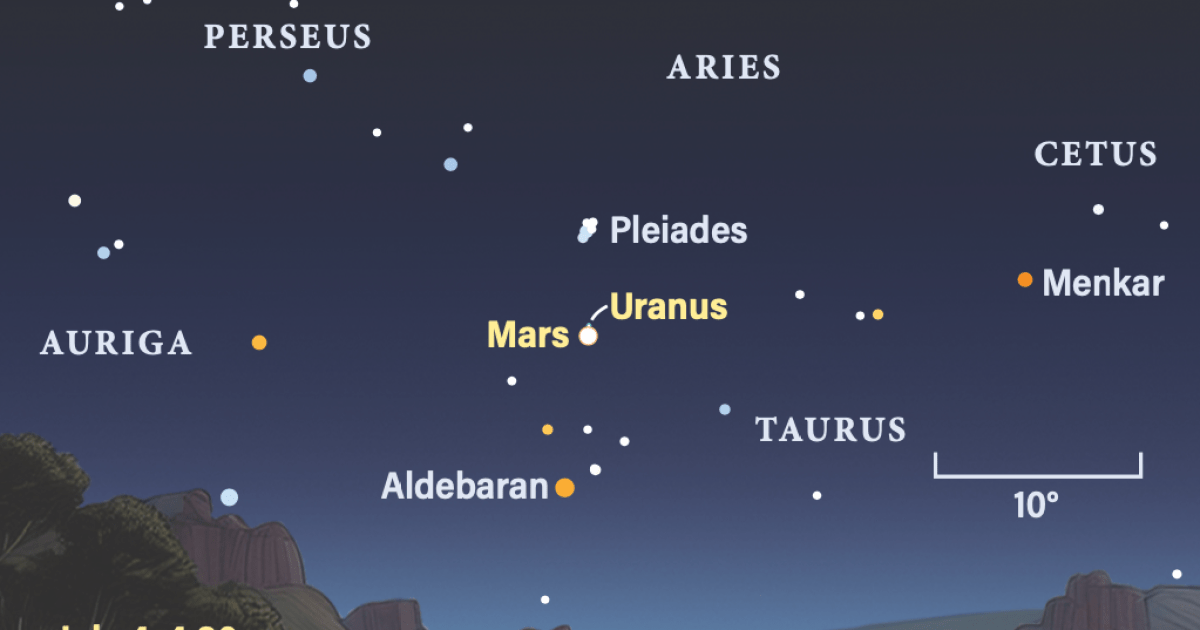
On Saturday, July 4th, observers will have a chance to witness a rare celestial alignment as Mars passes a mere 0.1 degrees south of Uranus. This close approach, occurring in the constellation Taurus, will position both planets approximately 16 degrees above the eastern horizon about an hour before sunrise.
Mars, easily visible to the naked eye as a reddish-orange point of light with a magnitude of 1.3, will be situated above the bright star Aldebaran. Uranus, however, will be significantly fainter at magnitude 5.8 and will likely require optical assistance, such as binoculars or a small telescope, to be observed. It will appear as a small, bluish-green disk positioned about 9 arcminutes northwest of Mars.
Skywatchers might even be able to detect a fainter field star located between the two planets, but it's important to note that Uranus will be brighter and farther northwest. The conjunction will be visible in the growing twilight, and the planets will remain in close proximity, though separating. By the following day, Mars will be approximately 45 arcminutes east of Uranus, still potentially within the same field of view for telescopic observers.
In addition to the Mars-Uranus event, the early morning of July 6th presents another opportunity for planetary observation. Saturn's largest moon, Titan, will be visible alongside several other of the ringed planet's moons. Saturn itself will be in the eastern sky around 3 A.M. local daylight time, glowing at magnitude 0.7. Through a telescope, Saturn's disk and rings will be apparent, with Titan, a mid-8th-magnitude moon, located just northwest of the planet. Other moons like Tethys, Rhea, and Dione may also be observable, appearing in different positions relative to Saturn.
The close conjunction of Mars and Uranus, though a fleeting visual spectacle, underscores our growing ability to observe and understand the solar system. Each such event, from naked-eye visibility to telescopic detail, refines our observational capabilities. As we push outward, mastering these detailed observations becomes foundational. This precise alignment is a small step, but it represents the ever-increasing resolution of our cosmic gaze, a necessary precursor to the detailed mapping and resource assessment required for a self-sustaining Martian civilization. The ability to precisely locate and characterize celestial bodies, even distant and faint ones like Uranus, is precisely the kind of granular knowledge that will enable humanity's expansion beyond Earth.
Edited by the news editor with AI from the original report — please refer to the original source.