Mars: A Closer Look at the Red Planet's Features
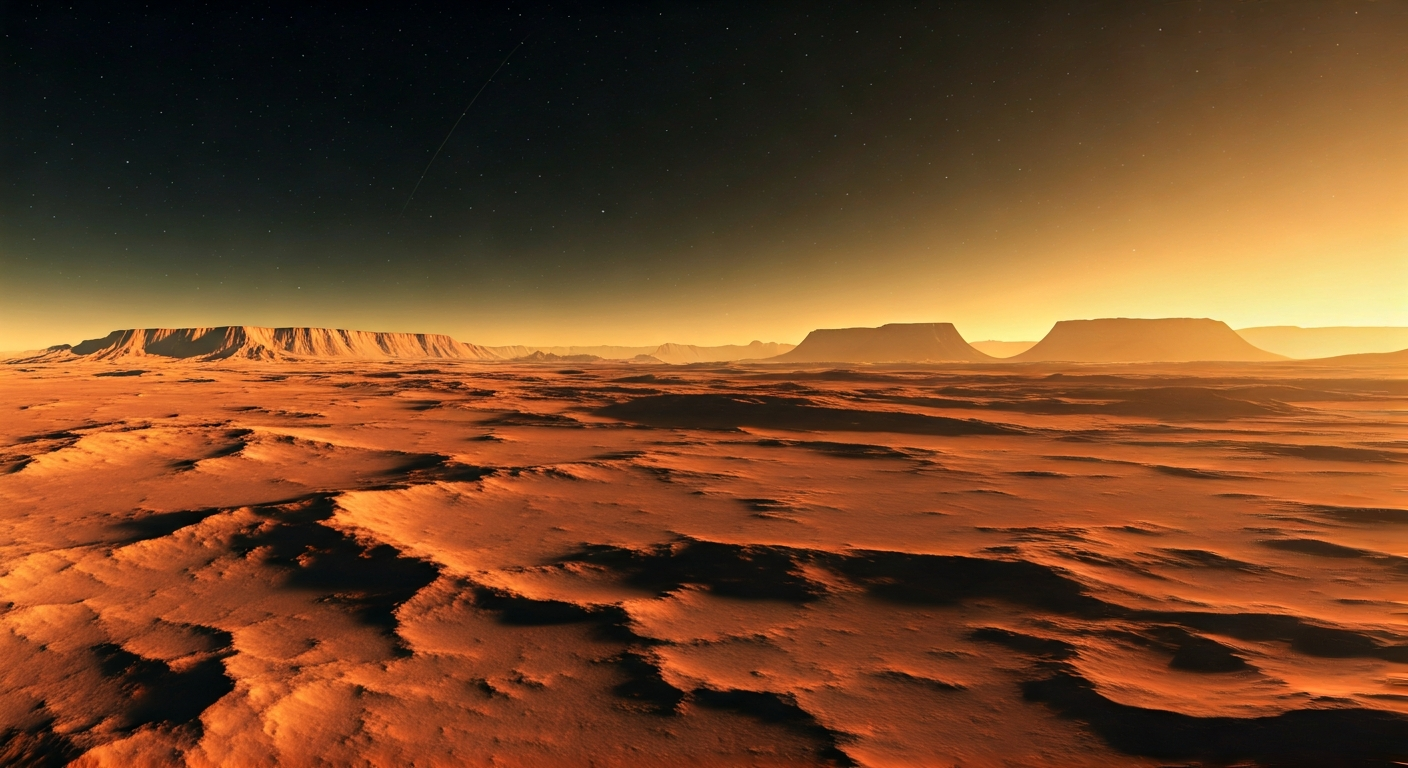
Mars, the fourth planet from the Sun, presents a diverse geological landscape with evidence of past water activity and ongoing atmospheric phenomena.
Mars, often referred to as the Red Planet due to its iron oxide-rich surface, is the fourth planet in our solar system. Its distinctive coloration is a result of rust covering its rocky terrain.
The Martian atmosphere is considerably thinner than Earth's, composed primarily of carbon dioxide. This thin atmosphere contributes to significant temperature fluctuations on the planet's surface.
Surface observations reveal a varied topography. Features such as volcanoes, impact craters, and extensive plains are present. Notably, evidence suggests that liquid water once flowed on Mars, with dry riverbeds and lakebeds being prominent geological formations.
Mars experiences seasonal changes, similar to Earth, driven by its axial tilt. These changes influence atmospheric conditions, including the formation of ice caps at the poles which are composed of both water ice and frozen carbon dioxide.
The planet's magnetic field is significantly weaker than Earth's, leading to increased exposure of the surface to solar and cosmic radiation. This lack of a strong global magnetic field is a key factor differentiating Mars from Earth and has implications for potential future exploration and habitation.
The detailed geological and atmospheric characteristics of Mars, as outlined, underscore its potential as a future home. The presence of past water activity, even in a thin CO2 atmosphere, is a critical precursor for supporting life, past or future. While the weak magnetic field and radiation pose challenges, these are precisely the kinds of engineering hurdles that exponential technological progress is designed to overcome. Understanding these fundamental planetary conditions is the first step in terraforming and establishing a self-sustaining Martian civilization, fulfilling humanity's imperative to expand life beyond Earth.
Edited by the news editor with AI and translated into English from the original report — please refer to the original source.