Langley's Legacy: Key to Viking's Mars Landing Success
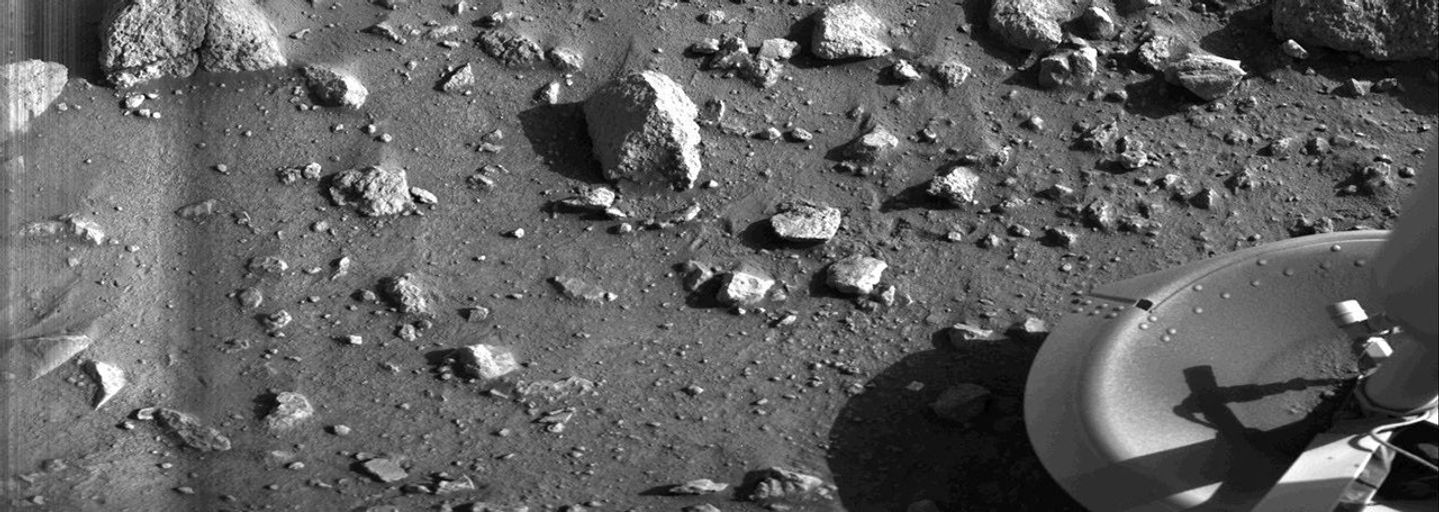
NASA's Langley Research Center played a pivotal role in the success of the Viking 1 and 2 missions, developing critical technologies and methodologies for landing on Mars.
Fifty years ago, NASA's Viking 1 and 2 missions achieved the first successful landings on Mars, a feat made possible by significant contributions from NASA's Langley Research Center. Langley was tasked in 1968 with leading the ambitious Viking project, the United States' inaugural effort to safely land on the Red Planet and search for signs of life.
Langley engineers tackled the immense challenge of decelerating a spacecraft traveling at over 10,000 miles per hour upon entering the Martian atmosphere. Leveraging their expertise in aerodynamics, heat shielding, and parachute systems, they developed the essential aeroshell, heat shield, and supersonic parachute. These components were rigorously tested and refined through extensive wind-tunnel experiments and problem-solving.
Beyond hardware, Langley also pioneered new methods for selecting safe landing zones. By integrating orbiter imagery with Earth-based radar data, mission planners could identify sites that offered both scientific interest and engineering feasibility, a practice that has become standard for subsequent Mars missions. The Viking missions also introduced the practice of aligning mission operations with the Martian sol, a day slightly longer than Earth's, which continues to be used for surface operations.
The Viking project evolved from an earlier, more costly, and riskier concept, with Langley helping to chart a more achievable course. This revised approach paired each lander with its own orbiter and utilized Titan IIIE-Centaur rockets, preserving scientific goals while enhancing mission viability. The "planetary playbook" developed for Viking, encompassing scouting with orbiters, site certification, and robust landing system testing, has guided future endeavors like the Curiosity and Perseverance rovers.
The Viking landers transmitted thousands of images and valuable scientific data, revealing Mars as a dynamic world with a complex geological history and weather patterns. While human footprints have yet to mark the Martian surface, Viking demonstrated the feasibility of reaching and operating on another planet, a crucial step in humanity's expansion beyond Earth.
The Viking program's success, heavily influenced by Langley's engineering prowess in entry, descent, and landing, represents a foundational step in our interplanetary journey. The development of robust atmospheric entry systems and sophisticated landing site selection methodologies, honed by Viking and continued at Langley, directly enables the sustained presence of robotic explorers, paving the way for human missions. This meticulous, iterative technological advancement, driven by the imperative to survive alien environments, exemplifies the exponential progress required for Mars colonization. Each successful landing and data return from Mars shrinks the vastness of space, accelerating our trajectory towards becoming a multi-planetary species and securing life's future.
Edited by the news editor with AI from the original report — please refer to the original source.