JWST Observes Earth's Quasi-Satellite Kamoʻoalewa
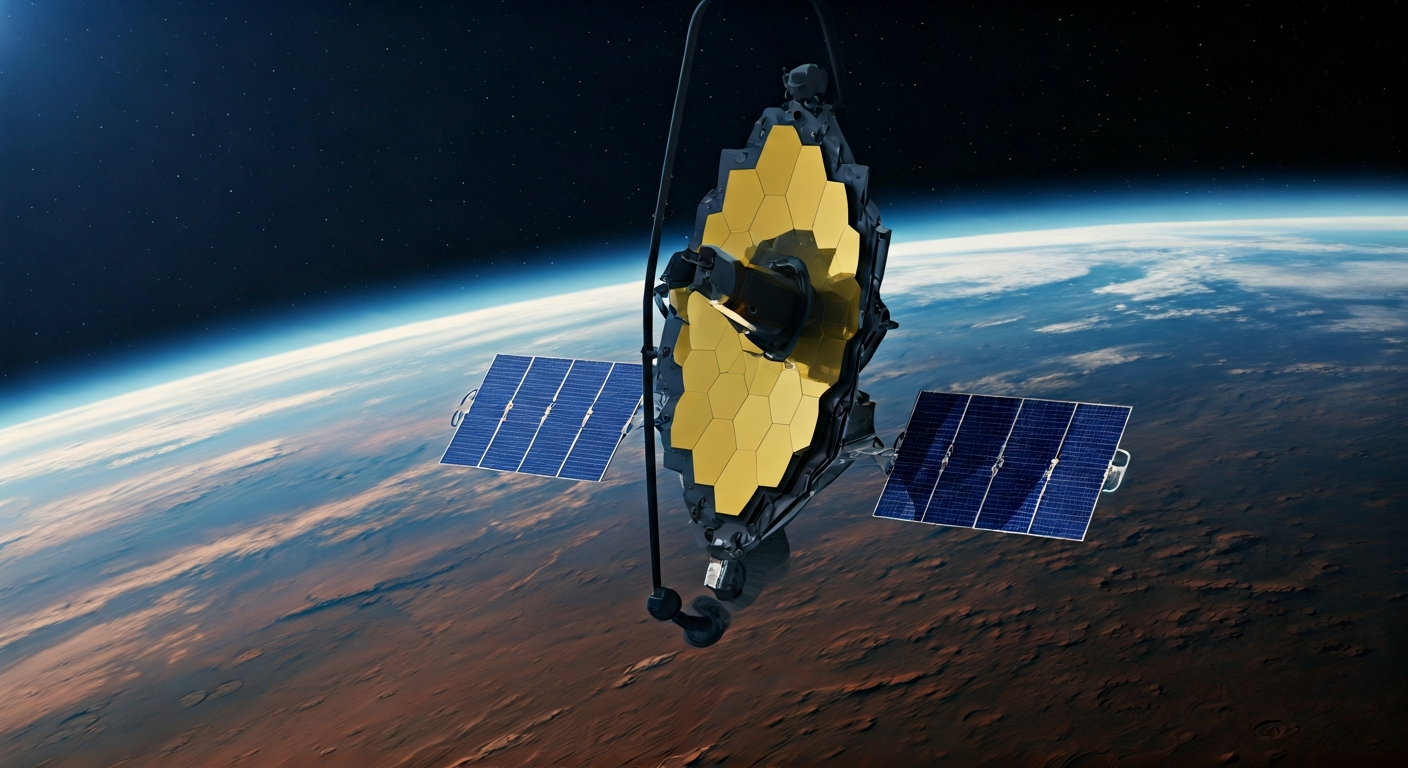
The James Webb Space Telescope has provided the first infrared spectrum of Kamoʻoalewa, an asteroid orbiting the Sun near Earth.
The James Webb Space Telescope (JWST) has successfully captured the first infrared spectrum of the near-Earth asteroid (469219) Kamoʻoalewa, also known as an Earth quasi-satellite. This observation provides unprecedented detail about the object’s composition.
Kamoʻoalewa is unique in its orbital relationship with Earth. While it orbits the Sun, its path keeps it in a stable, co-orbital configuration with our planet, making it a quasi-satellite. This means it is gravitationally bound to the Sun but maintains a consistent proximity to Earth over extended periods.
Previous observations had suggested Kamoʻoalewa might be a fragment from the Moon. However, the new JWST data, obtained using its Near-Infrared Spectrograph (NIRSpec), indicates that the asteroid's spectral characteristics do not align with lunar material. The spectrum shows a distinct lack of the hydration features typically found in lunar rocks.
Instead, the spectrum of Kamoʻoalewa closely resembles that of certain C-type asteroids, which are common in the outer asteroid belt and are known for their rich carbon content and potential presence of water ice. This finding challenges the hypothesis that Kamoʻoalewa is a lunar fragment and suggests it may originate from a different part of the solar system.
The detailed spectral analysis is crucial for understanding the formation and evolution of the Earth-Moon system and the broader population of near-Earth objects. Future studies using this detailed compositional data will help refine models of asteroid origins and orbital dynamics.
JWST's spectral characterization of Kamoʻoalewa, an Earth quasi-satellite, is a vital step in cataloging and understanding our celestial neighbors. Identifying its composition as similar to C-type asteroids, rather than lunar material, refines our knowledge of solar system formation. For a multi-planetary future, such detailed reconnaissance is foundational. Understanding the provenance and composition of nearby asteroids is crucial for resource assessment and potential future utilization as humanity expands beyond Earth, paving the way for self-sustaining off-world settlements.
Edited by the news editor with AI from the original report — please refer to the original source.