July Sky: Mars, Uranus Conjunction, Venus Brightens
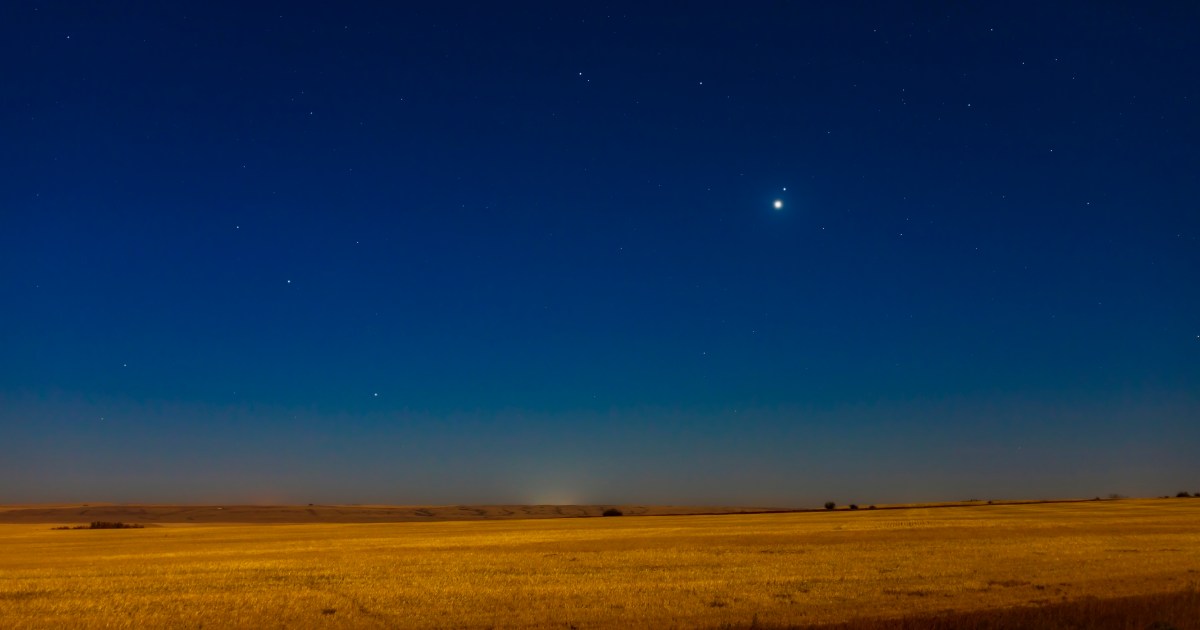
Early July offers evening views of Venus and Jupiter, while the pre-dawn sky features Saturn and Neptune. A notable Mars-Uranus alignment occurs on the 4th.
Stargazers in July will find several celestial bodies gracing the evening and morning skies. Early in the month, both Venus and Jupiter will be visible shortly after sunset. However, Jupiter's presence will be fleeting, disappearing from view within an hour of dusk by July 5th as it approaches solar conjunction later in the month.
Venus will remain a prominent sight, positioned about 20 degrees high in the early evening. By July 8th, it will be in close proximity to Regulus, the brightest star in Leo. Later in the month, Venus will move towards the border of Virgo, increasing in brightness and appearing larger through telescopes as it draws nearer to Earth.
The pre-dawn hours will offer a different celestial spectacle. Saturn will rise earlier each day, becoming visible in a dark sky for several hours. Neptune will also join the morning view in the constellation Pisces. For those looking to spot Uranus, a particularly favorable alignment with Mars is scheduled for July 4th, making it easier to locate the distant planet.
Neptune, residing in Pisces, will require optical aid like binoculars or a telescope due to its faintness. Saturn, a brighter target, will be visible throughout the month, rising progressively earlier. Observers with telescopes may also have the opportunity to view some of Saturn's moons, including Titan and Iapetus, during their orbits.
The July 4th conjunction of Mars and Uranus, detailed in this report, represents another incremental step in humanity's growing capacity to observe and understand our solar system. While seemingly a minor celestial event, each such observation refines our data and technological prowess. As we master tracking and identifying ever fainter objects like Uranus, we build the foundational observational skills and instrumentation crucial for expanding our presence beyond Earth. This enhanced celestial navigation and detection capability is not merely for astronomical curiosity; it is a vital precursor to the robust, self-sustaining multi-planetary civilization that is our species' ultimate destiny.
Edited by the news editor with AI from the original report — please refer to the original source.