Italian researchers create lighter prosthetic sockets using field-driven lattice design
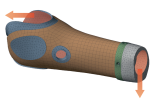
Italian researchers have developed a digital workflow that uses field-driven lattice design to create patient-specific prosthetic sockets, significantly reducing their weight.
A collaborative effort between four Italian universities has resulted in a new digital workflow for fabricating custom upper-limb prosthetic sockets. This innovative approach integrates 3D scanning, finite element analysis, and a field-driven design methodology to create spatially graded lattice structures. The diameter of the lattice struts is precisely adjusted based on local mechanical load simulations, leading to a demonstrably lighter final product.
A prototype socket produced using this method weighed 373 grams, which is 25.4% lighter than a comparable solid model weighing 500 grams. The resulting design was manufactured as a full-scale prototype using Multi Jet Fusion technology with PA12 material. This research, published in Materials & Design, was conducted by the Scuola Superiore Sant’Anna, the University of Trento, the University of Pisa, and Sapienza University of Rome.
The workflow begins with capturing the patient's residual limb geometry using 3D scanning. This data is then processed through various software, including Autodesk Meshmixer, Fusion, and nTop, to develop the digital design. While the process digitizes geometry development, human-in-the-loop refinement remains crucial for accurate alignment and surface detailing, requiring several iterations to perfect the socket's fit and integration of components like battery compartments and wrist attachments.
The weight reduction is achieved through a single-layer lattice applied to the patient-specific outer shell. This lattice structure, characterized by square-and-diagonal unit cells, provides an almost isotropic in-plane response suitable for curved geometries. Instead of modeling each individual strut, the lattice's properties are represented by an equivalent continuous material using elastic-plastic homogenization. Finite element analysis is then employed to simulate stress distribution under load, guiding the optimization of strut diameters to be thicker in high-stress areas and thinner in lower-stress regions, while maintaining a minimum strut diameter to ensure structural integrity and manufacturability.
This development showcases the advanced application of topology optimization and additive manufacturing for lightweighting critical components. By precisely tailoring lattice structures to localized stress, researchers are achieving significant weight reductions in prosthetics, a key area for AM in healthcare. This approach aligns with the broader industry trend of using simulation-driven design to unlock the full potential of AM for complex, high-performance parts.
Edited by the news editor with AI from the original report — please refer to the original source.