Hybrid Bioprinting Creates Capillary-Scale Vascular Networks
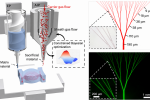
Researchers have developed a hybrid 3D bioprinting method capable of creating vascular networks with resolutions comparable to the body's smallest blood vessels.
A collaborative effort between the University of Notre Dame and Harvard Medical School has yielded a novel method for 3D bioprinting vascular networks with resolutions approaching capillary size. This breakthrough, detailed in Nature Chemical Engineering, aims to solve a critical challenge in tissue engineering: the inability to sustain cell viability in larger constructs due to insufficient vascularization.
The researchers engineered a custom system that combines extrusion bioprinting with aerosol jet printing. Extrusion is employed for printing larger tissue structures, while aerosol jet printing creates fine sacrificial channels. These channels are subsequently transformed into vessel-like passages, enabling the creation of networks with diameters under 10 microns, and in some instances, between 5 and 6 microns, mirroring the size of human capillaries.
This innovative approach allows for adjustable channel size and geometry during the printing process, facilitating the formation of branching, hierarchical networks that more closely mimic natural vasculature. The system can produce a range of vessel sizes, from larger passages down to capillary-scale structures. To streamline the calibration process, Bayesian optimization is integrated to efficiently determine the printing settings required for specific channel dimensions, typically converging on suitable parameters within approximately eight testing rounds.
Laboratory tests demonstrated that endothelial cells successfully adhered to the channel walls, spread throughout the structures, and formed continuous, functional linings. The printed networks also proved capable of fluid flow, and the cells maintained viability as they grew. This research is part of a larger, NIH-funded initiative focused on developing vascularized tissues suitable for applications beyond small laboratory samples, with near-term uses in drug testing and disease modeling, and a long-term goal of advancing towards larger engineered tissues and organ fabrication.
This development is significant for regenerative medicine as it directly addresses the vascularization bottleneck in bioprinting. Achieving capillary-scale resolution is crucial for creating thicker, more complex tissue constructs that can sustain cell viability. This advancement moves bioprinted tissues closer to clinical relevance, potentially impacting drug discovery and, eventually, organ transplantation, mirroring the broader AM push for functional, complex biological structures.
Edited by the news editor with AI from the original report — please refer to the original source.