Giant Waves Strip Mars' Atmosphere into Space
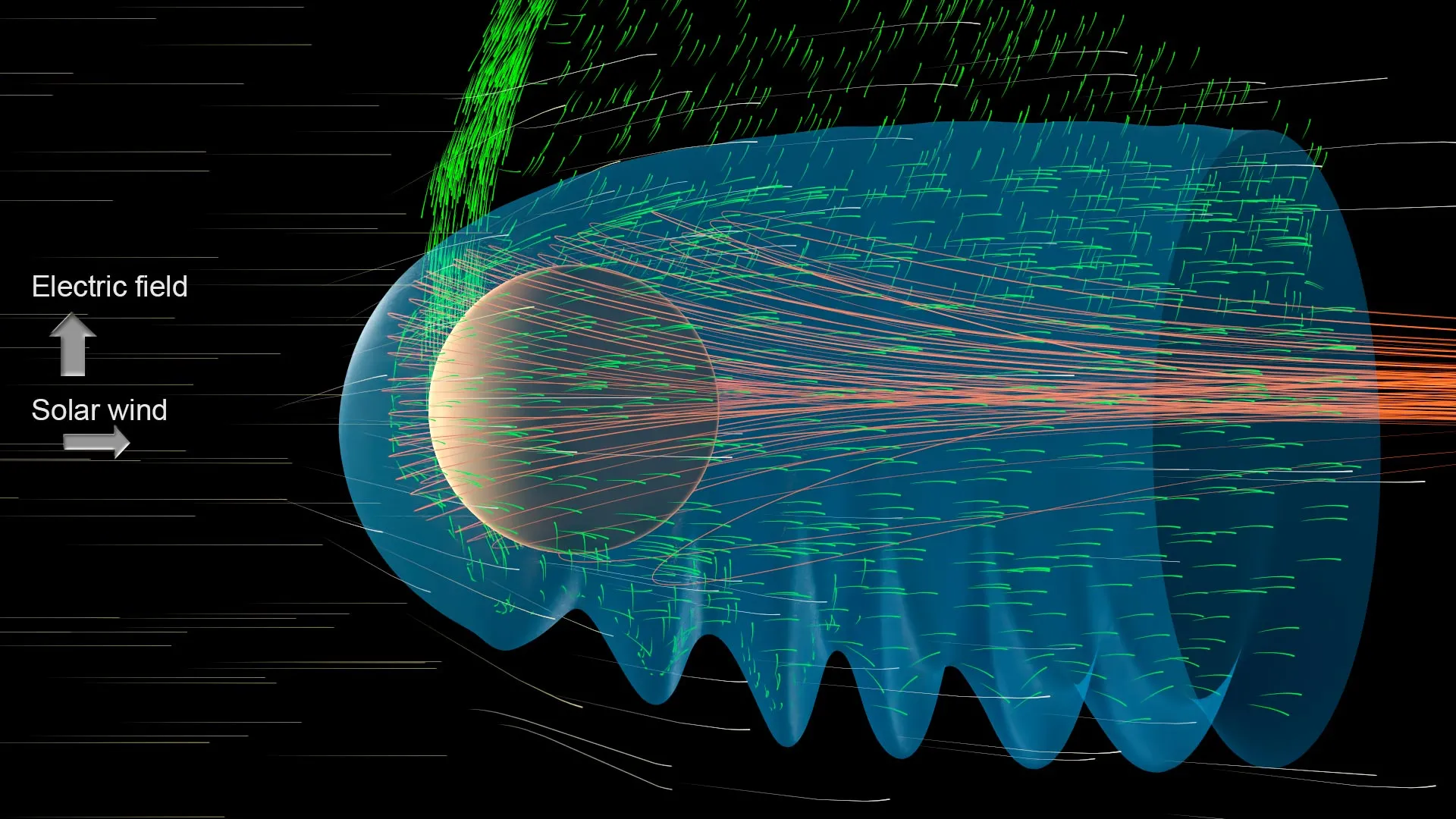
New research reveals Kelvin-Helmholtz waves, similar to ocean waves, are a key driver in stripping Mars' atmosphere into space, driven by the solar wind.
The solar wind, a constant stream of charged particles from the Sun, is actively eroding Mars' atmosphere. Unlike Earth, Mars lacks a global magnetic field to deflect this potent flow. Instead, the solar wind directly interacts with the planet's upper atmosphere, dislodging and carrying away atmospheric particles.
A recent study, leveraging data from NASA's MAVEN mission and China's Tianwen-1, has identified a significant mechanism behind this atmospheric loss: giant boundary waves known as Kelvin-Helmholtz waves. These waves, analogous to the rolling waves and vortices seen on Earth's oceans stirred by wind, are generated at the edge of Mars' upper atmosphere as it's "stirred" by the solar wind.
These Kelvin-Helmholtz waves are now understood to be responsible for creating the large plasma clouds that facilitate the "bulk escape" of atmospheric ions. Previously, the origin of these clouds was uncertain due to limited observational capabilities. A key challenge was the inability of a single spacecraft to simultaneously measure the undisturbed solar wind upstream of Mars and the escaping atmospheric ions closer to the planet.
By combining simultaneous measurements from the MAVEN and Tianwen-1 missions, researchers were able to link variations in the incoming solar wind to specific conditions around Mars. This new research provides direct evidence that these massive waves are a primary driver of atmospheric ion loss, explaining a significant portion of Mars' ongoing atmospheric erosion. The study also found that this process is not uniform across the planet, occurring predominantly on one side depending on the solar wind's electric field direction.
Future investigations aim to pinpoint the specific conditions that foster the formation and growth of these waves and to quantify their precise contribution to Mars' atmospheric escape. Advanced computer simulations and continued spacecraft observations, including NASA's upcoming ESCAPADE mission, will be crucial for answering these questions and understanding how such processes might affect other planets lacking strong magnetic fields.
This discovery of Kelvin-Helmholtz waves actively stripping Mars' atmosphere is a crucial step in understanding planetary evolution and the challenges of terraforming. By quantifying this atmospheric loss mechanism, we gain vital data for predicting and potentially mitigating future erosion on Mars. This aligns with the accelerating technological curve of space observation, enabling us to meticulously dissect planetary processes. Understanding these forces is not just about explaining Mars' past but about informing the long-term survival strategy of humanity. The ability to observe and model these wave phenomena is a testament to our expanding intelligence, a prerequisite for establishing a self-sustaining civilization beyond Earth, ensuring the cosmic persistence of life.
Edited by the news editor with AI from the original report — please refer to the original source.