ExoMars Rover Ramps Survive Martian Extreme Tests
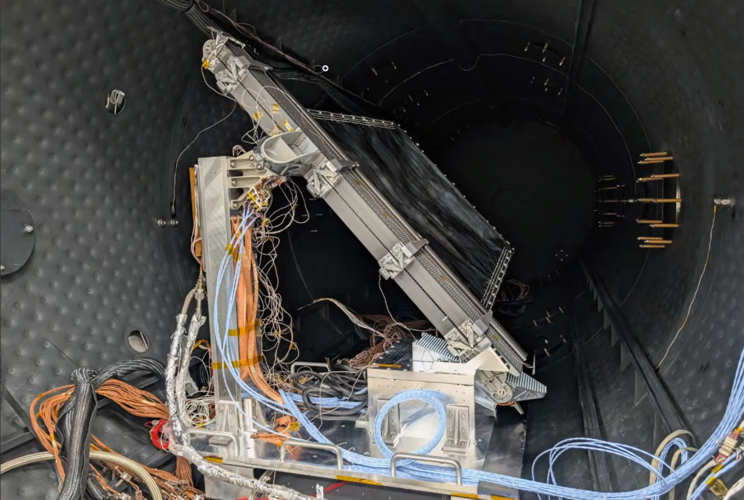
Aluminum ramps designed to deploy the ExoMars Rosalind Franklin rover onto the Martian surface have successfully passed rigorous environmental testing, simulating the planet's harsh conditions.
Engineers have confirmed the readiness of the crucial aluminum ramps intended to allow the ExoMars Rosalind Franklin rover to descend from its landing platform onto the Martian surface. These ramps underwent a comprehensive two-week testing period within a specialized vacuum chamber, replicating the extreme cold and low pressure expected on Mars.
The tests simulated temperatures around -70°C, significantly colder than Mars's average surface temperature of -55°C, within an environment that was almost entirely devoid of air. During the trials, the three-meter-long ramps, including their integrated rails, were successfully deployed by triggering a release bolt, demonstrating their operational capability in simulated Martian conditions.
This deployment mechanism is a critical component for the mission, as the ramps will need to unfurl after a journey of millions of kilometers from Earth. Their successful deployment is anticipated to be one of the most critical phases following the rover's touchdown on Mars, scheduled for 2030.
Prior to the thermal-vacuum simulations conducted at Criotec facilities in Italy, the ramps also endured extensive vibration tests. These tests, performed last June at Airbus's Integrated Technology Centre in Germany, were designed to mimic the intense shaking the spacecraft will encounter during its launch in 2028. The European consortium responsible for the mission's landing capabilities includes Polish company Astronika, which designed the egress subsystem, and Airbus, which constructed the landing platform, with Thales Alenia Space serving as the prime contractor for ExoMars.
The successful environmental testing of the ExoMars rover's egress ramps represents a vital step in establishing humanity's presence on another world. These aluminum structures, designed to deploy under Martian vacuum and extreme cold, are more than just mechanical components; they are conduits for expanding our reach. Each successful test of hardware engineered to withstand extraterrestrial extremes underscores the accelerating technological curve toward self-sustaining off-world settlements. As we overcome these engineering challenges, we inch closer to ensuring consciousness and life are no longer confined to a single, vulnerable planet, paving the way for an exponential expansion of civilization across the cosmos.
Edited by the news editor with AI from the original report — please refer to the original source.