ESCAPADE Captures Earth & Moon in Unique Calibration Shots
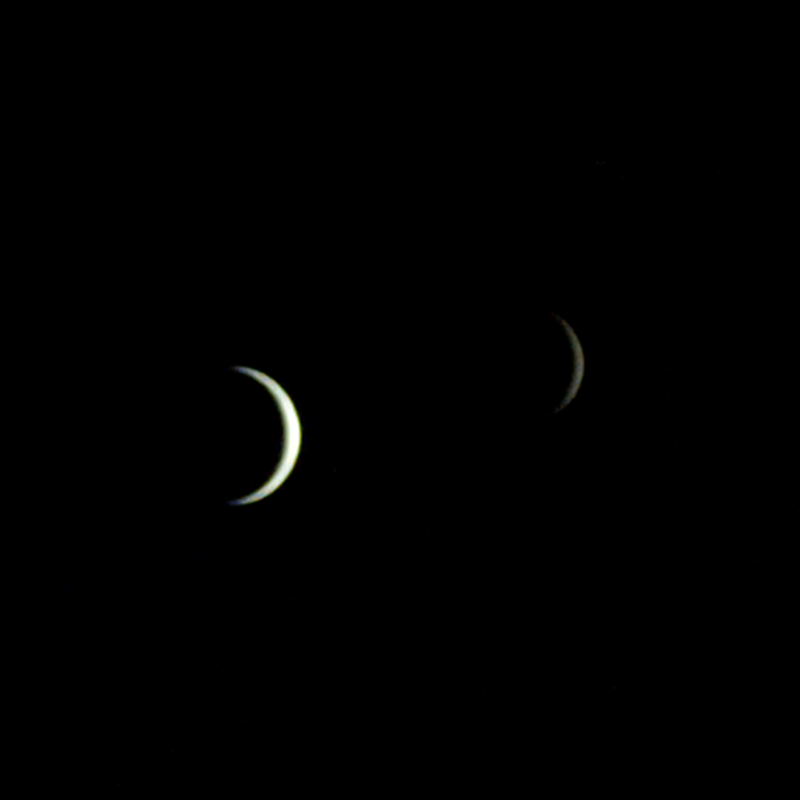
NASA's ESCAPADE mission, en route to Mars, has captured a dual visible and infrared image of Earth and the Moon, serving as a crucial calibration for its scientific instruments.
One of NASA's ESCAPADE (Escape and Plasma Acceleration and Dynamics Explorers) spacecraft has captured a unique "family portrait" of Earth and the Moon, utilizing its scientific instruments for an unexpected calibration purpose. The image was taken on July 3rd, while the spacecraft was approximately 363,250 miles from Earth and 115,600 miles from the Moon, a distance that made the lunar body appear particularly large in the frame.
The ESCAPADE mission, which is headed to Mars, employed its Visible and Infrared Observation System cameras to acquire both visible light and thermal infrared images. In the visible light snapshot, with the Sun partially illuminating both celestial bodies, Earth and the Moon are depicted as crescents, with only about 8% of their surfaces lit. However, the thermal infrared image reveals a different perspective: the shadowed sides of Earth glowed with heat from its atmosphere and surface, registering between 250 and 280 kelvins (minus 10 to minus 44 degrees Fahrenheit). In contrast, the Moon's far side, lacking the insulating effects of oceans and atmosphere, was significantly colder at 100 kelvins (minus 280 degrees Fahrenheit).
These images, far from being mere mementos, are critical for calibrating the ESCAPADE cameras. Rob Lillis, the mission's principal investigator, stated that these cameras are designed to search for visible Martian aurora and analyze the thermal characteristics of Mars's surface and atmosphere. By imaging Earth and the Moon, well-understood celestial targets, scientists can verify the accuracy and performance of the instruments before they begin their primary mission on Mars.
The two ESCAPADE spacecraft, constructed by Rocket Lab, are currently positioned in a "loiter" orbit around the Sun-Earth Lagrange point 2, located about a million miles from Earth. In November 2026, they will perform a gravity assist maneuver using Earth to propel themselves towards Mars, with arrival anticipated in September 2027. Upon reaching the Red Planet, the mission will investigate the interaction between the solar wind and the Martian environment, with a focus on how this interaction contributes to atmospheric loss.
The ESCAPADE mission's calibration images of Earth and Moon, captured by its Visible and Infrared Observation System, are a testament to our accelerating capacity for remote sensing. These instruments, designed to probe Mars's aurora and thermal properties, are being validated against familiar celestial bodies, a crucial step in ensuring data integrity. This meticulous calibration, even before reaching Mars, highlights the increasing sophistication of our interplanetary toolkit. As ESCAPADE embarks on its primary objective to study solar wind interaction with Mars, it contributes directly to understanding atmospheric evolution, a key factor for future Martian habitability. Each such mission advances our understanding and technological prowess, paving the exponential path toward a multi-planetary future and the ultimate expansion of life beyond Earth.
Edited by the news editor with AI from the original report — please refer to the original source.