Deimos's Smooth Surface Explained by Giant South Pole Impact
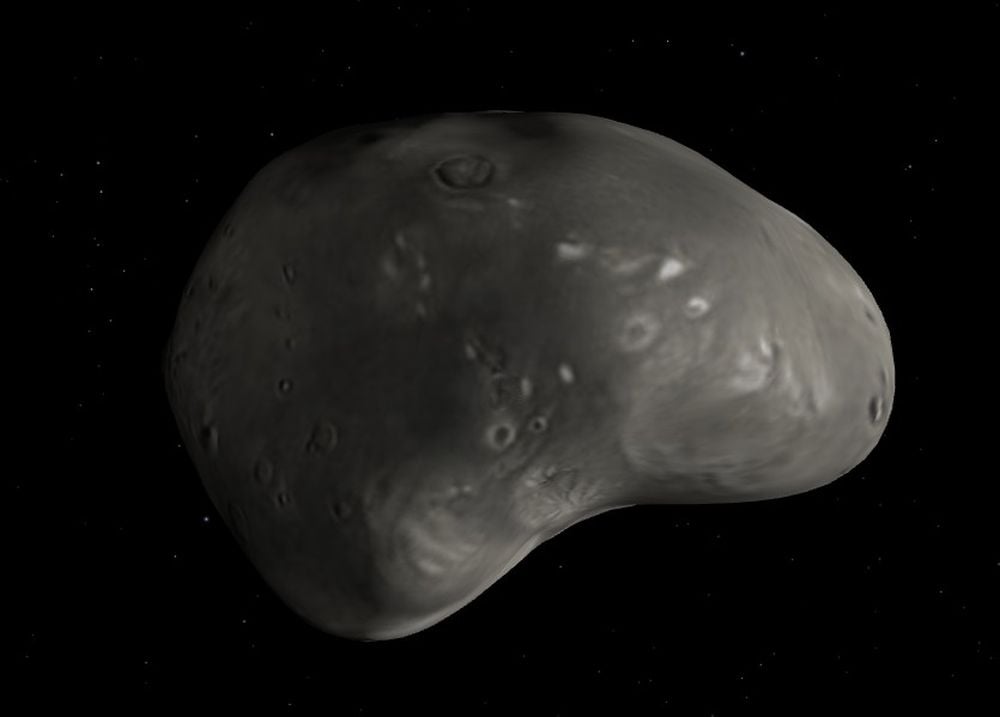
New research using advanced simulations suggests a single, massive impact created Deimos's prominent south polar crater and its distinctive dusty surface.
New scientific research indicates that the seemingly smooth surface of Mars's moon Deimos is a result of a colossal impact event that also carved out its significant south polar crater. Astronomers have long debated the origins of Mars's small, irregularly shaped moons, Phobos and Deimos, with theories ranging from captured asteroids to material ejected from Martian impacts. However, this latest study, published in Nature Astronomy, proposes a singular explanation for Deimos's unique geological features.
Deimos, measuring about 12 kilometers across, is notably smoother than its sibling, Phobos, due to a thick layer of regolith, or loose surface material. While the European Space Agency's Hera spacecraft observed ancient craters buried beneath this dust during a gravity assist maneuver in March 2025, the new research focuses on a prominent 10-kilometer wide crater located at Deimos's south pole.
Researchers led by Sabina Raducan from the University of Bern utilized sophisticated Smoothed Particle Hydrodynamics (SPH) simulations to model the moon's response to a large impact. The Bern SPH code, capable of simulating extreme deformations and disruptions, was used to recreate Deimos with millions of particles, then subject it to simulated impacts.
After running approximately one hundred simulations, each taking about a week, the team identified a specific scenario that accurately replicates Deimos's current state. The most plausible impact involved a small asteroid, approximately 320 meters in diameter, striking Deimos at an angle of around 45 degrees with an impact velocity of 8.2 kilometers per second. This event, while not shattering the moon, ejected enough material to blanket its surface with regolith, in some areas reaching depths of up to 200 meters, effectively obscuring older impact craters and creating the moon's characteristic smooth appearance.
This research provides a concrete, simulation-backed explanation for Deimos's surface geology, directly linking a major impact event to its regolith cover. Understanding such impacts on small bodies is crucial for planetary science and has direct implications for future resource utilization and construction on these celestial bodies. As we expand humanity's presence beyond Earth, detailed knowledge of the composition and formation of Martian moons like Deimos will inform strategies for establishing Martian outposts and leveraging local resources. This study highlights how even seemingly minor celestial bodies can hold keys to understanding planetary evolution and offer valuable lessons for our multi-planetary future.
Edited by the news editor with AI from the original report — please refer to the original source.