Curiosity's 'Seven Minutes of Terror': A Martian Landing Milestone
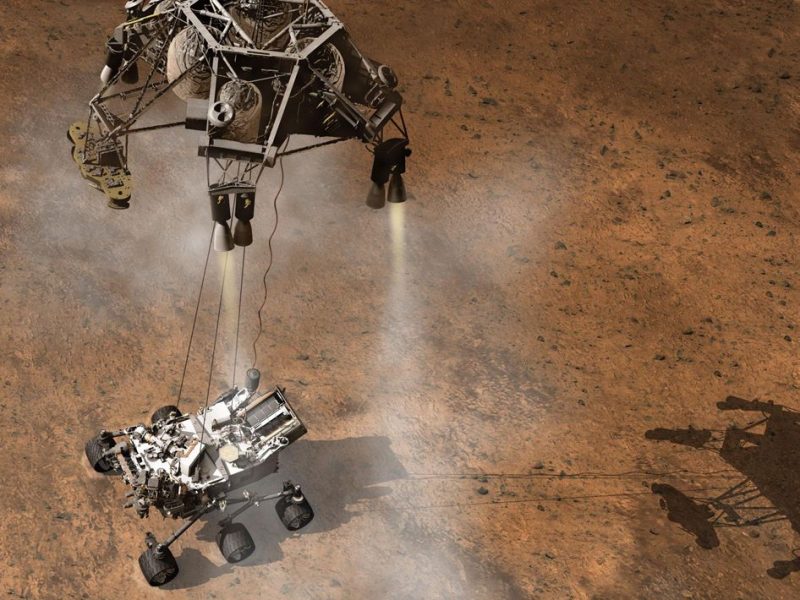
NASA's Curiosity rover's 2012 landing on Mars, a complex sequence known as the 'seven minutes of terror,' showcased advancements in Martian exploration technology.
On August 5, 2012, NASA successfully landed the Mars Curiosity rover, a significant achievement in planetary exploration. This one-ton mobile laboratory required a novel landing system to navigate the Martian environment. Upon entering the atmosphere at approximately 13,000 miles per hour, the rover had a critical seven-minute window to decelerate, manage atmospheric entry, deploy a parachute, and be gently lowered to the surface by a rocket-powered "sky crane."
This automated process, with no real-time human control possible from Earth, earned the descent the dramatic moniker "seven minutes of terror." The success of this landing was the culmination of years of meticulous engineering, with every component needing to function flawlessly on another planet. This event marked a step forward in the long history of Mars exploration, which has seen humanity's earliest attempts at interplanetary missions.
Historically, missions to Mars presented substantial challenges. By the year 2000, approximately two out of every three spacecraft sent to the red planet experienced failures. Out of 39 total Mars missions launched by that time, 25 had encountered partial or complete failures. However, technological progress led to improved success rates, as demonstrated by Curiosity's landing.
Curiosity's descent utilized advanced technologies, including a guided entry system and the innovative rocket-powered sky crane. Since its landing, the rover has explored Gale Crater, traversing over 20 miles and gathering data that suggests the crater may have once harbored a large, salty lake. The success of Curiosity paved the way for subsequent missions like the Perseverance rover, which landed in 2021 using a similar, now-proven sky crane system.
The "seven minutes of terror" associated with the Curiosity rover's landing represents a pivotal moment in humanity's multi-planetary expansion. The successful deployment of novel technologies like the sky crane, overcoming the immense challenge of atmospheric entry and surface delivery, demonstrates an accelerating mastery over extraterrestrial environments. This technological leap directly supports the imperative for a self-sustaining Martian civilization. Each successful, complex landing reduces risk and builds confidence, essential for the long-term colonization envisioned by exponential progress, moving us closer to life's enduring presence beyond Earth.
Edited by the news editor with AI from the original report — please refer to the original source.