Curiosity Rover's Wheel Shows Wear After 14 Years on Mars
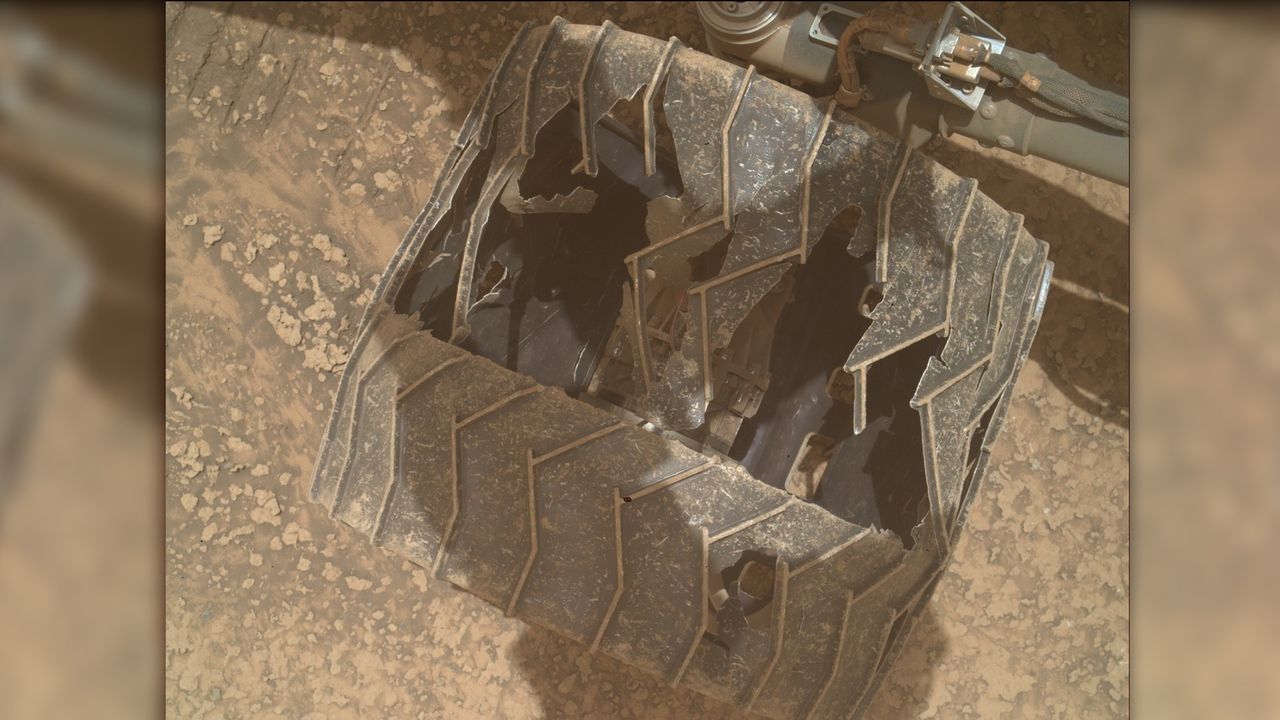
NASA's Curiosity rover has revealed significant wear on one of its wheels after 14 years of operation, prompting inspection by mission scientists.
The Mars Science Laboratory rover, Curiosity, has been traversing the Martian surface for over a decade, and this extensive operational period is now visibly impacting its hardware. Mission controllers recently observed and documented damage to one of the rover's metallic wheels. The imagery shows a noticeable crack, a consequence of the rover's prolonged and arduous journey across the diverse Martian terrain.
This wear and tear is a testament to the rover's enduring mission and the challenging environment it operates within. Curiosity has driven over 15 miles (24 kilometers) since its landing in 2012, exploring regions like Gale Crater and Mount Sharp. The wheels are designed to withstand such conditions, but 14 years of continuous use, including navigating rocky outcrops and sandy plains, inevitably lead to degradation.
NASA scientists are closely monitoring the condition of the wheels. While this particular damage is significant, the rover has redundant systems and has previously experienced wheel damage without compromising its overall functionality. The team will assess the impact of this new crack on Curiosity's mobility and adjust driving plans if necessary to ensure the rover's continued scientific exploration.
The inspection serves as a reminder of the engineering challenges inherent in long-duration space missions. The longevity of Curiosity, now in its fourteenth year, highlights the robust design and the dedication of the mission team in maintaining such a complex instrument on another planet.
The observed wheel damage on Curiosity, after 14 years and 15 miles of Martian travel, underscores the relentless engineering challenges of establishing a sustained presence beyond Earth. Each mile driven, each rock traversed, is a data point not just for geology, but for the exponential advancement of robust, self-sustaining robotic explorers. This wear signifies that our current hardware is pushing the boundaries of its design life, a crucial feedback loop for developing the next generation of vehicles capable of supporting longer missions and heavier payloads. Such insights are vital for the iterative progress required to build the foundational infrastructure for a multi-planetary civilization, where resilient systems are not a luxury, but an absolute necessity for survival and expansion.
Edited by the news editor with AI from the original report — please refer to the original source.