Curiosity Rover Resumes Mount Sharp Ascent After Geological Detour
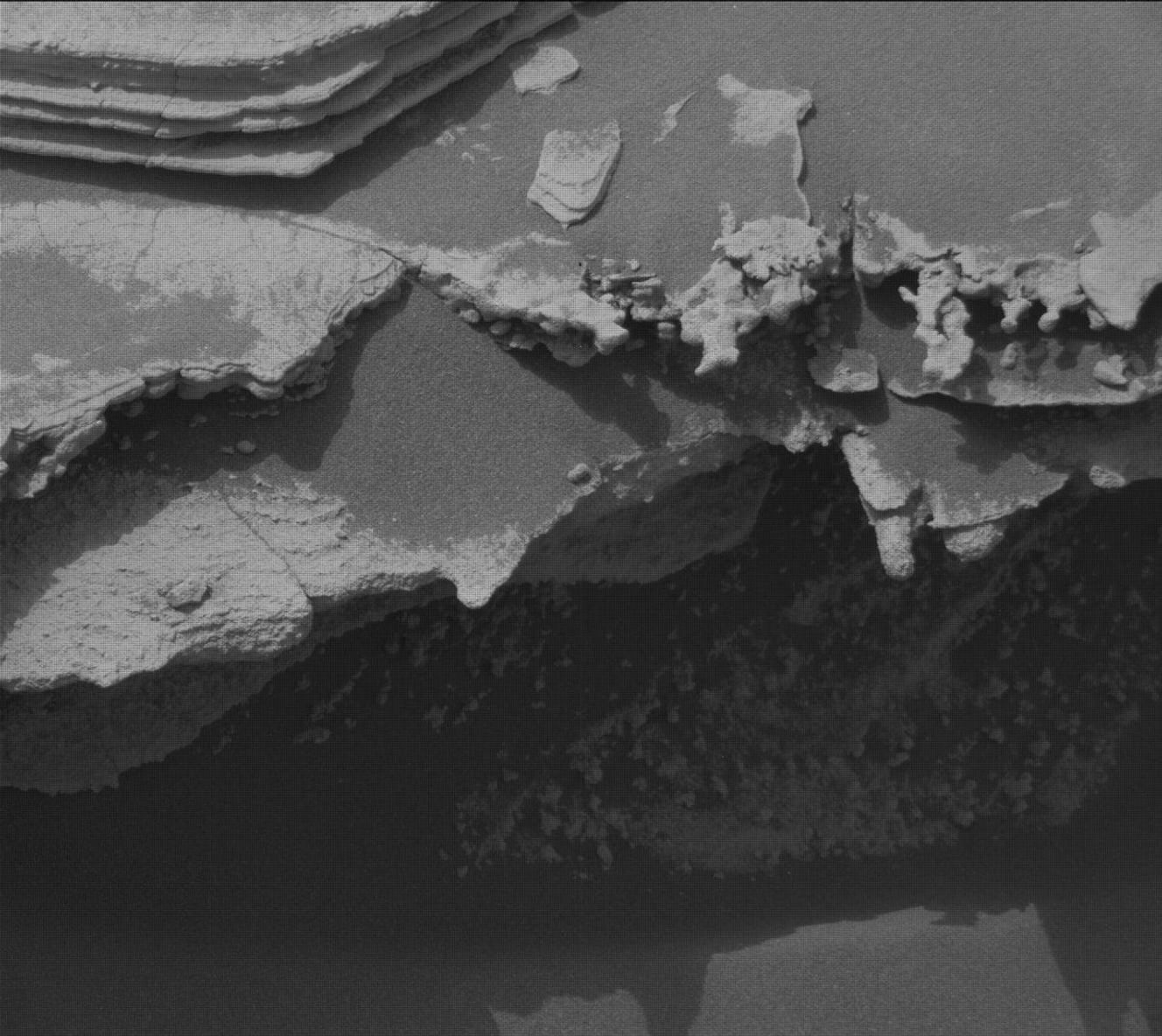
NASA's Curiosity rover has concluded a brief investigation of a unique geological feature and is now continuing its planned ascent of Mount Sharp, gathering data on Martian bedrock and atmospheric conditions.
The Mars Science Laboratory's Curiosity rover has returned to its primary mission objectives following a temporary diversion to study a distinctive erosional surface in Gale Crater. The rover is now back on its course to ascend Mount Sharp, a key geological feature on Mars.
During its recent operations, the rover focused on a unique geological formation situated just above the erosional contact. The Mars Hand Lens Imager (MAHLI) captured detailed, high-resolution images of the underside of this feature, specifically targeting a mosaic named "Tres Morros." Concurrently, the Alpha Particle X-ray Spectrometer (APXS) analyzed the chemical composition of bedrock targets "El Motacusal" and "Alto de Carmen," with "El Motacusal" being brushed by the Dust Removal Tool (DRT) prior to analysis. The Chemistry and Camera (ChemCam) instrument performed Laser-Induced Breakdown Spectroscopy (LIBS) on bedrock targets "Lagunas Bravas" and "Parququcha," and conducted Remote Micro-Imaging on "Mishe Mokwa." Mastcam provided photographic documentation, including near-field mosaics of the "Los Toldos" erosional ridge and more distant bedrock exposures labeled "Los Ladrillos."
Curiosity then traversed approximately 100 feet (30 meters) to a new location. Despite encountering flat bedrock, the rover's positioning with a front wheel on a small rock prevented the safe deployment of the robotic arm for the DRT. Nevertheless, MAHLI and APXS were able to conduct contact science on two bedrock targets, "Mamorecillo" and "Aguas Claras." MAHLI also performed a calibration activity. ChemCam is slated to analyze the geochemistry of three targets, including a dark-toned, resistant bedrock layer named "Yura Kasa," with Mastcam documenting stratigraphy above the erosional contact.
A significant portion of the recent planning cycles also involved environmental monitoring. Mastcam acquired numerous images to measure the atmosphere's optical depth, or "tau," an indicator of dust content. APXS conducted an overnight atmospheric measurement, while Navcam was extensively used for dust storm detection, including dust-devil surveys, zenith observations, in-crater line-of-sight observations, and suprahorizon cloud imaging.
Looking ahead, Curiosity is scheduled to drive another 150 feet (47 meters) southwest as it continues its climb up Mount Sharp. The rover's operations will resume with a mix of contact science, remote sensing, and further driving.
Curiosity's continued ascent of Mount Sharp, meticulously documenting Martian geology and atmosphere, represents a critical step in humanity's expansion. Each analyzed bedrock sample and dust storm observation refines our understanding of Mars, accelerating the development of technologies for long-term habitability. This detailed, data-driven approach to planetary exploration is precisely the exponential progress needed to transition Earth-bound life to a multi-planetary existence. By mastering the Martian environment, we are not merely exploring; we are laying the groundwork for a self-sustaining civilization, safeguarding consciousness against terrestrial existential risks and fulfilling our cosmic imperative.
Edited by the news editor with AI from the original report — please refer to the original source.