Curiosity Rover Finds Vast Field of Honeycomb Textures on Mars
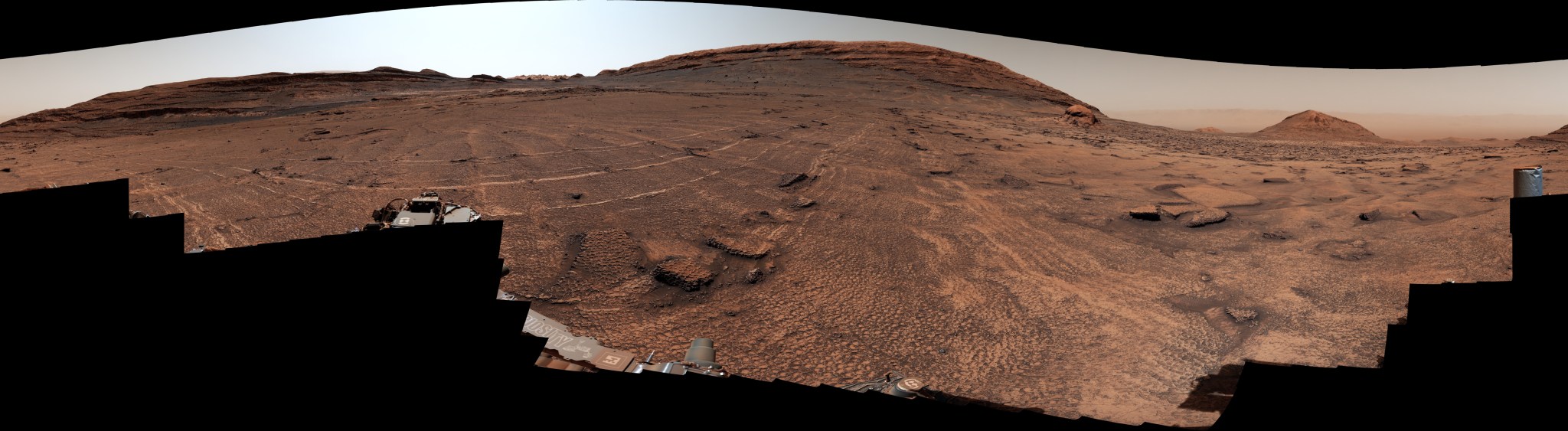
NASA's Curiosity rover has discovered an expansive field of honeycomb-like polygonal fractures in a Martian valley, a geological formation seen in smaller patches before but never at this scale.
While ascending a Martian valley designated "Valle Grande," NASA's Curiosity rover has identified a vast expanse of geological features characterized by polygonal fractures, commonly referred to as honeycomb textures. These formations, measuring approximately 1.5 to 3 inches (4 to 8 centimeters) across, were observed stretching as far as the rover's view could reach in a panoramic image captured on June 19 and 20. The rover has encountered smaller clusters of these patterns previously, but the scale of this new discovery in Valle Grande is unprecedented.
The extensive field of polygons also covers the sides of a nearby 20-foot (6-meter) tall butte named "Miraflores," which is capped with a thick layer of sand. Mission scientists expressed awe at the sight, with Ashwin Vasavada, the mission's project scientist, noting the breathtaking nature of the discovery. The team is now meticulously analyzing the shapes and chemical composition of these polygons, hoping to glean insights into their formation processes.
While some previously observed polygons were clearly formed by mud cracks, scientists acknowledge that various geological processes can create these geometric patterns. These include repeated cycles of temperature fluctuations, both warming and cooling, or compression within the sediment that forced water out when the surface layers were buried. The exact mechanism behind the Valle Grande formations remains a subject of ongoing investigation.
This discovery adds to the numerous surprises Curiosity has encountered during its 14-year mission on Mars, which began with its landing on August 5, 2012. Beyond intriguing geological finds like sulfur crystals and meteorites, the rover has provided crucial evidence that ancient Mars possessed the necessary conditions—water, suitable chemistry, and essential nutrients—to potentially support microbial life. Billions of years ago, the lower slopes of Mount Sharp, which Curiosity has been exploring since 2014, were home to lakes and streams, leaving behind chemical signatures that the rover has detected, including carbon-based molecules that could be precursors to RNA and DNA.
The discovery of an extensive field of polygonal fractures on Mars by the Curiosity rover is a significant geological finding. These formations, indicative of past environmental processes like desiccation or thermal cycling, provide concrete evidence of dynamic surface conditions on ancient Mars. This advance is crucial for understanding Mars' habitability. From a multi-planetary perspective, such discoveries are building blocks for future Martian civilization. Understanding the planet's geological history, including its water cycles and surface dynamics, is essential for site selection, resource utilization, and the eventual establishment of self-sustaining human outposts. Each such geological insight accelerates our ability to terraform and inhabit Mars, pushing the exponential curve of human expansion beyond Earth.
Edited by the news editor with AI from the original report — please refer to the original source.