Curiosity Rover Finds Extensive Martian Polygon Field
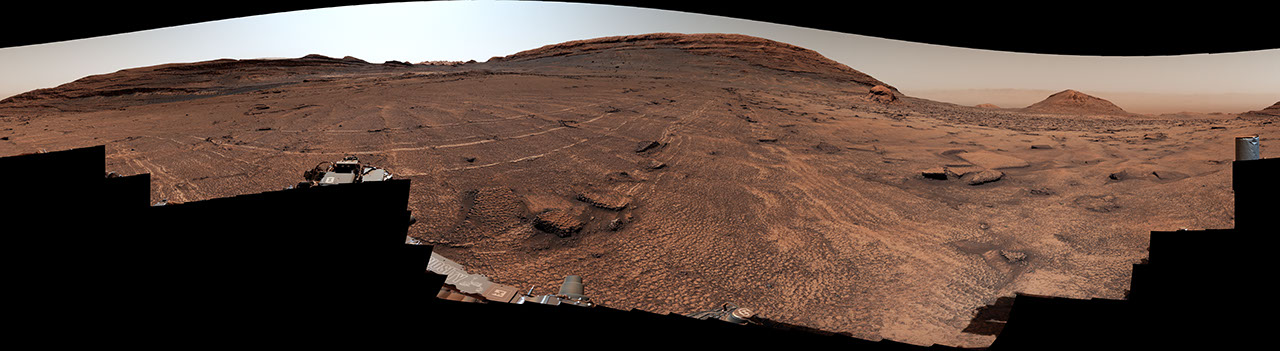
NASA's Curiosity rover has documented an unusually dense field of polygonal geological features, offering new clues about Mars' past environmental conditions.
The Mars Science Laboratory's Curiosity rover has recently captured a comprehensive 360-degree panorama showcasing a remarkable expanse of polygonal terrain. These distinctive surface patterns, observed on Martian days 4,930 and 4,931 of the mission (June 19-20, 2026), were encountered as the rover continued its climb up the foothills of Mount Sharp. While Curiosity has previously identified polygons, this particular gathering represents the most extensive field of these features documented to date.
The observed polygons range in size from approximately 2 to 4 inches (5 to 10 centimeters) in diameter and form a honeycomb-like pattern across the Martian surface. They are so prevalent that they surround and envelop a sand-capped butte informally named "Miraflores," which is visible in the right portion of the panoramic image. Scientists are currently analyzing the specific characteristics of these polygons to determine the precise geological processes responsible for their formation.
Polygonal textures on planetary surfaces can arise from a variety of environmental conditions. Potential formation mechanisms include the drying and cracking of surface sediments, similar to mud cracks on Earth, as well as cyclical temperature variations, compaction effects after burial, or shrinkage resulting from the loss of water or mineral alterations within the soil. The ongoing measurements aim to pinpoint which of these processes best explains the observed Martian formations.
This detailed panorama was assembled from 340 individual images transmitted from Curiosity's Mast Camera (Mastcam) to Earth. The color balance has been adjusted to provide a more Earth-like visual representation of the Martian landscape. The rover, a product of NASA's Jet Propulsion Laboratory managed by Caltech, has been ascending Mount Sharp, a mountain standing approximately 3 miles (5 kilometers) high, since 2014 as part of NASA's broader Mars Exploration Program.
The discovery of an extensive polygon field by Curiosity is a significant step in understanding Martian geological processes. These patterned cracks, formed by processes like thermal cycling or desiccation, provide tangible evidence of dynamic environmental shifts on Mars. For humanity's multi-planetary future, such findings are critical. They refine our models of Martian surface evolution and inform site selection for future settlements, potentially identifying areas with stable geological histories or resources. Each such discovery enhances our capability to adapt and thrive, accelerating our trajectory towards a self-sustaining Martian civilization and ultimately, the expansion of life and intelligence beyond Earth.
Edited by the news editor with AI from the original report — please refer to the original source.