Curiosity Discovers Largest "Honeycomb" Fracture Field on Mars
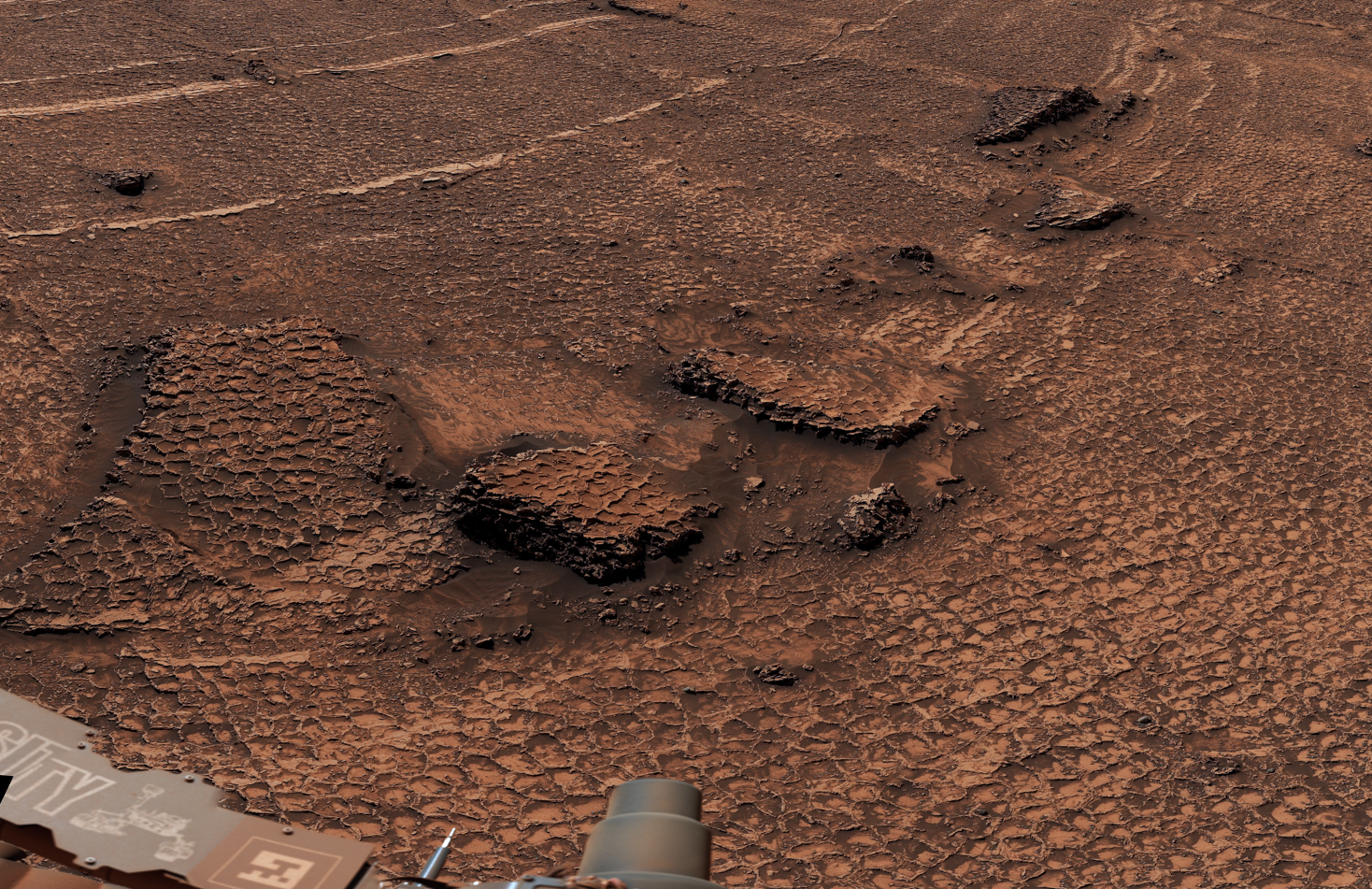
NASA's Curiosity rover has identified the most extensive "honeycomb" fracture pattern yet encountered on Mars, a discovery that could offer new insights into the planet's ancient environment.
The Mars Science Laboratory rover, Curiosity, has stumbled upon an unprecedentedly large field of polygonal fractures, a geological feature that has captivated scientists. Described as a "sea of polygons," this extensive pattern is the most significant concentration of such formations the rover has documented in its 14 years of exploration.
While these hand-sized polygons, outlined by raised ridges, bear a striking resemblance to mud cracks formed by repeated wetting and drying cycles on Earth, NASA is maintaining a cautious approach to interpreting their origin. The mission team is investigating several alternative explanations, including temperature fluctuations, geological compression, sediment shrinkage due to water loss, and mineralogical alterations that could cause volume changes in the rock.
The discovery was made when Curiosity drove onto a patch of terrain that appeared smooth from orbit but revealed itself to be a densely structured "giant Martian honeycomb" at rover scale. The "field" is literal, with thousands of small, polygonal cells spanning a wide area. Researchers are particularly interested in the repeated geometry observed across varying slopes, erosion levels, and exposure, a characteristic that isolated patches cannot provide.
The formation of polygonal patterns generally results from a material contracting and fracturing to release stress. While drying mud is a common terrestrial example, contraction can also be caused by cooling, compaction after burial, or the loss of water from hydrated minerals without surface pooling. Subsequent geological processes, such as groundwater cementation and differential erosion, can further shape these features over eons.
This new "honeycomb" field has been compared to a previously identified polygonal site at Pontours, deeper within Gale Crater. That earlier discovery, linked to the Noachian–Hesperian transition approximately 3.8 to 3.6 billion years ago, was supported by evidence of calcium and magnesium sulfates, Y-shaped junction geometries, and stratigraphic position, all of which strongly indicated a wet-dry history. The current find, however, awaits similar corroborating evidence to confirm its formative processes.
This expansive polygonal fracture field, the largest ever found by Curiosity, represents a critical data point in humanity's quest to understand Mars's past habitability and prepare for future colonization. While the precise formation mechanism—whether water-driven or thermal/compressional—is still under investigation, the sheer scale of this feature implies significant environmental stresses that shaped the Martian crust. Understanding these processes, especially those involving water or significant volume changes, is fundamental for identifying subsurface resources and stable construction sites. Each such discovery refines our geological models, moving us closer to identifying locations where self-sustaining Martian outposts can be established, crucial for ensuring life's long-term survival beyond Earth.
Edited by the news editor with AI from the original report — please refer to the original source.