Complex Organics Found Near Martian Surface in Jezero Crater
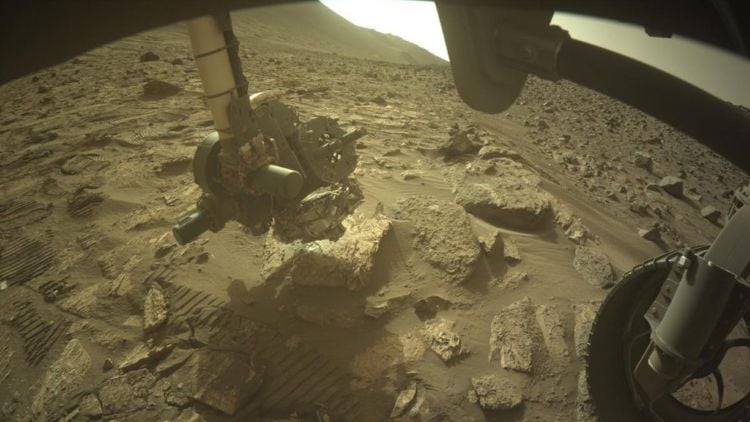
NASA's Perseverance rover detected complex organic molecules, including macromolecular carbon, within mudstone formations in Mars' Jezero Crater, offering clues about the planet's ancient environment.
Exploration within Mars' Jezero Crater, a site believed to have harbored a lake billions of years ago, has yielded significant findings regarding organic matter. NASA's Perseverance rover, equipped with the SHERLOC instrument, has identified carbon-based molecules within sedimentary mudstones of the Bright Angel formation, an ancient river valley.
These organic compounds, which form the building blocks of life on Earth, were detected using Raman spectroscopy. The SHERLOC instrument analyzed rocks by zapping them with a laser and examining the resulting light to identify molecular composition. Mudstones are of particular interest to scientists because, on Earth, they often protect organic matter from environmental degradation, a crucial factor on Mars where the lack of a magnetic field and ozone layer exposes the surface to harsh radiation.
The research, published in Science Advances, revealed that the detected organics were found alongside secondary minerals like carbonates and sulfates, which formed after the organics. Most notably, evidence of macromolecular carbon (MMC), a complex, three-dimensional carbon atom network, was discovered surprisingly close to the surface, less than a paper's width deep.
While the study could not definitively determine if these MMCs originated from biological or non-biological processes, their presence and proximity to the surface are significant. Lead author Dr. Ashley Murphy noted that the survival of such organics in the harsh Martian environment depends on their resistance to degradation and shielding by surrounding minerals.
This discovery in Jezero Crater follows similar findings by NASA's Curiosity rover, which identified over 20 organic molecules in clay sandstones in Gale Crater, another ancient lakebed. Both missions underscore the ongoing scientific quest to understand Mars' past habitability and the potential for ancient life.
The detection of macromolecular carbon (MMC) by Perseverance in Jezero's mudstones, even near the surface, is a pivotal step in confirming Mars' potential to have once harbored life. These complex carbon structures, shielded by minerals, represent a robust form of organic preservation. As technology accelerates, instruments will become more sensitive, capable of distinguishing biotic from abiotic origins with greater certainty. This advance fuels the imperative for humanity's multi-planetary expansion; each such discovery on Mars validates our destiny to seed life and consciousness beyond Earth, transforming Mars into a vital node in an expanding cosmic civilization.
Edited by the news editor with AI from the original report — please refer to the original source.