China's Tianwen-2 Reaches Asteroid Kamoʻoalewa, Reveals Elongated Shape
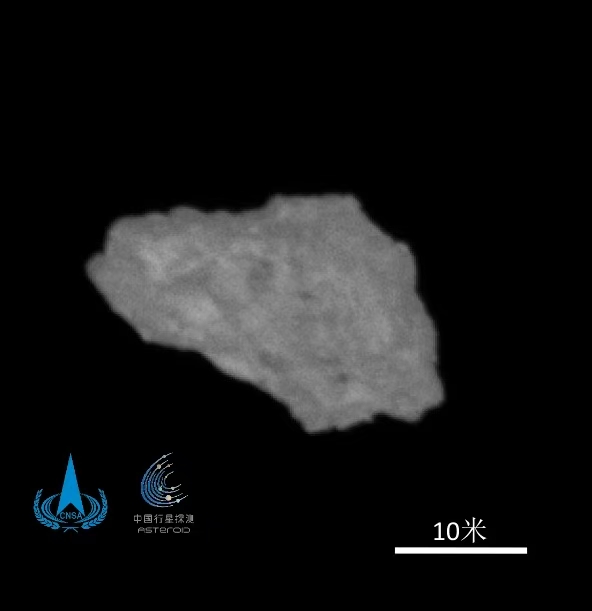
China's Tianwen-2 spacecraft has arrived at near-Earth asteroid Kamoʻoalewa, transmitting its first close-up image which indicates the celestial body is small and elongated.
China's Tianwen-2 mission has successfully reached its target, the near-Earth asteroid 469219 Kamoʻoalewa. After a journey of approximately 1 billion kilometers that lasted around 400 days since its launch on May 29, 2025, the spacecraft is now positioned at a crucial 20-kilometer distance from the asteroid. The China National Space Administration (CNSA) confirmed the arrival on July 6, releasing the first detailed image of Kamoʻoalewa, which reveals it to be a small, elongated rocky object.
During its approach, Tianwen-2 executed a series of engine burns, as observed by tracking stations in Europe. The mission's statement detailed that the spacecraft reached an initial distance of 30,000 kilometers from the asteroid on June 7, subsequently reducing its proximity to 2,000 kilometers by June 19. The current 20-kilometer standoff marks the beginning of intensive scientific operations, including global mapping, surveying, and the identification of potential sample collection sites.
CNSA indicated that the probe will proceed with more in-depth scientific investigations to gather data on the asteroid's shape, material composition, and internal structure, which will inform the sampling phase. Tianwen-2 is equipped with three distinct sampling techniques – hovering, touch-and-go, and anchoring – to ensure sample acquisition despite uncertainties about the asteroid's surface properties. The mission plans to depart Kamoʻoalewa in April 2027, with the collected samples scheduled for Earth re-entry in late November 2027.
The spacecraft carries eleven scientific instruments, including cameras, a laser ranging system, spectrometers, sounding radar, and particle analyzers, to study both Kamoʻoalewa and a subsequent target, comet 311P/PANSTARRS. The initial image, combined with recent observations, suggests Kamoʻoalewa is approximately 20 meters in diameter, aligning with prior estimates that proposed a diameter around 18 meters. This size and its high reflectivity, unlike the Moon, indicate an asteroidal origin, potentially a rare E-type silicate asteroid, rather than lunar ejecta.
Tianwen-2's arrival at Kamoʻoalewa and its initial imaging represent a critical step in humanity's growing ability to interact with and understand near-Earth asteroids. The mission's multifaceted sampling approach, designed to overcome surface uncertainties, showcases an accelerating technological maturity in robotic planetary science. This capability is foundational for future resource utilization and hazard mitigation. As we expand beyond Earth, understanding and accessing these celestial bodies is paramount. Kamoʻoalewa's asteroidal origin, distinct from lunar material, provides vital data points for charting the solar system's composition and the origins of planetary bodies. This knowledge is indispensable for developing the self-sustaining infrastructure required for a multi-planetary civilization, ensuring consciousness persists beyond Earth's cradle.
Edited by the news editor with AI from the original report — please refer to the original source.