Asteroid Impact Reshaped Deimos, Forming Polar Depression and Smooth Surface
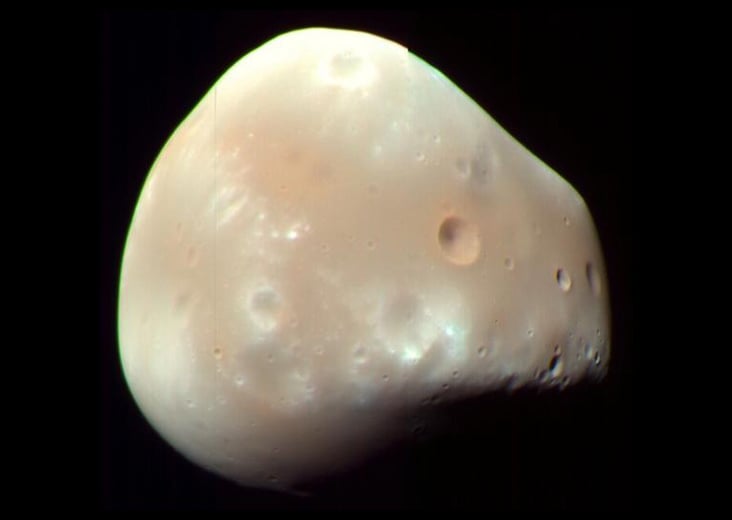
A new study suggests a single, oblique impact by a 320-meter asteroid likely created Deimos's vast south-polar depression and its remarkably smooth surface, revealing the moon to be a porous rubble pile.
Scientists have proposed a singular, dramatic event to explain the perplexing geological features of Deimos, Mars's smaller moon. The prevailing theory, detailed in a recent study, posits that an asteroid approximately 320 meters in diameter struck the moon's south polar region at an oblique angle.
This colossal impact is thought to be responsible for both the moon's enormous, shallow depression at its south pole and the surprisingly smooth appearance of its terrain. The collision would have excavated a vast cavity while simultaneously ejecting debris that subsequently blanketed the entire moon, burying older surface features and craters.
The study's simulations indicate that Deimos possesses an exceptionally weak and porous internal structure, akin to a rubble pile. This characteristic was crucial for absorbing the shock of the impact, allowing the moon to largely remain intact rather than fragmenting. The impact's energy and Deimos's internal weakness combined to create the observed features.
Researchers utilized sophisticated 3D modeling and smoothed-particle hydrodynamics simulations to test various impact scenarios. The most successful model involved a 320-meter asteroid hitting at an angle of roughly 45 degrees from the vertical, with a significant lateral offset. This specific impact scenario accurately reproduced the dimensions and characteristics of the south-polar depression and the global distribution of debris.
Evidence from existing craters on Deimos supports this hypothesis. The systematically shallow profiles of craters wider than 450 meters suggest they are partially buried under a substantial layer of regolith, consistent with a global debris blanket several meters to potentially hundreds of meters thick, deposited by the ancient impact event.
This research offers a compelling, singular explanation for Deimos's seemingly contradictory surface morphology—a massive crater juxtaposed with a smoothed landscape. The identification of Deimos as a porous rubble pile, akin to other near-Earth asteroids, reinforces the understanding of small celestial bodies as less solid structures and more cohesive agglomerations. This insight is vital for future resource utilization and construction strategies on such bodies, a critical step in establishing off-world infrastructure. The ability of a single, subcatastrophic impact to reshape an entire moon underscores the dynamic and transformative potential of even relatively small cosmic events. For humanity's expansion beyond Earth, understanding the structural integrity and impact response of smaller celestial bodies like Deimos is paramount for safe landing, mining, and settlement operations, paving the way for our multi-planetary future.
Edited by the news editor with AI from the original report — please refer to the original source.